NAD+ Supplementation: What the Evidence Actually Shows
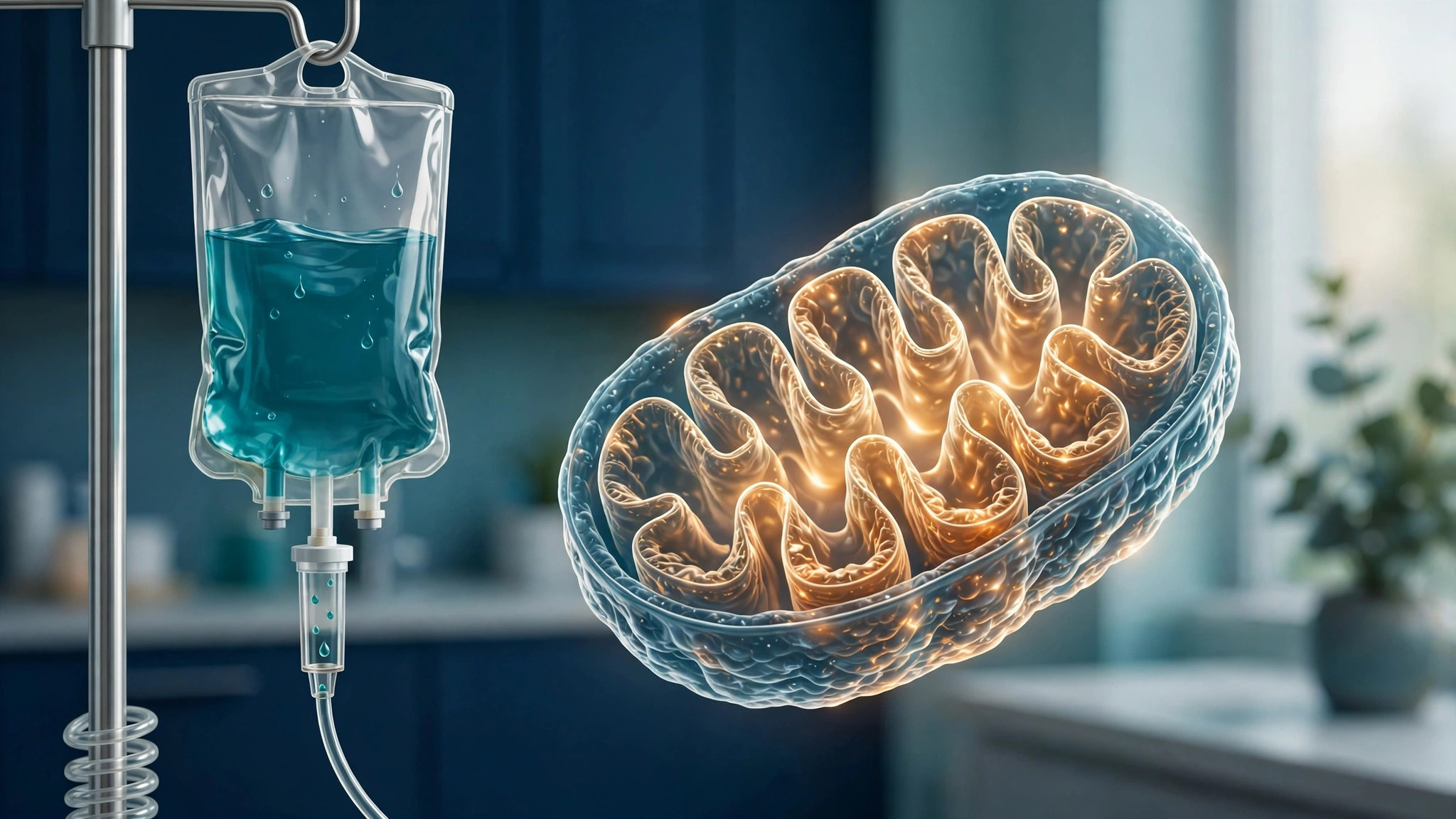
NAD+ is indispensable to mitochondrial biology. But can a capsule, drip, or injection actually raise it where it matters — inside your mitochondria? We assessed every delivery method against the human evidence.
Why NAD+ matters for mitochondria
NAD+ sits at the center of mitochondrial biology: the NAD+/NADH redox couple carries the electrons that drive oxidative phosphorylation, and NAD+ is the obligate substrate for hundreds of enzymes including the sirtuins (notably mitochondrial SIRT3), PARP DNA-repair enzymes, and CD38 signaling. It also feeds the pathways behind mitochondrial biogenesis and quality control (mitophagy). None of this is disputed — it is textbook biochemistry.
The “NAD+ declines with age” story is more nuanced than the meme
Tissue-specific age-related declines have been reported in humans: skin (Massudi et al. 2012 — the study the popular “50% by age 50” claim traces to, an oversimplification of its findings), brain (Zhu et al. 2015), and muscle (Janssens et al. 2022). But a 2026 Nature Metabolism study across seven cohorts and 300+ people (Trętowicz et al.) found whole-blood NAD+ does not vary with age or lifestyle interventions — and showed that sample handling, including freezing and thawing, substantially distorts measurements. The takeaway: blood NAD+ is a poor proxy for tissue or mitochondrial NAD+, and the decline narrative should be reframed around metabolic dysfunction rather than aging per se. Established · methodological
The core rule for this entire article
Raising a blood NAD+ metabolite is a pharmacodynamic finding, not evidence of improved mitochondrial function. Blood rise ≠ tissue rise ≠ mitochondrial function. Every claim below is graded against that standard.
Oral NAD+ capsules
Extracellular NAD+ is a large dinucleotide with no established mechanism for intact intestinal absorption; the credible expectation is degradation to smaller metabolites before any contribution to intracellular pools. In October 2025, the US National Advertising Division ruled in the Reus Research (Cata-Kor) case that there were no human clinical studies on orally ingested NAD+, “liposomal or otherwise,” and that there was “no evidence in the record” to support the challenged health claims — recommending they be discontinued.
The challenge was brought by competitor Niagen Biosciences — a commercially interested process, but the evidentiary finding stands on its own. A 2025 ChromaDex-funded surveillance report claimed over 75% of direct-NAD+ consumer products fell short of label claims. That report is commercially conflicted because ChromaDex sells competing NR, but it signals a product-quality concern worth independent testing.
Liposomal NAD+
A 2026 randomized crossover reported higher plasma NAD+ exposure from liposomal versus conventional NAD+ — plasma exposure only, not cellular or mitochondrial uptake, improved respiration, or clinical benefit. The publishing venue raises quality concerns; treat the finding as preliminary at best. The October 2025 advertising ruling applied to oral NAD+ “liposomal or otherwise.”
Sublingual strips, lozenges, and sprays
No credible human pharmacokinetic or mitochondrial-function evidence was identified. Marketing claims such as “92.5% absorption” were traced to advertising validated on glutathione, not NAD+ — ingredient substitution in ad copy. Sublingual delivery research sometimes cited by sellers concerns other compounds, not NAD+. Salivary and blood ectonucleotidases remain an enzymatic barrier.
IV NAD+ infusions
The key human study (Grant et al. 2019, n=11, six-hour infusion totaling about 750 mg) found plasma NAD+ spiked 398% initially, but metabolites returned to baseline within hours; urine showed intact NAD+ up 538% — rapid removal and degradation by ectonucleotidases, notably CD38, which cleave NAD+ before it can act. It is uncertain how much intact NAD+ ever enters cells. One breakdown product created through NNMT methylation cannot re-enter the NAD+ salvage pathway at all — an invisible loss.
A 2026 PRISMA systematic review of 113 studies (Gallagher et al., PMID 41655607) found “no eligible outcomes trials” evaluating intravenous or intramuscular NAD+ itself for anti-aging or wellness indications. Infusion reactions are common — nausea, cramping, flushing, sweating, tachycardia and chest pressure or tightness (Grant 2019; Reyna et al. 2026, a real-world IV NAD+ pilot, n=48, whose authors were all employed by Restore Hyper Wellness, the clinic operator). Compounded injectable NAD+ is not FDA-approved for any wellness, anti-aging, addiction, or mitochondrial indication. Secondary reporting cites FDA adverse-event reports of severe chills, shaking, vomiting and fatigue tied to compounded injectable NAD+. “Bypasses digestion” does not mean “reaches mitochondria.”
Subcutaneous and intramuscular injections
No human pharmacokinetic data, randomized trials, or chronic safety data were identified. “Slow-release depot effect” and clinic “micro-dosing protocols” come from seller pages, not validated trials.
Transdermal patches and creams
No peer-reviewed human trials or human pharmacokinetic data were identified. Dose-scaling alone is sobering: patches typically deliver about 20 mg versus about 750 mg in the IV study that itself showed rapid plasma clearance.
The mitochondrial bottom line
Across the human trials that actually measured mitochondrial function — muscle biopsies with respirometry — results are consistently null despite blood NAD+ elevation. Read the full NR human-trial record. Infusing or swallowing NAD+ produces measurable pharmacology; it has not produced measurable mitochondrial improvement in humans.