
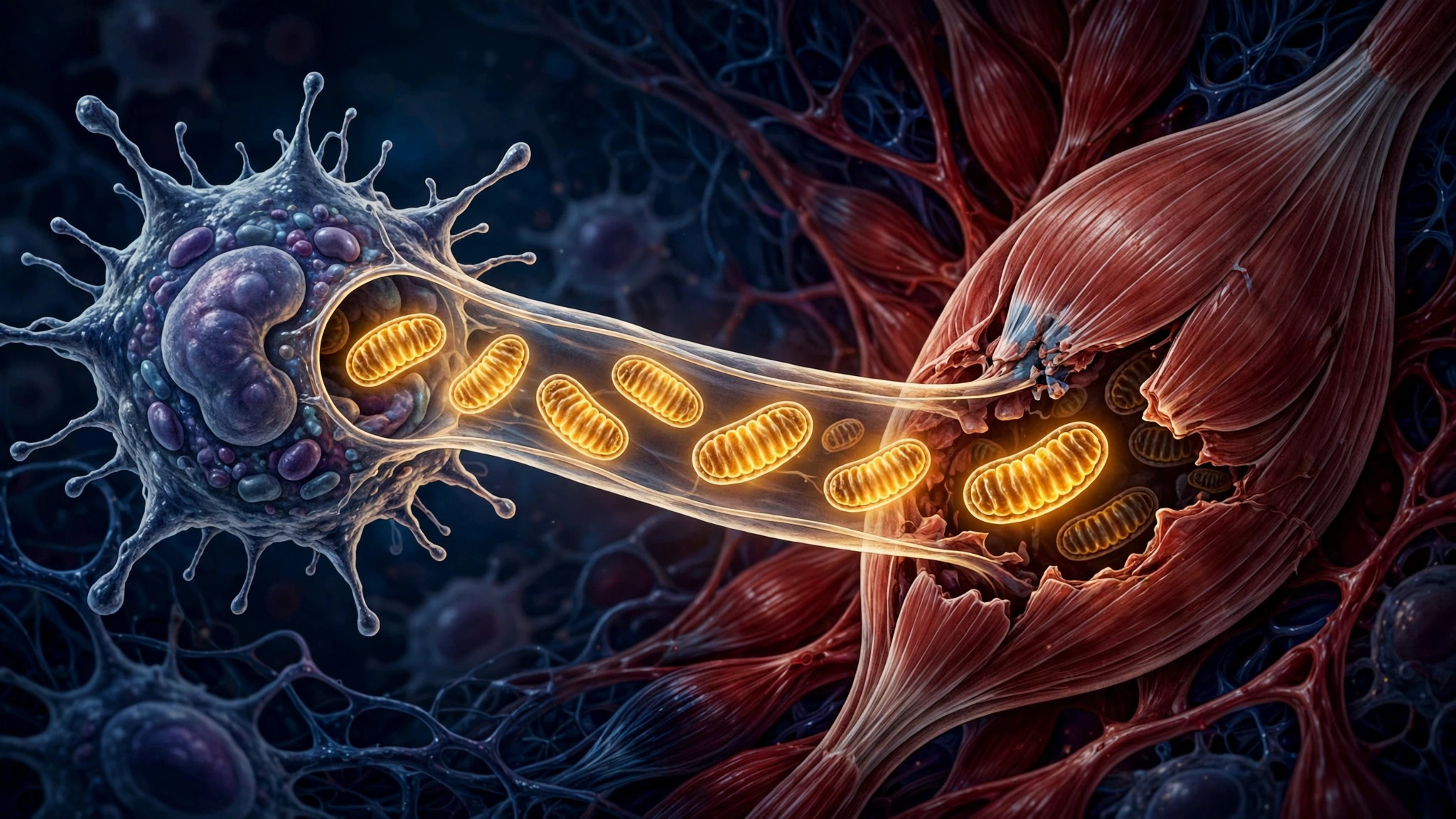
Macrophages can transfer healthy mitochondria to injured heart cells
Your immune system may already know how to fix a broken heart — by handing over spare batteries. In a new study in Cell Death & Disease, researchers found that activating the Flt3 receptor on macrophages prompted the immune cells to transfer healthy mitochondria into injured heart-muscle cells after a heart attack, rejuvenating the cells' energy production and reducing the harmful ventricular remodeling that leads to heart failure.
How does the handoff work?
The team — led by researchers at Xi'an Jiaotong University with collaborators at Rutgers University — traced a regulatory chain: Flt3 activation engages a STAT3–TRIM16–ISG15–SEC22B axis. TRIM16 degrades ISG15 and quiets interferon signaling, shifting macrophages into a reparative M2-like state that enables them to pass mitochondria to damaged cardiomyocytes through intercellular connections.
Why this matters
Intercellular mitochondrial transfer is one of the most credible frontiers in mitochondrial medicine — this site has covered bone-marrow cells delivering mitochondria and early human transplantation trials. What's new here is the route: an immune-mediated, drug-targetable one. Flt3 is a known druggable receptor, which gives drug developers a concrete handle.
The honest limits
This was animal-model work. No human data exists yet, and heart-attack biology in mice differs from humans in important ways. Still, as a proof of concept for recruiting the immune system to resupply failing mitochondria, it's a genuinely new direction.
Where the evidence stands
- Established: Intercellular mitochondrial transfer between cell types is a documented, active area of research with multiple independent lines of evidence.
- Preliminary: The Flt3–macrophage–cardiomyocyte transfer mechanism was demonstrated in animal models; no human data exists.
- Contested: Whether Flt3 activation can be made safe and effective as a heart-attack therapy in people is entirely untested.
- Absent: No clinical trial of Flt3-driven mitochondrial transfer exists.