
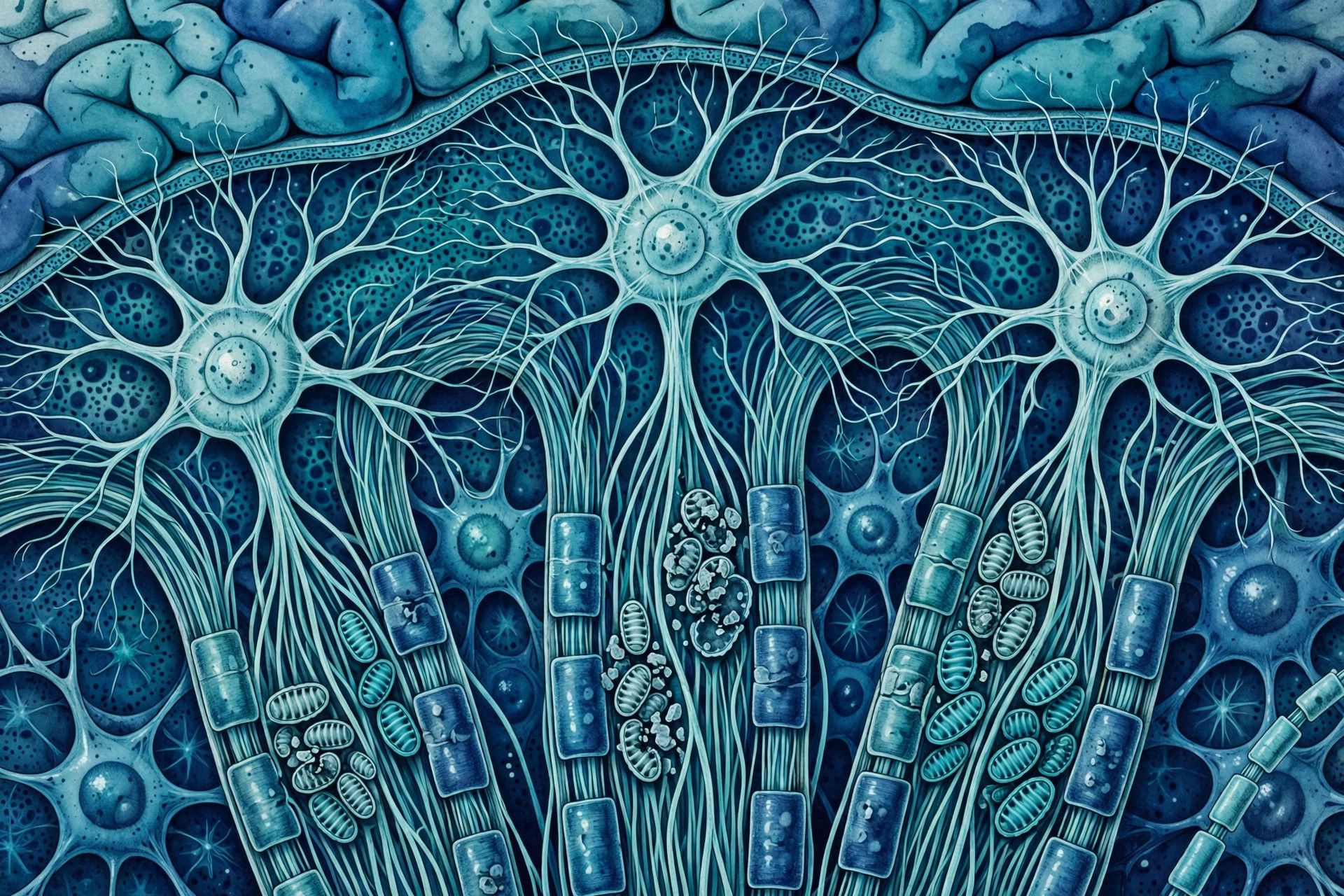
“Mitochondrial plaques”: damaged mitochondria cluster in Alzheimer’s brains
Researchers in Paul Robbins's lab at the University of Minnesota have identified something previously unseen in Alzheimer's brains: clustered, damaged mitochondria packed inside nerve fibers, dubbed “mitochondrial plaques.” The clusters arise from lysosomal waste-disposal failure — the cell's recycling system breaking down — and the authors suggest that early lysosome failure may precede the amyloid plaques that have dominated Alzheimer's research for decades. The findings were published in Nature Neuroscience and covered September 23, 2026.
What are mitochondrial plaques?
Not amyloid, not tau — clumps of the cell's own broken power plants. When mitochondria are damaged, healthy cells clear them through mitophagy, a lysosome-dependent recycling process. In these brains, the lysosomes failed first, so damaged mitochondria accumulated inside nerve fibers.
Why would lysosome failure come first?
The proposed sequence flips the usual story: waste-disposal machinery breaks down, damaged mitochondria pile up and leak, and the resulting cellular damage may set the stage for the better-known Alzheimer's pathology. If the ordering holds, the therapeutic window opens earlier than amyloid-targeting drugs can reach.
How does this connect to mitochondrial health?
It puts mitochondrial quality control — mitophagy and lysosomal clearance — at the center of neurodegeneration, alongside the amyloid story. The authors suggest targeting mitochondrial clearance alongside amyloid therapies rather than treating them as competing hypotheses.
What comes next?
The finding is observational and mechanistic: clusters observed in human brain tissue plus supporting biology. Causality — whether restoring clearance actually slows disease — is not yet shown and is the obvious next experiment.
Where the evidence stands
- Established: Clustered damaged mitochondria in nerve fibers were observed in human Alzheimer's brain tissue and reported in a peer-reviewed Nature Neuroscience paper.
- Preliminary: The causal ordering — lysosome failure preceding amyloid pathology — and the therapeutic value of targeting mitochondrial clearance alongside amyloid are mechanistic hypotheses, not demonstrated.
- Absent: No therapeutic application exists; this is discovery science, not a treatment.