Methylene Blue: Oral vs. IV — What the Evidence Actually Shows
Methylene blue is a synthetic blue redox dye — first made in 1876 — that concentrates inside mitochondria and acts as a catalytic electron shuttle in the electron transport chain. Its mitochondrial mechanism is among the best-mapped of any compound covered on this site. But outside two narrow indications — acquired methemoglobinemia (FDA-approved IV) and adjunctive bipolar depression (one small trial) — the human evidence is thin, and the wellness claims run far ahead of the data.
How methylene blue acts on mitochondria
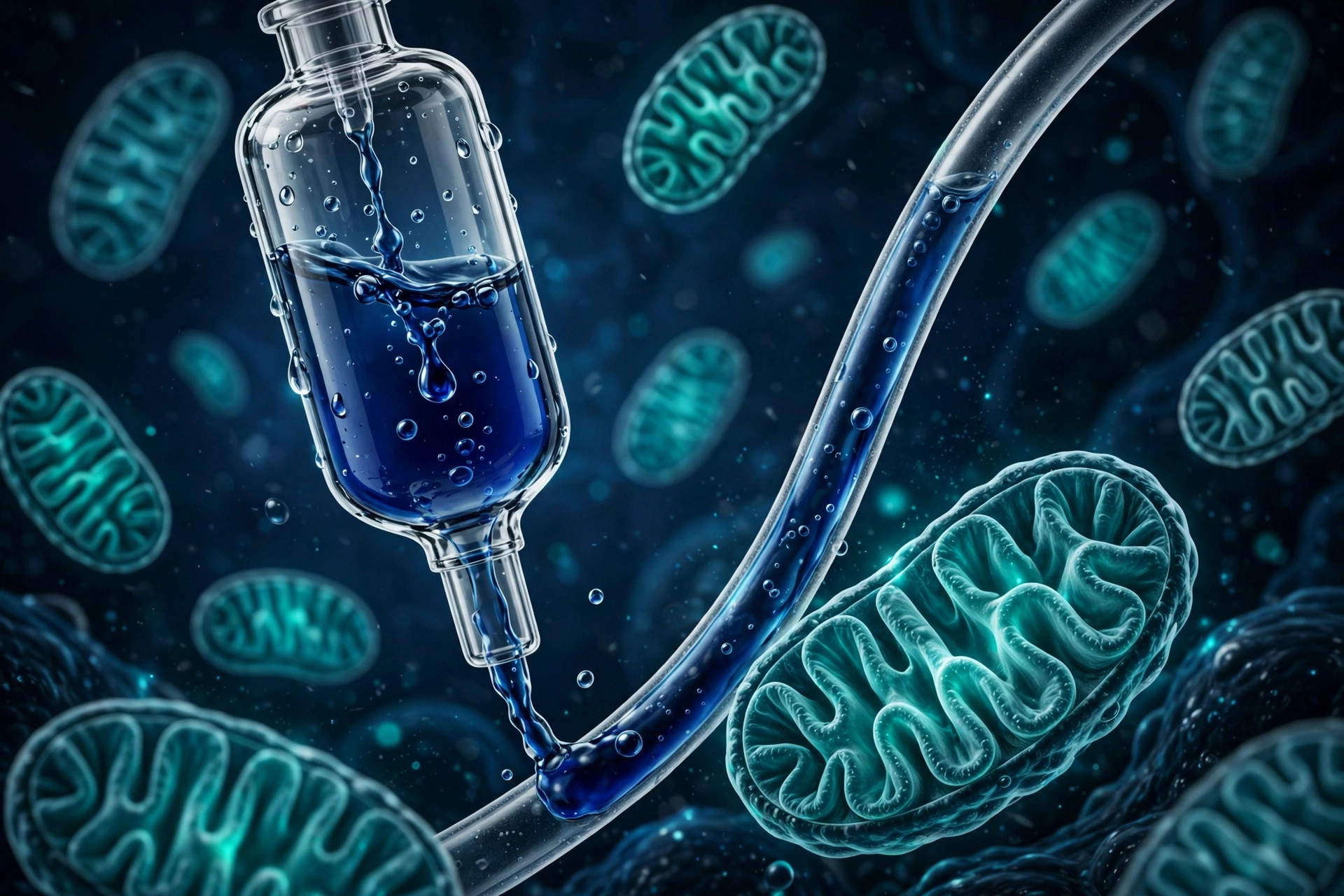
Methylene blue (MB) is a lipophilic, positively charged dye that crosses the blood–brain barrier and concentrates in mitochondria, where it acts as a catalytic electron cycler in the electron transport chain (ETC):
1. Oxidized MB accepts electrons from NADH (and FADH₂), becoming reduced to colorless leucomethylene blue (LMB). 2. LMB donates those electrons directly to cytochrome c — bypassing Complexes I and III, the two main sites of electron leak and superoxide generation. 3. Cytochrome c feeds Complex IV (cytochrome c oxidase), which reduces oxygen to water, sustaining the proton gradient and ATP synthesis. 4. MB is regenerated in the cycle, so it acts catalytically rather than being consumed like a conventional antioxidant.
The downstream consequences have been demonstrated experimentally: low micromolar MB increased brain oxygen consumption in rat brain preparations, both in vitro and 24 hours after in vivo dosing at memory-enhancing doses (Riha et al., 2005). In rats, systemic low-dose MB increased cerebral metabolic rate of oxygen (CMRO₂), cerebral blood flow, and glucose uptake under both normoxic and hypoxic conditions, and 10 µM MB increased the rate of cytochrome c reduction with NADH as electron donor via the Complex I→III pathway — with no effect via the Complex II pathway (Lin et al., 2012). By shunting electrons past Complexes I/III, MB also minimizes superoxide leakage in the ETC, and repeated low doses increase cytochrome c oxidase activity in brain tissue (Gonzalez-Lima & Bruchey, 2004; Rojas et al., 2012 review). The one functional human confirmation: a single low oral dose in 26 healthy adults altered fMRI responses during attention and memory tasks (Rodriguez et al., 2016). Direct mitochondrial respiration has never been measured in living humans — extending the animal findings to people is an extrapolation. Established · preclinical
The most misunderstood fact about this compound: the dose inverts the effect. Low doses (roughly 0.2–4 mg/kg) are antioxidant and respiration-enhancing; high doses (above ~10 mg/kg) are pro-oxidant, suppress cytochrome oxidase, and can cause methemoglobinemia (Bruchey & Gonzalez-Lima, 2008; Riha et al., 2005, where 50–100 mg/kg in rats produced adverse behavioral effects). As the reviewers put it: it does not make sense to refer to methylene blue without specifying the dose, because different doses produce opposite effects. Two more pharmacology facts matter for the rest of this article: MB is also a potent MAO-A inhibitor (Ki 27 nM; Ramsay et al., 2007) and an inhibitor of soluble guanylate cyclase and the NO–cGMP pathway — the latter is the basis of its vasopressor effect in shock.
Oral methylene blue: the human evidence
The nootropic evidence in healthy humans rests on one small single-dose brain-imaging study. Rodriguez et al. (2016) randomized 26 healthy adults (ages 22–62) to a single low oral dose or placebo and measured brain activity during attention and short-term-memory tasks: fMRI responses increased in the insula, prefrontal, parietal, and occipital cortex, and correct memory-retrieval responses rose by 7% versus placebo. That is a 7% increase in correct retrieval responses in one acute study — not "7% smarter" — and it has not become a replicated clinical program. A 2026 NatMed Pro review judged the evidence for cognitive enhancement and anti-aging benefits "weak." Preliminary
The strongest oral clinical signal is in bipolar disorder. Alda et al. (2017, British Journal of Psychiatry) ran a randomized, double-blind crossover trial over 6 months in 37 bipolar I patients, testing 195 mg/day of MB versus 15 mg/day as an adjunct to lamotrigine — a true placebo was impossible because MB turns urine blue. Depression improved (MADRS p=0.02, HAMD p=0.05), anxiety improved (HAMA p=0.02), mania remained stable, cognitive effects were not significant, and it was well tolerated. Small, adjunctive, but genuinely randomized and published in a major journal. Preliminary
The Alzheimer's story is a cautionary tale. The MB derivative LMTM (hydromethylthionine mesylate) went through two large phase 3 programs and failed its primary endpoints in both: TRx-237-015 (n=891, 15 months) failed ADAS-Cog and ADL co-primaries, and TRx-237-005 (n=800, 18 months) failed as designed — though both showed signals in post-hoc, non-randomized monotherapy subgroup analyses. The follow-up LUCIDITY trial (n=598) is claimed by its sponsor to show benefit, but the control arm turned out to be pharmacologically active (blood levels above the effect threshold), so no valid placebo comparison exists and the regulatory path is uncertain. Methylene blue is not a proven dementia treatment. Contested
Two dosing caveats for oral use: reported oral bioavailability of about 72% comes from a secondary review of Walter-Sack et al. (2009) — the primary was not independently verified — and the commonly cited oral "therapeutic window" of 0.2–4 mg/kg comes from reviews (Rojas et al., 2012), not from a human dose-finding trial. Treat both as working estimates, not established pharmacology.
IV methylene blue: what it is approved for vs. what is investigational
Approved: ProvayBlue (methylene blue) injection, USP, received initial U.S. approval in 2016 under accelerated approval for one indication only — acquired methemoglobinemia in pediatric and adult patients. Label dosing is 1 mg/kg IV over 5–30 minutes, with a repeat dose of up to 1 mg/kg one hour later if methemoglobin remains above 30% or symptoms persist; a single dose only in moderate-to-severe renal impairment. In this indication MB is reduced to leucomethylene blue via the NADPH-dependent methemoglobin reductase pathway, which then reduces methemoglobin back to hemoglobin — which is exactly why it fails in G6PD deficiency (insufficient NADPH). Established · regulatory
Investigational but best-evidenced off-label use: septic shock. By inhibiting soluble guanylate cyclase, MB blunts NO–cGMP-mediated vasodilation and restores vascular tone, sparing catecholamines. Ibarra-Estrada et al. (2023, Critical Care 27:110) ran a single-center randomized trial in roughly 91–92 septic-shock patients on norepinephrine: MB 100 mg IV daily for 3 days versus saline cut time to vasopressor discontinuation from 94 hours to 69 hours (p<0.001), added one vasopressor-free day at day 28, and shortened ICU stay by 1.5 days and hospital stay by 2.7 days — with no mortality difference (the trial was not powered for mortality) and blinding compromised by blue-green urine discoloration. (Note: some secondary coverage describes the dose differently — 500 mg over 6 hours daily — so cite the primary paper's dosing.) Meta-analyses point the same direction on hemodynamics: Ballarin et al. (2024, Frontiers in Medicine; 3 RCTs, n=141) found ICU stay shortened by 1.58 days, ventilation by 0.72 days, and vasopressor discontinuation by 31.5 hours, with no methemoglobinemia signal; Fernando et al. (2024, 6 RCTs) found low-certainty evidence of reduced vasopressor duration and hospital stay; Pruna et al. (2024, 11 studies including non-randomized data) suggested lower mortality. Grade: hemodynamic benefit preliminary, mortality benefit contested — and this is ICU medicine, not a wellness indication. Preliminary · ICU only
Everything else IV is thinner still. Post-cardiopulmonary-bypass vasoplegia: used for catecholamine-refractory cases — preliminary, hospital setting. Refractory anaphylaxis shock: case reports of MB as rescue vasopressor. Surgical dye: established as a dye, with the serotonin-syndrome interaction caveat (see Safety). Neuroprotection (TBI, stroke, cardiac arrest): animal models only — absent in humans. Long COVID, ME/CFS, and chronic fatigue: no controlled trials — anecdotes and functional-medicine practice only, however mechanistically plausible.
The honest clinic framing: wellness clinics variously advertise MB IV drips for "mitochondrial support," mental clarity, anti-aging, and post-viral fatigue — typically at low doses, often well under the 1 mg/kg methemoglobinemia dose. None of these wellness indications is FDA-approved or supported by controlled human trials. What a clinic can legitimately say: IV methylene blue is an approved hospital drug with a genuinely well-mapped mitochondrial mechanism and emerging ICU data; wellness applications are off-label and investigational, require the same safety screening as hospital use, and use pharmaceutical-grade product at conservative doses — never internet-grade bottles.
Safety: the boxed warning and the contraindications
Serotonin syndrome — boxed warning added November 2023. Because MB is a potent MAO-A inhibitor (Ki 27 nM; Ramsay et al., 2007, PMID 17721552), the ProvayBlue label warns of serious or fatal serotonin syndrome with serotonergic drugs and opioids — avoid concomitant use with SSRIs, SNRIs, MAOIs, and opioids. Most reported cases occurred when MB was used as a surgical dye (1–8 mg/kg IV) in patients on SSRIs/SNRIs; a systematic review identified roughly 50 published cases, all with concurrent serotonergic antidepressants (per secondary coverage — the primary was not independently verified). It is unclear whether the risk extends to lower IV doses or other routes — so screen every patient on antidepressants regardless of route. Established · regulatory
G6PD deficiency — contraindicated. MB requires NADPH (which is G6PD-dependent) to be reduced to its active form; in G6PD deficiency it cannot work and acts as a pure oxidant, causing hemolytic anemia and Heinz bodies. G6PD screening before IV use is standard of care. Established · regulatory
Dose toxicity inverts the benefit. Doses at or above ~7 mg/kg can paradoxically cause methemoglobinemia by directly oxidizing hemoglobin; doses above ~15 mg/kg are associated with hemolysis, particularly in neonates; and long-term administration may cause marked anemia. The blue discoloration of blood causes falsely low pulse-oximetry readings (typically around 85%) — use arterial blood gas instead. Blue discoloration of urine, skin, sclera, and secretions is expected and transient, and it is what unblinds trials. Common adverse reactions (over 10% on the label) include extremity pain, chromaturia, dysgeusia, feeling hot, dizziness, hyperhidrosis, nausea, skin discoloration, and headache. Renal impairment delays clearance (single dose only in moderate-to-severe impairment); use in pregnancy only if benefit justifies fetal risk, and discontinue breastfeeding for up to 8 days after treatment. NatMed Pro (July 2026) also flags possible reproductive harm from oral supplement use. Extravasation can cause local tissue necrosis. One practical note for clinics: MB can precipitate if diluted in 0.9% saline (chloride reduces solubility) — sterile water or 5% dextrose is the recommended diluent.
Supplement bottles vs. pharmaceutical grade
Oral "methylene blue supplements" are not FDA-approved for any indication. The 1% drops and capsules sold online occupy a supplement gray area with the standard not-intended-to-diagnose-treat-cure disclaimers. Grade matters enormously: only USP-grade MB — manufactured under FDA cGMP, heavy-metals tested per USP <232>/<233> by ICP-MS, assay 98–103%, Azure B under 2.5% — is appropriate for human use. Industrial, laboratory/reagent, and aquarium-grade MB can carry heavy metals (lead, mercury, cadmium, arsenic) at levels hundreds to thousands of times above safe oral thresholds. One compounding-pharmacy safety review notes that even USP-grade raw material sometimes fails QC — reputable compounders report failing three to five raw batches before one passes. Established · toxicological rationale
Red flags for consumers: "laboratory use only," "industrial dye," or "aquarium treatment" labeling; no batch-specific third-party Certificate of Analysis; vague "pass/fail" purity claims instead of ppm-level ICP-MS data. The compound in the trials is pharmaceutical-grade; the compound in many internet bottles is not the same thing.
The mitochondrial bottom line
Methylene blue has one of the most clearly mapped mitochondrial mechanisms of any compound we cover: a catalytic electron shuttle that keeps the electron transport chain moving past Complex I/III bottlenecks, demonstrated across laboratories in vitro and in animals. The human record is far narrower: one FDA-approved IV indication (acquired methemoglobinemia), one small acute brain-imaging study, one small bipolar RCT, one positive single-center septic-shock trial, and two failed Alzheimer's phase 3 programs. Wellness claims — energy, anti-aging, long COVID, general "mitochondrial optimization" — have no controlled trials behind them, and the dose-inversion curve plus a boxed warning make unsupervised use genuinely unsafe. One more gap worth stating: there is currently no validated mitochondrial-function test that would let anyone titrate methylene blue against actual mitochondrial output — dosing is empirical, not personalized.