
A mitochondria-targeting brain drug goes on camera: NRG starts PET scans to prove NRG5051 reaches the brain
·Tip: press play, then lock your phone or switch apps — the article keeps reading.
NRG Therapeutics, a clinical-stage neuroscience company based in Stevenage, UK, is developing NRG5051 to restore mitochondrial function in neurodegenerative disease. The mitochondrial permeability transition pore is a stress-activated channel whose opening can collapse a mitochondrion's energy production and trigger cell death; blocking it through the regulator NLRX1 is NRG's chosen route to protecting neurons in amyotrophic lateral sclerosis (ALS) and Parkinson's disease.
What will the PET trial actually measure?
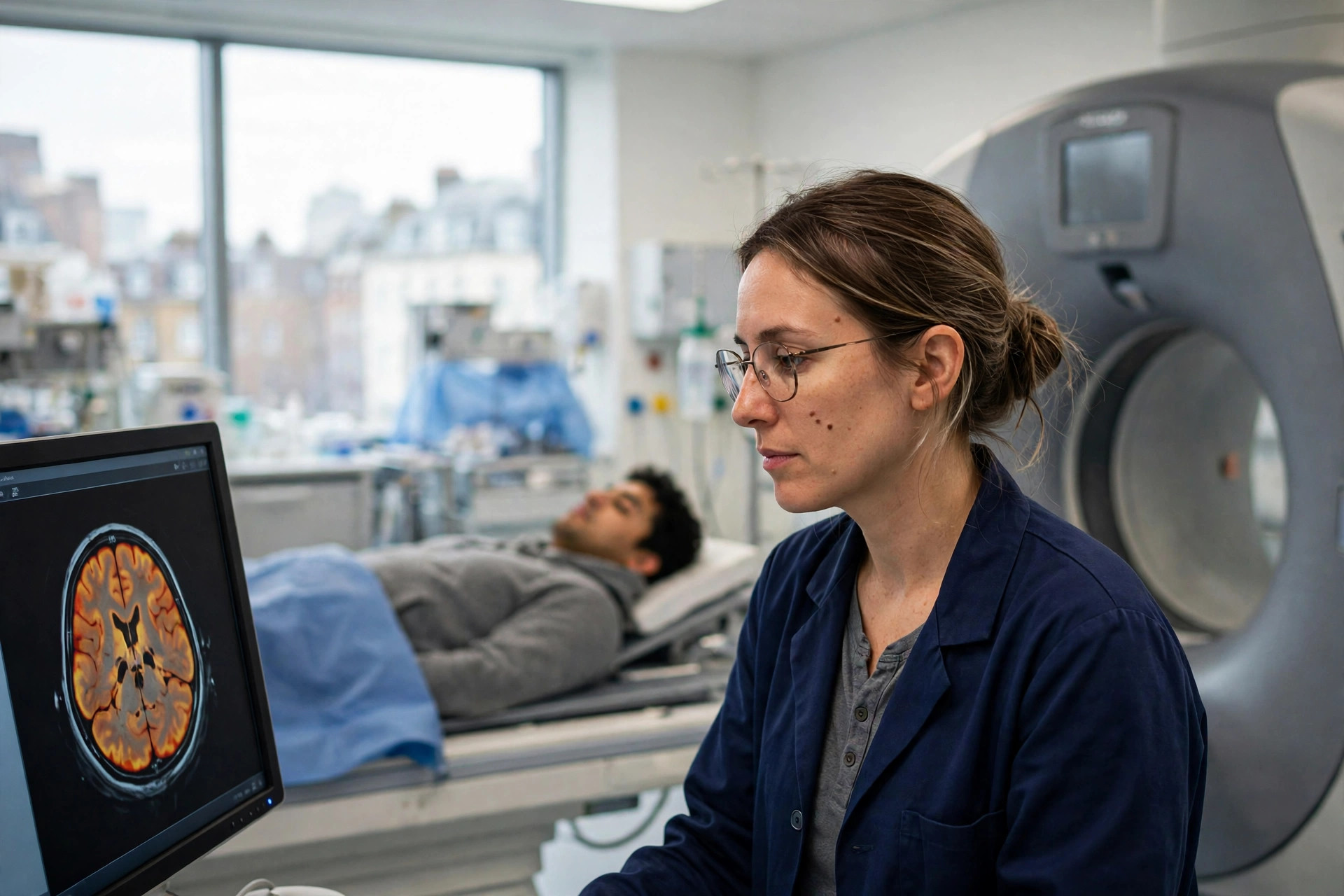
NRG has successfully radiolabelled NRG5051 for imaging and is now scanning healthy volunteer participants in London. The trial will determine blood plasma kinetics and a calculated distribution coefficient, which together allow the company to estimate NRG5051 levels in brain parenchyma (the functional tissue of the brain). In plain terms: before asking whether the drug works, NRG is measuring whether it gets in, how fast, and how much.
Where does NRG5051 stand in development?
NRG5051 is completing a Phase 1 randomized, double-blind trial (NRG5051-101) assessing safety, tolerability and pharmacokinetics in healthy volunteers. Future dosing in ALS patients, including a Phase 2 proof-of-concept trial in ALS, is planned for 2027. Chief Development Officer Paul Thompson said the PET data will complement CNS-penetration estimates from other methods and contribute to the dataset supporting clinical development in ALS and Parkinson's.
What would count as success — and what would not?
A clean PET result would show the drug reaches the human brain at levels consistent with the doses planned for patients — a genuine de-risking step, because brain penetration is where many CNS candidates quietly die. It would not show that NRG5051 slows ALS or Parkinson's, protects a single neuron in a patient, or is safe over long-term dosing. Those questions belong to the patient trials that have not yet begun.
Where the evidence stands
- Established: Mitochondrial permeability transition pore opening contributes to neuronal death in neurodegeneration models, and demonstrating human brain penetration is a standard gate before efficacy trials of CNS drugs.
- Preliminary: Per NRG Therapeutics' October 21, 2026 announcement, the NRG5051-102 PET biodistribution trial has started in healthy volunteers in London; NRG5051 is completing Phase 1 safety testing (NRG5051-101), with an ALS Phase 2 proof-of-concept planned for 2027.
- Absent: Any efficacy data in ALS or Parkinson's patients, long-term safety data, and published peer-reviewed results for NRG5051.
Join the discussion
To get the conversation started: What questions does this story raise for you? Share them below — every comment is reviewed by our moderators before it appears.
Community discussion only — not medical advice. Every comment is reviewed by our moderators before it appears. Sign in with Google or a free Hyvor account to join in.