71 mitochondrial-disease trials in 20 years — what failed, what worked, what's next
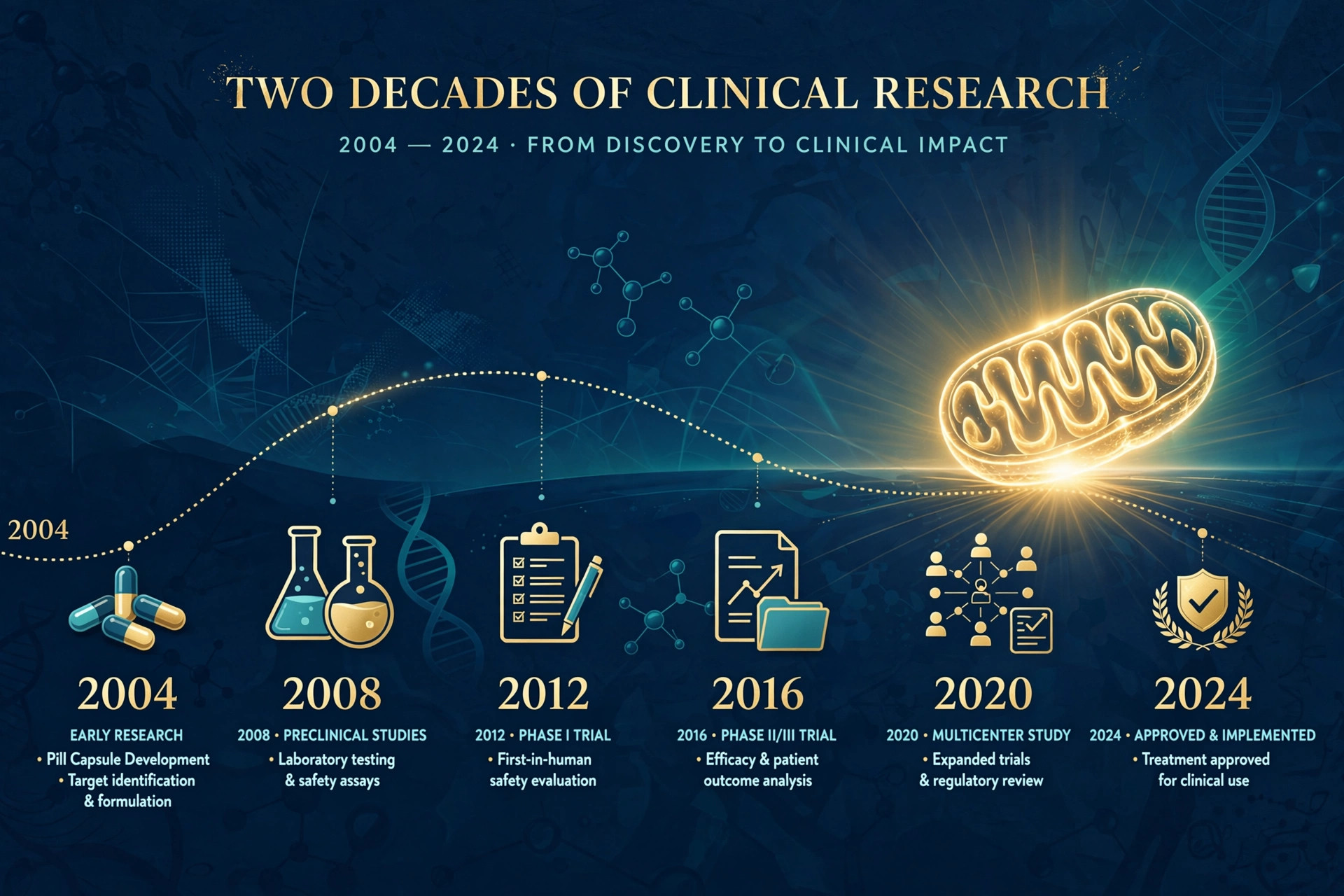
·After twenty years and 71 clinical trials, what does mitochondrial medicine actually have to show? A new narrative review — covering every primary mitochondrial disease trial from 2006 to 2026 — lays out the ledger of wins and losses. The headline failure: the 218-patient MMPOWER-3 Phase 3 of elamipretide in primary mitochondrial myopathy missed both co-primary endpoints (a walking test and a fatigue score). The headline success: Kygevvi won full FDA approval for TK2 deficiency in children, cutting mortality from 36% to 4% in a matched comparison — proof that when the genetics are precise, mitochondrial drugs can work.
Why so many trials missed
The review argues the failures taught a lesson about trial design: broad enrollment of mixed genotypes diluted any signal. MMPOWER-3's miss led to a more targeted trial (now complete, results pending). Most trials were small and open-label; only 28 of 71 were randomized, double-blind, placebo-controlled. Industry sponsored 47; investigators led 21. LHON drew the most trials (20), followed by m.3243A>G disorders (15).
Where the wins came from
Where the disease is genetically defined and homogeneous, medicine won: Kygevvi for TK2 deficiency (children 12 and under), and FORZINITY's accelerated approval for Barth syndrome based on improved knee-extensor strength — with a randomized confirmatory trial required by the FDA. The pattern: precision genetics beat broad functional endpoints.
What the next decade should look like
Twenty years in, mitochondrial medicine has two FDA approvals, a pipeline of 14 gene-therapy programs (mostly LHON), and a hard-won lesson: small, well-defined patient groups and sharp endpoints beat sprawling trials. For families facing a rare diagnosis, that maturation — from “let's try it in everyone” to targeted medicine — is itself progress.
Where the evidence stands
- Established: The trial inventory (71 trials, 2006–2026) and the outcomes of elamipretide's MMPOWER-3, Kygevvi's TK2D approval, and FORZINITY's accelerated Barth-syndrome approval are matters of published record.
- Preliminary: The review's lessons on endpoints and enrollment are narrative synthesis — no formal risk-of-bias assessment or meta-analysis was performed.
- Contested: Whether accelerated approvals based on surrogate endpoints (FORZINITY's knee-extensor strength) predict durable clinical benefit awaits confirmatory trials.
- Absent: No disease-modifying therapy exists for most primary mitochondrial diseases; idebenone remains approved in Europe for LHON only.