
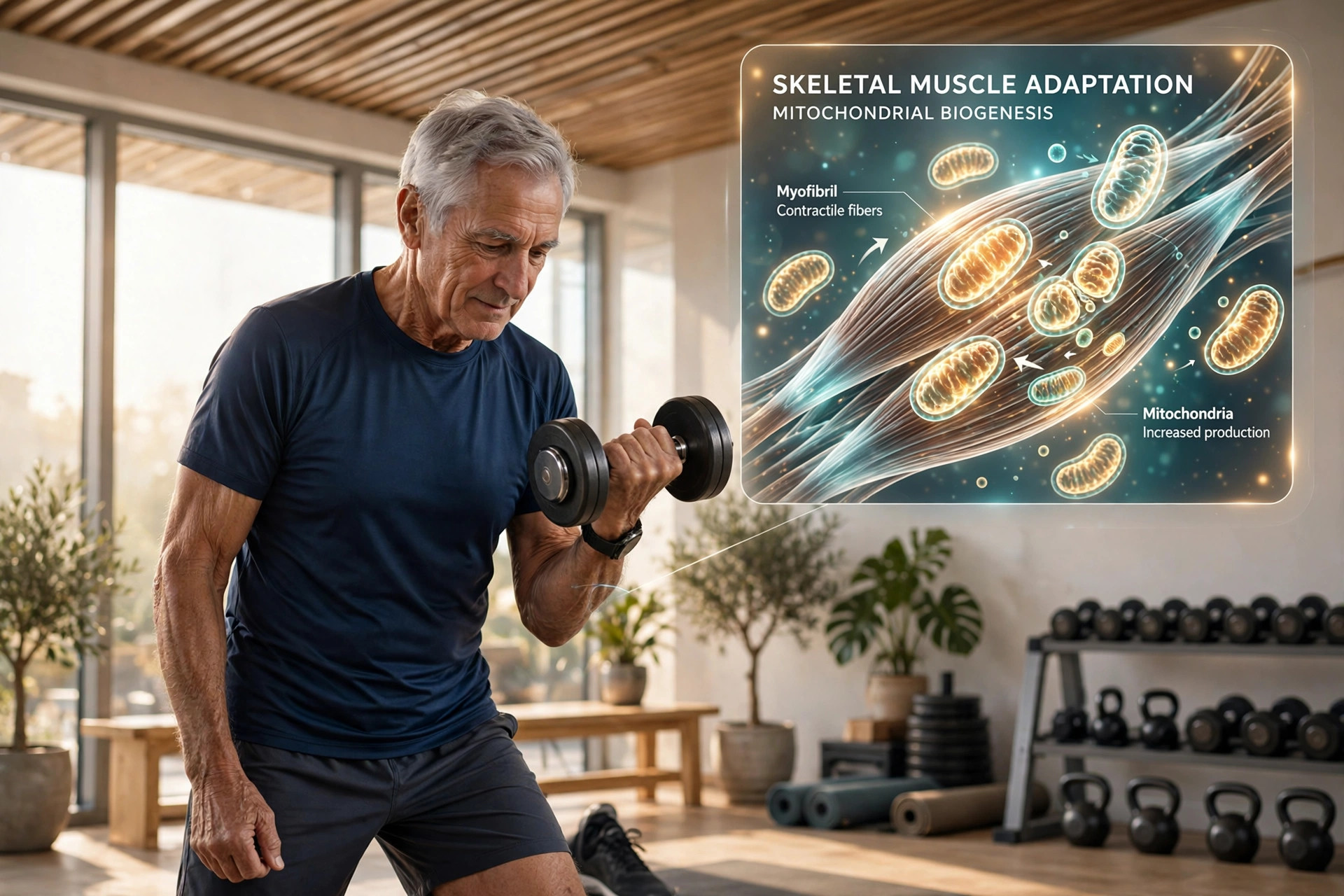
Exercise reverses age-related decline by remodeling mitochondria — mice and a human trial
·Scientists have long known that exercise slows aging — but the why was fuzzy. A new study published in PNAS gives one of the clearest answers yet: the anti-aging benefits of exercise depend on your muscle mitochondria physically remodeling themselves. And in the study's boldest finding, when researchers genetically blocked that mitochondrial remodeling in mice, the benefits of exercise disappeared — the animals could still run, but their bodies no longer aged better for it.
What the study found
In the mouse arm, aged mice with 12 weeks of running-wheel access showed significant gains in grip strength, endurance, and overall physical performance versus sedentary age-matched mice — and the researchers traced those gains directly to remodeling of skeletal-muscle mitochondria, including higher expression of respiratory-chain proteins such as Cox7a1. The more of these proteins in muscle, the greater the physical improvement.
The human arm was equally notable: a 12-week multicomponent program (resistance training, balance work, gait training) in frail adults averaging 78 years old reduced frailty, and muscle biopsies showed the same mitochondrial remodeling patterns seen in the mice.
The proof it's the mechanism
Most exercise science shows correlations: active people have healthier mitochondria. This team went further, using genetic tools to block the remodeling pathway in mice. Wheel-running without mitochondrial remodeling produced no functional benefit — a clean causation result, rare in aging research.
That doesn't mean mitochondria are the only mechanism — but it does mean they are a required one, at least in these models.
What this means for your routine
Three practical notes from the study: consistency beat intensity (the mice simply had continuous wheel access — no extreme workouts); resistance training was a core component in the human trial, consistent with the muscle-mitochondria location of the effect; and it was never too late — late-70s and early-80s participants responded meaningfully after 12 weeks.
The honest limits
The human evidence is a small, short trial in frail elders — not proof of a lifespan extension prescription. And the causation experiment was done in mice, not people. Still, as mechanisms go, this is among the most convincing links ever drawn between a lifestyle behavior and mitochondrial function.
Where the evidence stands
- Established: Exercise improves strength, endurance, and frailty scores in older adults; the mouse arm used controlled 12-week running-wheel access with sedentary controls.
- Preliminary: The human trial's mitochondrial findings came from muscle biopsies in a small frail-elderly cohort; the remodeling-protein link (Cox7a1 and related proteins) is associative in humans.
- Contested: Whether exercise's longevity benefits run mainly through mitochondrial remodeling versus cardiovascular, metabolic, or neurological adaptations is still being weighed.
- Absent: No study shows an exercise pill or supplement produces this remodeling without movement.