
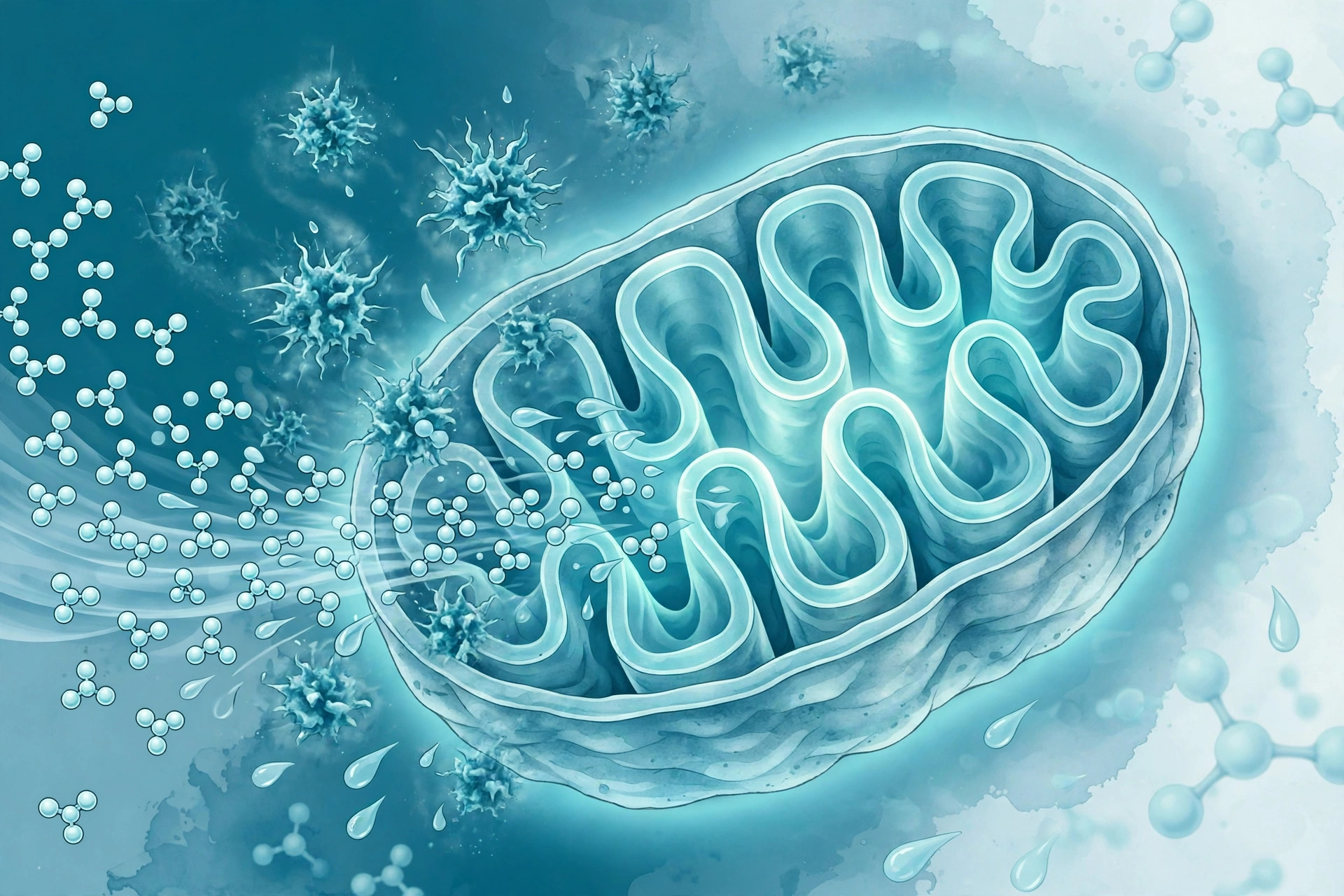
A new review maps molecular hydrogen's mitochondrial mechanisms
A new review in Frontiers in Pharmacology synthesizes the clinical case for hydrogen as a “pleiotropic agent” — and gives the standing hydrogen watch its freshest mechanistic map. The review traces how molecular hydrogen interacts with mitochondria: restoration of the Nrf2/HO-1 antioxidant axis, rebalancing of mitochondrial fission and fusion, PINK1/Parkin-mediated mitophagy, and recovery of state-3 respiration and ATP production. It also cites a randomized sleep-disorder trial (Gao et al., 2026, n=66) in which hydrogen-oxygen inhalation improved sleep quality and mood.
What mechanisms does the review map?
Four, mainly: Nrf2/HO-1 signaling restored, the fission/fusion balance of the mitochondrial network rebalanced, damaged mitochondria cleared through PINK1/Parkin mitophagy, and energy output (state-3 respiration, ATP production) recovered. The picture is coherent — and mostly from animal and cell models.
What human data exists?
Early and small: the cited randomized sleep trial (n=66) is one of the more rigorous human entries. But human mitochondrial outcomes remain largely inferred from animal and platelet models, and the authors of a separate 2026 clinical review have already noted that large hydrogen trials are inconsistent.
How does this fit the hydrogen watch?
As a mechanisms map, this is the strongest hydrogen item in weeks — it organizes scattered findings into a testable framework. As clinical evidence, it changes little: review, not new primary data. The watch stays honest by holding both readings at once.
Where does the evidence stand?
Mechanistic findings are strong in animal models; human data are early. Anyone selling hydrogen therapy on the basis of Nrf2 diagrams is selling the map, not the territory.
Where the evidence stands
- Established: The mitochondrial mechanisms (Nrf2/HO-1, fission/fusion, mitophagy, respiration recovery) are documented across animal and cell models.
- Preliminary: Human evidence: small trials (e.g. n=66 sleep trial); human mitochondrial outcomes largely inferred.
- Contested: Large-trial consistency — a separate 2026 clinical review found human trial results inconsistent and mechanisms incompletely clarified.