
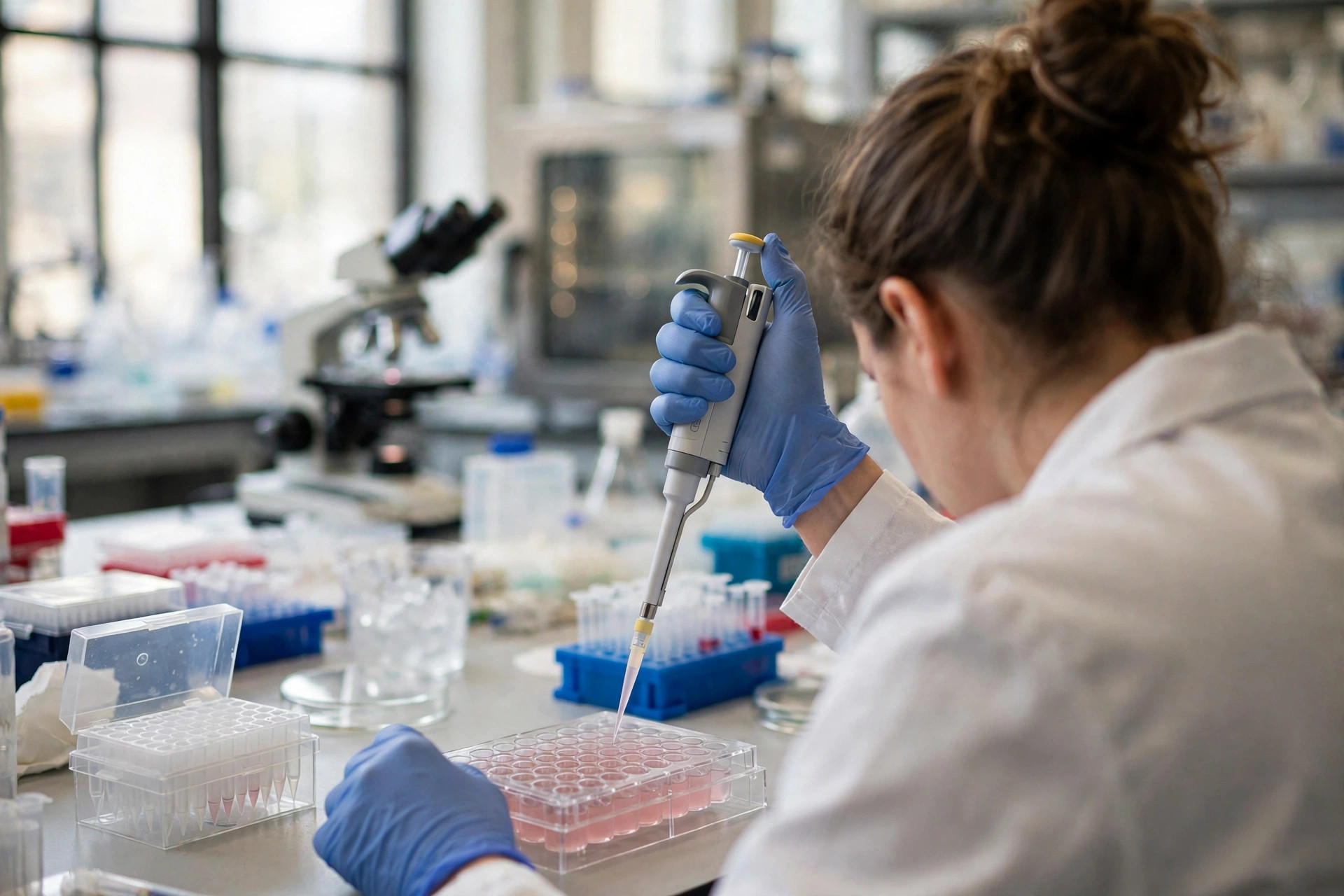
Simufilam calmed a cellular stress signal and restored mitochondrial membrane potential — in lab-grown TSC2-deficient cells
Edited by Samael A. Tejada, Founder & Editor-in-Chief
·Tip: press play, then lock your phone or switch apps — the article keeps reading.
Membrane potential is a real and measurable mitochondrial endpoint, and ATF4 is a real stress signal — this is not a vague wellness claim. It is also a cell-line experiment announced by the company developing the drug, in a disease model built by deleting one gene. Both things are true, and the distance between them and a patient benefit is the whole story of preclinical drug development.
What did the Yale team measure?
The model was a human cell line engineered to knock out TSC2, reproducing the cellular signaling abnormality of tuberous sclerosis complex. Against that background, simufilam treatment reduced the elevated expression of ATF4 by about 37 percent. ATF4 is the transcription factor that coordinates the integrated stress response — the program cells run when protein folding, nutrient supply or organelle function goes wrong — so a reduction is consistent with the drug attenuating that stress program rather than merely masking a symptom. The study also mapped changes in mitochondrial pathways associated with treatment and found restoration of mitochondrial membrane potential, which TSC2-deficient cells had lost.
Why does mitochondrial membrane potential matter here?
Membrane potential is the electrical gradient across the inner mitochondrial membrane, and it is the immediate energy source for ATP synthesis: lose it, and the organelle cannot power the cell no matter how much fuel is available. Its disruption is also a trigger for mitochondrial quality-control and cell-death pathways. A treatment that restores potential in a disease-model cell has therefore done something mechanistically meaningful — it has returned the organelle's basic ability to work. What it has not done is show that the same effect occurs in a patient's neurons, at a tolerable dose, with a clinical benefit attached. TSC-related epilepsy is driven by brain lesions and network dysfunction far above the level of a single cell line, which is why the planned Phase 2a study, not this paper, is the test that matters.
How should readers weigh a company-announced cell study?
Three ordinary cautions, all visible in the announcement itself. The work is preclinical: a cell line, not animals or patients. The announcement is the sponsor's: Filana issued the release, and a senior company neuroscience executive is among the Yale researchers — a common arrangement in translational research, and still a reason to wait for independent replication. And the drug's own history argues for patience: simufilam has been a closely watched and debated candidate in another indication, Alzheimer's disease, which makes peer scrutiny of each new dataset more important, not less. None of that erases the finding; it prices it. The correct label is a promising mechanistic result awaiting a clinical test, with screening for that test expected by early 2027.
Frequently asked questions
What is simufilam being studied for here?
Tuberous sclerosis complex (TSC), a genetic condition caused by loss of TSC1 or TSC2. Filana is developing simufilam for TSC-related epilepsy and plans a Phase 2a study, with patient screening expected by the first quarter of 2027.
What did the study find about mitochondria?
In human cells engineered to lack TSC2, simufilam treatment was associated with changes in mitochondrial pathways and restoration of mitochondrial membrane potential, alongside a roughly 37 percent reduction in the elevated stress factor ATF4.
Has simufilam helped any patient with TSC?
Not in any published result. The October 2026 findings are from a laboratory cell line. No animal or human efficacy for TSC has been reported yet.
Where the evidence stands
- Established: TSC2 loss drives tuberous sclerosis complex biology; ATF4 coordinates the cellular integrated stress response; and mitochondrial membrane potential is required for ATP synthesis and is a standard measurable endpoint of mitochondrial function.
- Preliminary: In a TSC2-knockout human cell line (Cells, announced Oct 28, 2026), simufilam reduced elevated ATF4 expression by approximately 37 percent, with changes in mitochondrial pathways and restoration of mitochondrial membrane potential.
- Absent: Animal efficacy, human safety or efficacy in TSC, and any clinical outcome — a Phase 2a study is planned, with patient screening expected by the first quarter of 2027.
Join the discussion
To get the conversation started: What questions does this story raise for you? Share them below — every comment is reviewed by our moderators before it appears.
Community discussion only — not medical advice. Every comment is reviewed by our moderators before it appears. Sign in with Google or a free Hyvor account to join in.