
A mitochondria-targeted geropeptide preserved movement in super-aged rats — in rats, in small interim groups
Edited by Samael A. Tejada, Founder & Editor-in-Chief
·Tip: press play, then lock your phone or switch apps — the article keeps reading.
A peptide built to work on mitochondria themselves — not on a downstream symptom — has now produced the same functional signal in a second species, tested by an outside academic core rather than only in the sponsor's own lab. That is a real translational step. It is also, today, three and four rats per group in an interim company release, and this page keeps the step and the size in the same sentence.
What exactly did the Einstein study test?
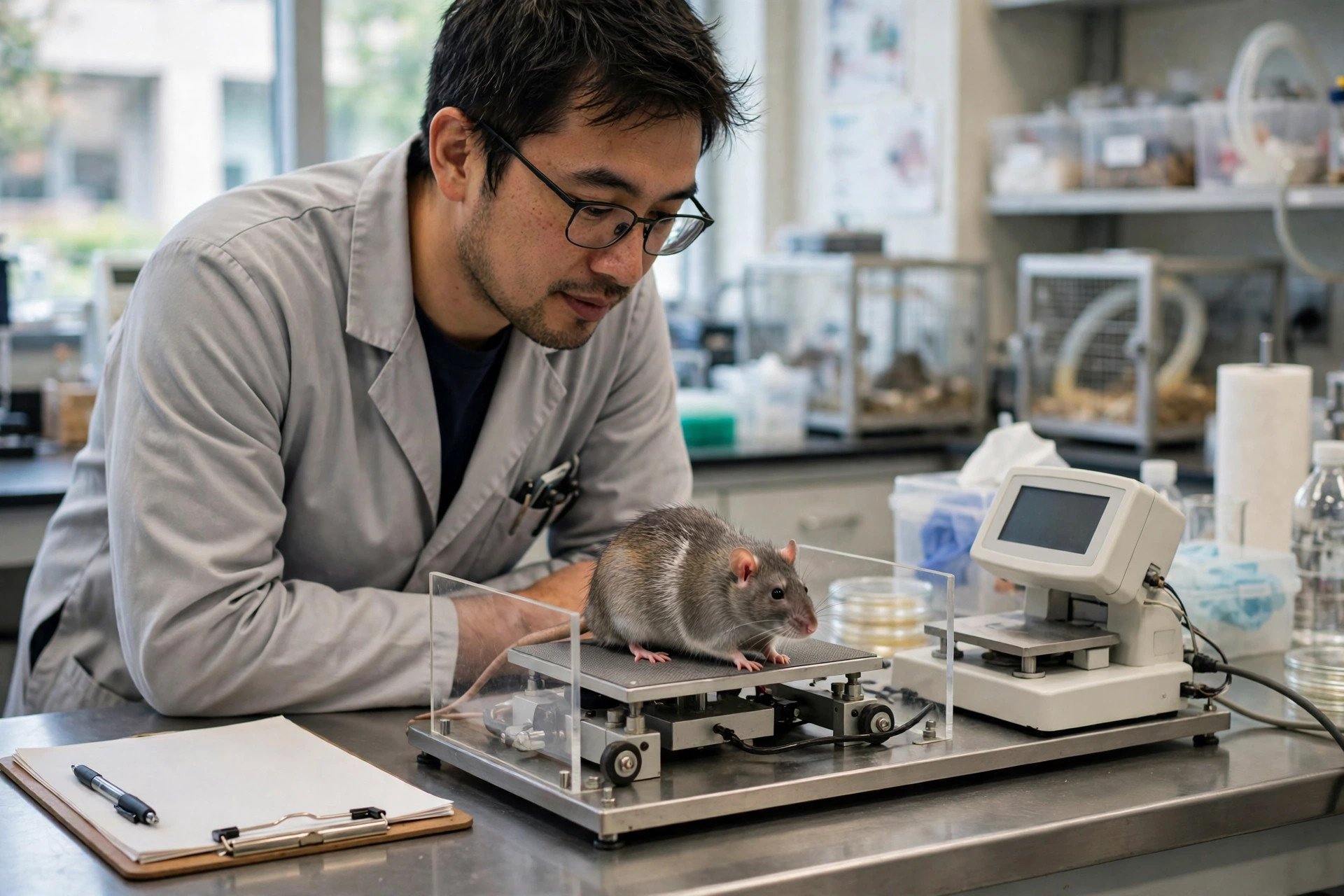
The BIO-VITAL Program Preclinical Testing Core at Albert Einstein College of Medicine is running a 32-week study in aged rats under a fee-for-service agreement, with staggered enrollment across six planned age cohorts and two once-weekly subcutaneous doses of PTC-2105 (0.5 and 12.5 mg/kg — doses used in this published study design) against vehicle. Endpoints mirror the company's earlier mouse work so the species can be compared directly: quantitative MRI body composition, grip strength, Rotarod, treadmill, gait analysis, frailty indexing and cognition, assessed every eight weeks. Of the planned cohorts, the two oldest have reached Week 8 and the oldest cohort (39 rats enrolled) has reached the Week 16 mid-study point; the detailed functional numbers released so far come from small interim subgroups within that oldest cohort.
What did PTC-2105 do, on the company's numbers?
In the oldest cohort, Rotarod latency at Week 16 remained near baseline on 0.5 mg/kg PTC-2105 while vehicle animals declined about 76% — a 78.4-percentage-point difference (p=0.012; n=3 treated, n=4 vehicle), with a similar pattern for Rotarod distance (90.3 percentage points, p=0.008). Grip strength rose 30.7% on treatment versus 7.3% on vehicle, a difference that was not statistically significant (p=0.396). Treated rats also showed greater fat-mass loss at Week 8. The company reports no adverse safety signals in the animals to date, and says the rat findings are consistent with its prior naturally aged mouse studies, in which the peptide preferentially reduced fat while increasing lean mass and improving physical function — including, in combination work, preserving lean mass alongside GLP-1 drugs. End-of-study sub-studies are planned to measure senescent T cells, mitochondrial bioenergetics by Seahorse analysis, inflammatory cytokines, and skeletal-muscle mitochondrial structure by electron microscopy.
How far is this from a treatment for people?
The full distance that separates any animal geroprotector from a medicine: an IND application not yet cleared, no human dosing, no human safety data, and interim animal groups so small that a single animal changes the percentages. Company press releases are the sponsor's own account of its own interim analysis, not a peer-reviewed paper, and the fee-for-service testing arrangement — while genuinely external — is paid for by the sponsor. What can fairly be said is narrower and still interesting: a mitochondria-targeted peptide aimed at sarcopenia has a consistent cross-species functional signal, an academic core is generating the data, and a randomized, placebo-controlled Phase 1b study in adults 60 and older with sarcopenia is the stated 2027 plan. The human experiment has not started.
Frequently asked questions
What is PTC-2105?
An investigational once-weekly injected peptide from Eos SENOLYTIX's MitoXcel program. It is designed to target the age-related decline in mitochondrial membrane potential, improving mitochondrial efficiency in aging cells and selectively eliminating senescent cells through mitochondria-mediated apoptosis.
What did the aged-rat study find?
In interim results reported October 30, 2026 from a study at Albert Einstein College of Medicine's BIO-VITAL core, the oldest rats on PTC-2105 preserved Rotarod and treadmill performance at Week 16 and lost more fat mass at Week 8 than vehicle controls — in very small interim groups of 3 to 4 animals.
Can people take PTC-2105 for sarcopenia or aging?
No. It has never been given to a human, is not approved anywhere, and first-in-human trials are only targeted for 2027, subject to FDA clearance of an IND application.
Where the evidence stands
- Established: Mitochondrial dysfunction, including declining mitochondrial membrane potential, is a conserved feature of mammalian aging, and sarcopenia — age-related loss of muscle mass, strength and function — has no approved disease-modifying drug therapy.
- Preliminary: In interim company-reported data from an external academic-core rat study (Eos SENOLYTIX, Oct 30, 2026), once-weekly PTC-2105 preserved Rotarod and treadmill performance at Week 16 and increased fat-mass loss at Week 8 versus vehicle in the oldest rats, in subgroups as small as n=3 versus n=4; prior aged-mouse studies showed fat loss with lean-mass and function gains.
- Absent: Any human data of any kind — PTC-2105 is investigational, unapproved by the FDA or any regulator, and untested for lifespan or healthspan in people; the rat results are interim, company-released and not yet peer-reviewed.
Join the discussion
To get the conversation started: What questions does this story raise for you? Share them below — every comment is reviewed by our moderators before it appears.
Community discussion only — not medical advice. Every comment is reviewed by our moderators before it appears. Sign in with Google or a free Hyvor account to join in.