
Liver growth hormone receptor loss accelerates aging via mitochondrial failure — in mice
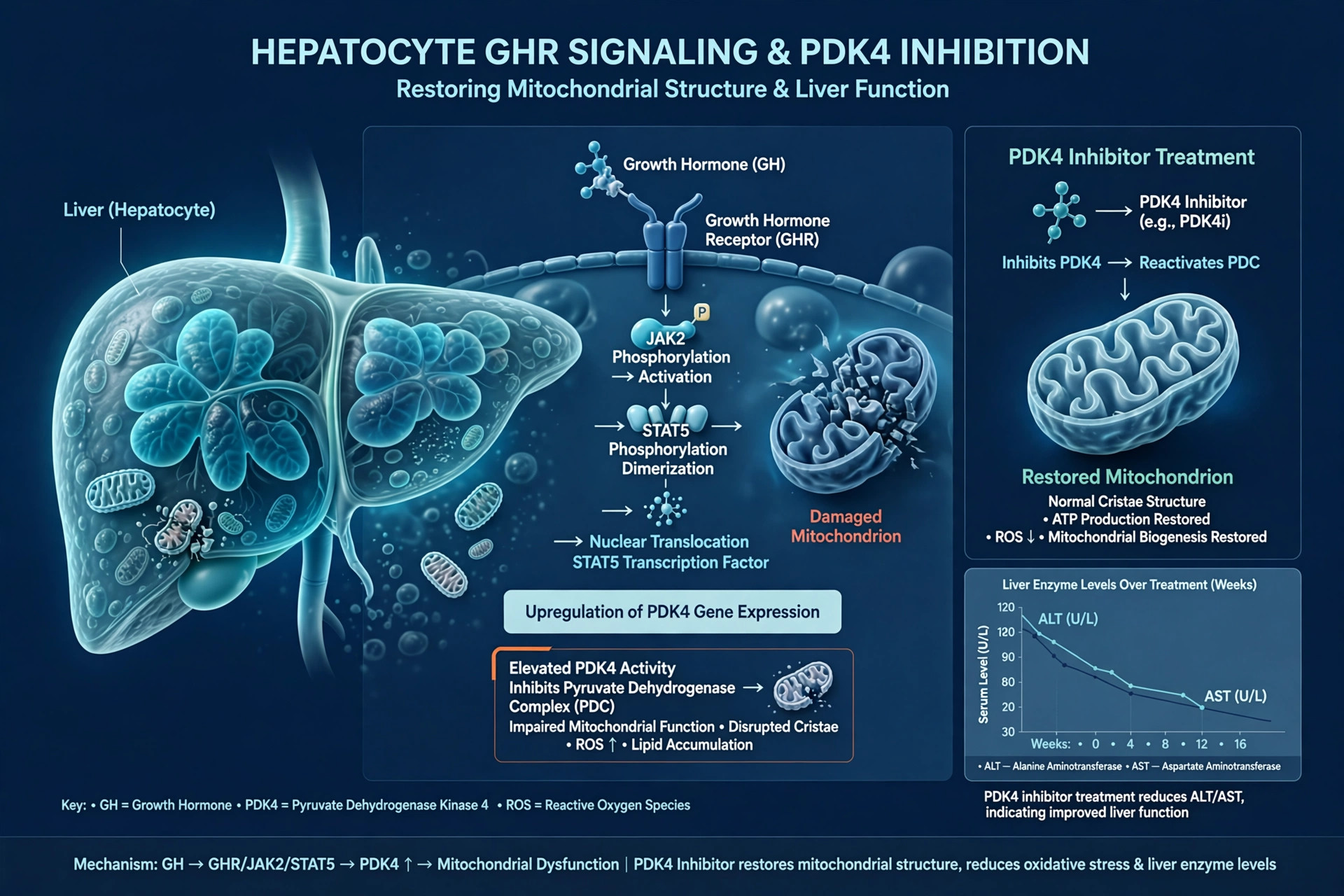
·The liver listens to growth hormone every day. Remove that signal only in liver cells, and mice age faster where it hurts: the liver fills with fat, mitochondria fail, inflammation rises, and senescence markers climb. The new Aging Cell study (Yang et al., 2026) traces the chain — GHR → STAT5b → PPARγ → PDK4 — and then breaks it: a PDK4-specific inhibitor given weekly from 20 months of age restored mitochondrial ultrastructure, lowered ALT/AST, and eased fibrosis in both knockout and naturally aged mice.
What the study found
Hepatocyte-specific GHR knockout mice developed hepatic steatosis, mitochondrial dysfunction, and a self-reinforcing loop of lipid overload and mitochondrial failure. Senescence markers p16, p21, and γ-H2AX rose alongside inflammatory cytokines. Sixteen weeks of PDK4 inhibition reversed much of it in a dose-dependent manner — less fat, cleaner mitochondria on electron microscopy, lower ROS.
Why the liver-mitochondria link matters
The liver is a metabolic clearinghouse; when its mitochondria falter, lipids back up, inflammation spills into blood, and other organs age faster. A liver-intrinsic hormone signal that can be tuned late in life — the inhibitor also helped naturally aged controls — is a plausible healthspan lever.
What this means
PDK4 sits at the switch between burning fat and burning carbohydrate. Inhibiting it restored metabolic flexibility in these mice. That echoes earlier reports that late-life PDK4 inhibition extends median lifespan in aged animals — now with a defined upstream pathway.
The honest limits
This is mouse work. Growth hormone signaling in humans is systemic and pulsatile; liver-only manipulation is a research tool, not a therapy. PDK4 inhibitors are not approved for aging, and long-term safety in people is unknown.
Where the evidence stands
- Established: Hepatic mitochondrial dysfunction, steatosis, and inflammaging co-travel in aging; PDK4 regulates the fat-versus-carbohydrate oxidation switch.
- Preliminary: The GHR–STAT5b–PPARγ–PDK4 causal chain and its reversal by a PDK4 inhibitor are demonstrated in one mouse study.
- Contested: How much of the phenotype is liver-intrinsic versus secondary to altered circulating hormones awaits inducible-model work, per the authors.
- Absent: No human data exist for PDK4 inhibition as an anti-aging intervention.