
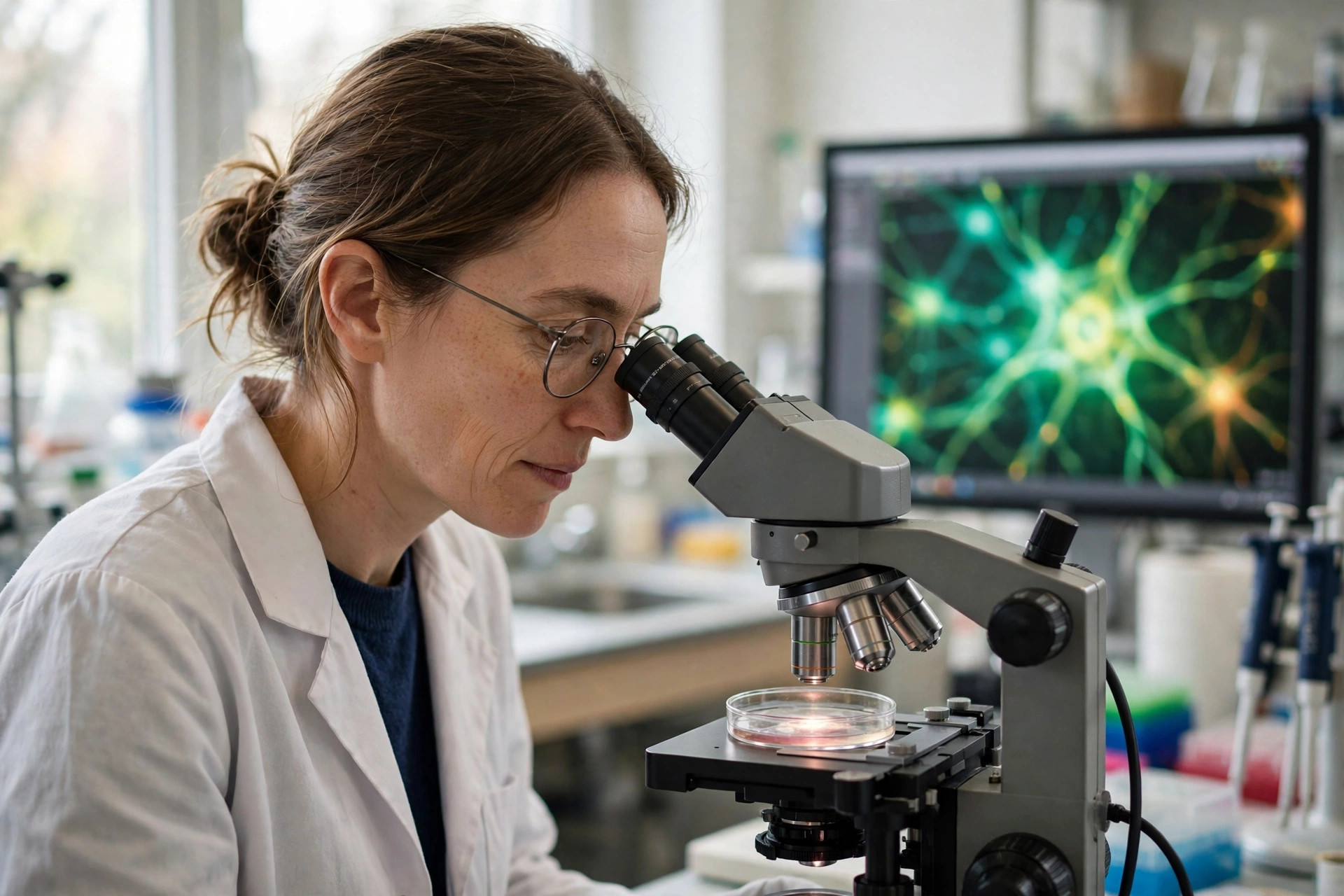
In human neurons, aging does not break the cleanup crew — it breaks the delivery route to the lysosome
·Tip: press play, then lock your phone or switch apps — the article keeps reading.
Most of what science knows about neuronal aging comes from short-lived animals. This team used direct neuronal reprogramming — converting adult skin fibroblasts into induced neurons (iNs) that retain the donor's cellular aging signatures — to watch mitochondrial health and mitophagy in human neurons from donors spanning eight decades of life.
What changed in the older neurons?
Comparing neurons from younger (under 60) and older (over 60) healthy donors, the researchers replicated earlier findings of age-related mitochondrial impairment in neurites: lower mitochondrial membrane potential and increased network fragmentation, meaning less energy capacity and a more broken-up mitochondrial network. On top of that, they found the new result: after mitophagy was triggered, mitochondria targeted for degradation accumulated inside autophagosomes and LAMP1-positive lysosomal vesicles instead of being cleared.
If the lysosomes still work, why does clearance fail?
The lysosomal enzymes the team assessed kept their activity with age. The failure sat one step earlier: defective translocation — damaged mitochondria were not being delivered properly to acidified lysosomes, the low-pH compartments where digestion actually happens. Cargo packaged but never delivered is still cargo piling up, and in a neuron that cannot divide to dilute the damage, that pile-up is a plausible driver of decline.
Why does a delivery step matter for Alzheimer's and Parkinson's?
Mitophagy defects are implicated in both diseases, and this study pinpoints a specific, potentially druggable step — getting damaged mitochondria into acidified lysosomes — in human cells rather than in a mouse. It is a cell-model finding, not a treatment: induced neurons in a dish are not an aging brain. But it tells researchers where in the pipeline to look, and gives anti-aging and neuroprotection programs a human-cell assay to test against.
Where the evidence stands
- Established: Mitochondrial dysfunction and defective mitophagy are hallmarks of aging and are implicated in Alzheimer's and Parkinson's disease; damaged mitochondria are normally cleared by delivery to lysosomes.
- Preliminary: In induced human neurons from healthy donors aged 11-91 (Frontiers in Aging Neuroscience, 2026), older donors' neurons showed lower membrane potential, more fragmentation, and — for the first time in human neurons — impaired mitophagy with mitochondria accumulating in autophagic structures, attributed to defective delivery to acidified lysosomes despite preserved lysosomal enzyme activity.
- Absent: Evidence from intact human brain tissue over time, and any intervention shown to restore mitophagy delivery in aging human neurons.
Join the discussion
To get the conversation started: What questions does this story raise for you? Share them below — every comment is reviewed by our moderators before it appears.
Community discussion only — not medical advice. Every comment is reviewed by our moderators before it appears. Sign in with Google or a free Hyvor account to join in.