CTAB targets mitochondrial EGFR in triple-negative breast cancer
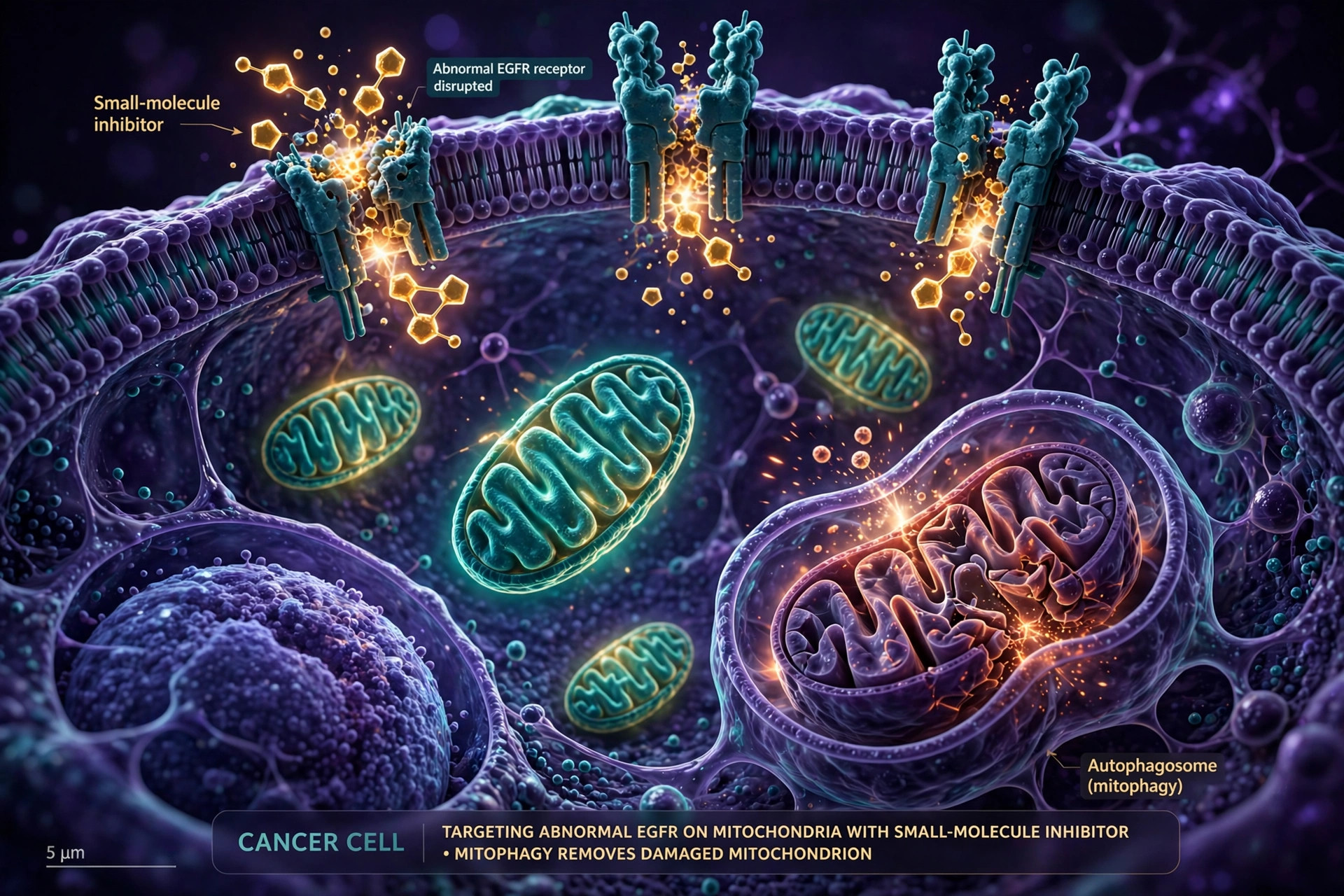
·Triple-negative breast cancer is the hardest-to-treat breast cancer — and part of its aggression lives in an unexpected place: inside the cell's mitochondria. A new study in Cell Death & Disease shows that EGFR, a well-known cancer growth receptor, is enriched inside mitochondria in TNBC, where it drives malignant behavior. Screening then turned up a surprising counterpunch: cetrimonium bromide (CTAB), which degrades mitochondrial EGFR and throws the cancer cells' mitochondria into lethal dysfunction.
How the attack works
Most EGFR research focuses on the receptor at the cell surface. This team (Li, Yang, et al.) found the mitochondrial pool — mitoEGFR — closely tied to aggressive traits in TNBC. CTAB interacts with mitoEGFR, induces its degradation, and triggers a cascade: abnormal mitochondrial morphology, disrupted ROS balance, and activated mitophagy (the targeted destruction of mitochondria). Net effect: suppressed proliferation, stemness, and migration — the core machinery of tumor growth and spread.
Why hitting mitochondria helps cancer therapy
This is the mirror image of most mitochondrial medicine: instead of rescuing failing mitochondria, the goal is to wreck the cancer's mitochondria. Drugs that turn mitochondrial dysfunction into a weapon are a credible — and growing — oncology strategy.
The long road
CTAB is a detergent-like quaternary ammonium compound — a long way from a drug. Expect the chemistry to be refined or replaced long before any clinic. And TNBC in a dish is not TNBC in a patient. This is a new therapeutic target with a first-hit compound, not a treatment.
Where the evidence stands
- Established: Mitochondrial EGFR enrichment is associated with aggressive phenotypes in TNBC cell models, per the published Cell Death & Disease paper.
- Preliminary: All efficacy data — proliferation, stemness, migration suppression — come from cell and preclinical models; no animal efficacy or toxicity data was reported in the abstract.
- Contested: Whether CTAB can be formulated into a safe therapeutic (it's a detergent-like quaternary ammonium compound) is an open formulation and toxicology question.
- Absent: No human data or clinical trial exists for CTAB as a cancer therapy.