
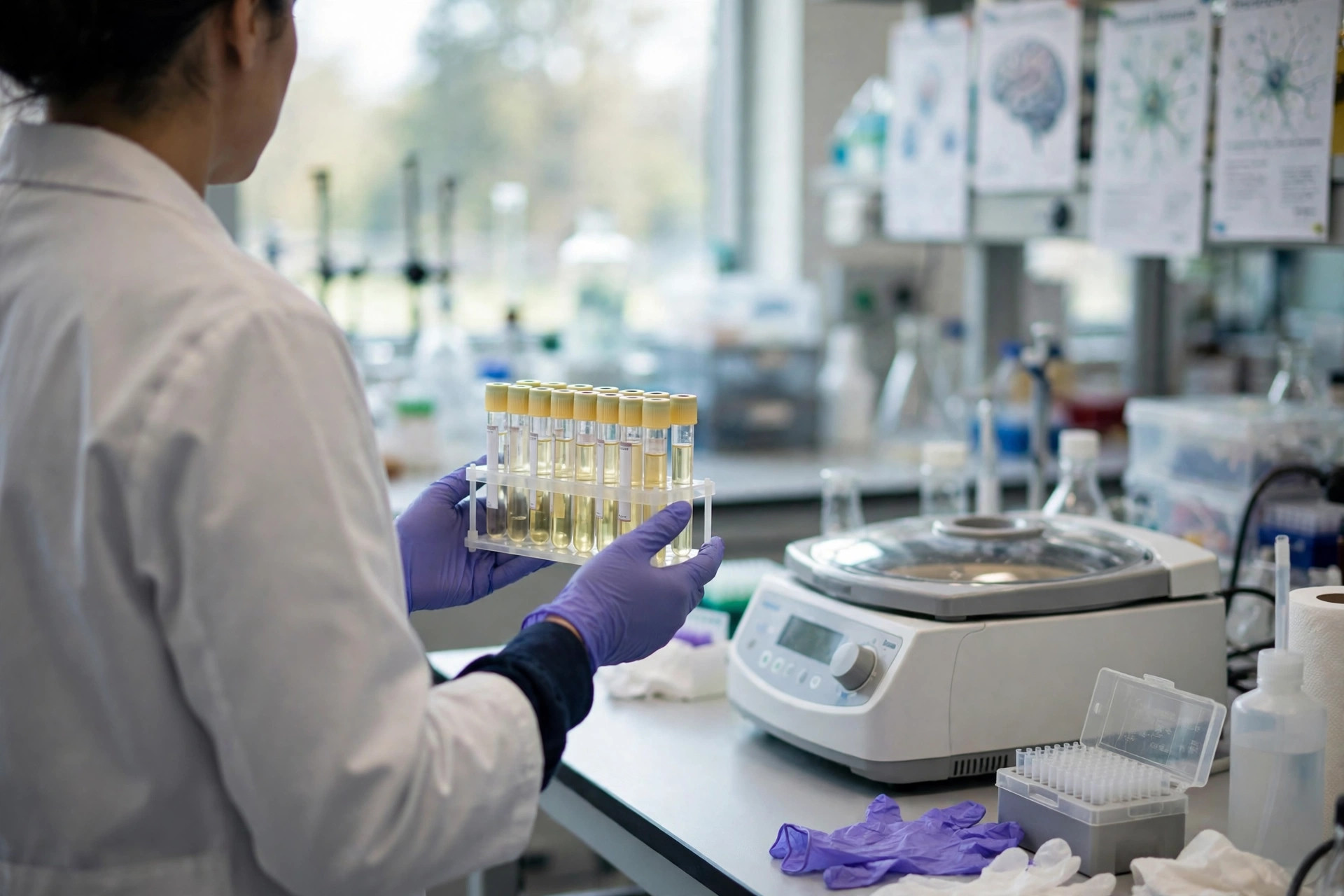
A blood exosome signature classified Parkinson's with high accuracy — and pointed back at mitochondria
Edited by Samael A. Tejada, Founder & Editor-in-Chief
·Tip: press play, then lock your phone or switch apps — the article keeps reading.
A useful Parkinson's blood test would change clinic visits long before it changed treatment: earlier confidence, cleaner trial enrollment, fewer years of diagnostic uncertainty. This study's contribution is twofold — a microRNA signature that held up across cohorts, and a protein signature that did not, which is exactly the kind of honest contrast biomarker research needs.
What did the 69-microRNA signature actually achieve?
The researchers integrated microRNA and proteomic profiling of blood exosomes from multiple public datasets for discovery, with an in-house cohort for independent validation. Consensus feature selection across five methods produced the biomarker panels, tested with four classification models. The 69-microRNA signature achieved strong Parkinson's classification, with a Random Forest model showing the best generalization at AUC 0.952 — where 1.0 is perfect discrimination and 0.5 is chance.
Why did the protein panel perform so much worse?
The 63-protein proteomics signature showed limited cross-study reproducibility, with a best AUC of 0.611, which the authors attribute to inter-platform heterogeneity — different measurement platforms disagreeing with each other. That gap matters for readers pricing any 'Parkinson's blood test' headline: a signature is only as good as its performance on samples and machines it has never seen.
Where do mitochondria come into a blood test?
In the biology underneath the signature. Functional enrichment across the omics layers consistently highlighted mitochondrial energetics failure alongside suppression of complement and coagulation cascades, and tracing the exosomes' origins pointed to an immune-metabolic axis involving B cells and CD4+ T cells. The authors frame the work as a foundation for exosome-based liquid biopsy and mechanistic biomarker development — a research test, not a validated clinical assay, and not available as a consumer test.
Frequently asked questions
What did this study test?
Researchers profiled microRNAs and proteins in blood exosomes — tiny vesicles that can carry material from the brain across the blood-brain barrier — looking for a non-invasive Parkinson's signature. A consensus panel of 69 microRNAs classified Parkinson's strongly across cohorts, with independent validation.
How accurate was the blood signature?
The best model reached an AUC of 0.952, where 1.0 is perfect discrimination and 0.5 is chance. A 63-protein panel from the same exosomes performed much worse across studies, reaching only 0.611 — a reminder that a signature is only as good as its performance on samples and machines it has never seen.
What does this have to do with mitochondria?
The biology underneath the signature pointed to mitochondrial energetics failure alongside immune dysregulation — themes that run through Parkinson's itself. Tracing the exosomes' origins also pointed to an immune-metabolic axis involving B cells and CD4+ T cells.
Can I get this Parkinson's blood test now?
No. This is a research finding — a foundation for future exosome-based liquid biopsy development — not a validated clinical test, and it is not available to consumers.
Where the evidence stands
- Established: Parkinson's disease lacks reliable non-invasive biomarkers for early diagnosis; blood exosomes can carry central-nervous-system-derived cargo across the blood-brain barrier, and mitochondrial dysfunction is a core feature of Parkinson's biology.
- Preliminary: In a cross-cohort analysis with independent validation (npj Parkinson's Disease, 2026), a 69-microRNA exosomal signature classified Parkinson's with best AUC 0.952, while a 63-protein signature reached only AUC 0.611 across studies; enrichment highlighted mitochondrial energetics failure and immune dysregulation.
- Absent: A validated, clinically available exosomal Parkinson's test, prospective early-diagnosis data, and evidence the signature predicts progression or treatment response.
Join the discussion
To get the conversation started: What questions does this story raise for you? Share them below — every comment is reviewed by our moderators before it appears.
Community discussion only — not medical advice. Every comment is reviewed by our moderators before it appears. Sign in with Google or a free Hyvor account to join in.