
Eye-fluid biopsy maps 64 mitochondrial proteins in geographic atrophy — and an oral nutrient reached the eye
Edited by Samael A. Tejada, Founder & Editor-in-Chief
·Tip: press play, then lock your phone or switch apps — the article keeps reading.
This is what validated testing looks like when it is done rigorously: a defined fluid, a named assay, a registered phase 0 study, paired samples from the same patients, and a claim sized to the result — an oral nutrient changed energy metabolites inside the eye. Whether that change helps anyone see better is a separate question the study does not claim to answer.
What did the eye fluid show in geographic atrophy?
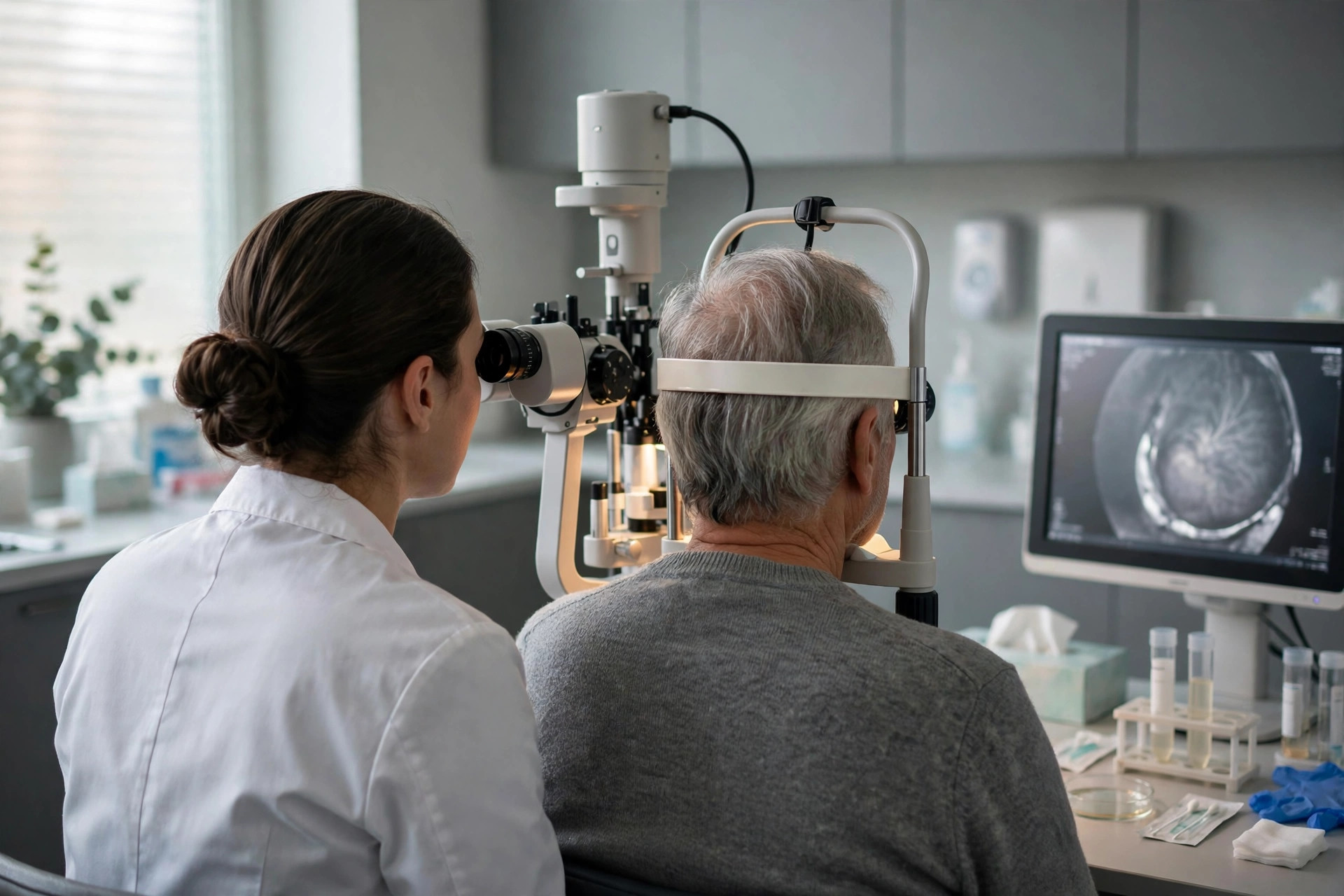
Using DNA-aptamer-based proteomics on aqueous humor from geographic atrophy patients, the team found 64 differentially expressed mitochondrial proteins. The pattern was not random: enzymes regulating entry into and flux through the tricarboxylic acid (TCA) cycle — including PDHB and DLST — were reduced together, which the authors read as mitochondrial pathway depletion consistent with reduced oxidative bioenergetic capacity in the diseased eye. Aqueous humor is accessible during routine eye surgery, which is what makes this a practical liquid-biopsy framework rather than a one-off experiment.
What did the phase 0 alpha-ketoglutarate study prove — and not prove?
Patients scheduled for cataract surgery on both eyes gave paired aqueous humor samples: one at first-eye surgery, and one at second-eye surgery after a week of oral alpha-ketoglutarate supplementation in between. Targeted metabolomics showed intraocular alpha-KG and the alpha-KG-to-succinate ratio rose significantly (P < 0.05), with coordinated shifts across TCA-cycle intermediates. That is target engagement — proof the oral supplement's metabolite reaches and moves the eye's energy chemistry in living humans. It is not evidence about geographic atrophy progression, vision, or dosing for treatment, none of which this phase 0 design measured.
Why does a test like this matter for mitochondrial medicine?
Most mitochondrial claims fail at measurement: the tissue that matters cannot be sampled, so proxies of proxies get sold instead. The eye is a rare exception — its fluid is drawn in routine procedures, and its energy-hungry retina is exactly where mitochondrial failure is suspected. The authors frame ocular liquid biopsy as a precision-health framework for per-patient, biomarker-guided metabolic trials in geographic atrophy: measure the patient's own mitochondrial protein and metabolite pattern, then test whether an intervention moves it. That framework, if replicated, is the contribution — ahead of any specific supplement claim.
Frequently asked questions
What is geographic atrophy?
Geographic atrophy is the advanced dry form of age-related macular degeneration. It slowly damages the retina and causes permanent sight loss, and its causes are not fully understood.
What is an eye-fluid (aqueous humor) liquid biopsy?
It is the profiling of proteins and metabolites in aqueous humor — the fluid inside the eye — sampled during routine eye surgery. In this study it revealed 64 differentially expressed mitochondrial proteins in geographic atrophy, including a coordinated TCA-cycle deficiency.
Does alpha-ketoglutarate treat geographic atrophy?
That has not been shown. The phase 0 study demonstrated only that one week of oral alpha-ketoglutarate raised alpha-KG levels and the alpha-KG-to-succinate ratio inside the eye of cataract-surgery patients — target engagement, not a vision or disease benefit.
Where the evidence stands
- Established: Geographic atrophy is an advanced form of age-related macular degeneration causing progressive, permanent sight loss; the retina is highly energy-demanding, and aqueous humor sampled during eye surgery can carry proteins and metabolites from the intraocular environment.
- Preliminary: In human aqueous humor (Communications Medicine, Oct 26, 2026), geographic atrophy showed 64 differentially expressed mitochondrial proteins with coordinated TCA-cycle deficiency (reduced PDHB and DLST), and in a registered phase 0 cohort, one week of oral alpha-ketoglutarate significantly raised intraocular alpha-KG and the alpha-KG-to-succinate ratio in paired samples.
- Absent: Any evidence that alpha-ketoglutarate improves vision or slows geographic atrophy, and replication of the proteomic signature in independent cohorts.
Join the discussion
To get the conversation started: What questions does this story raise for you? Share them below — every comment is reviewed by our moderators before it appears.
Community discussion only — not medical advice. Every comment is reviewed by our moderators before it appears. Sign in with Google or a free Hyvor account to join in.