
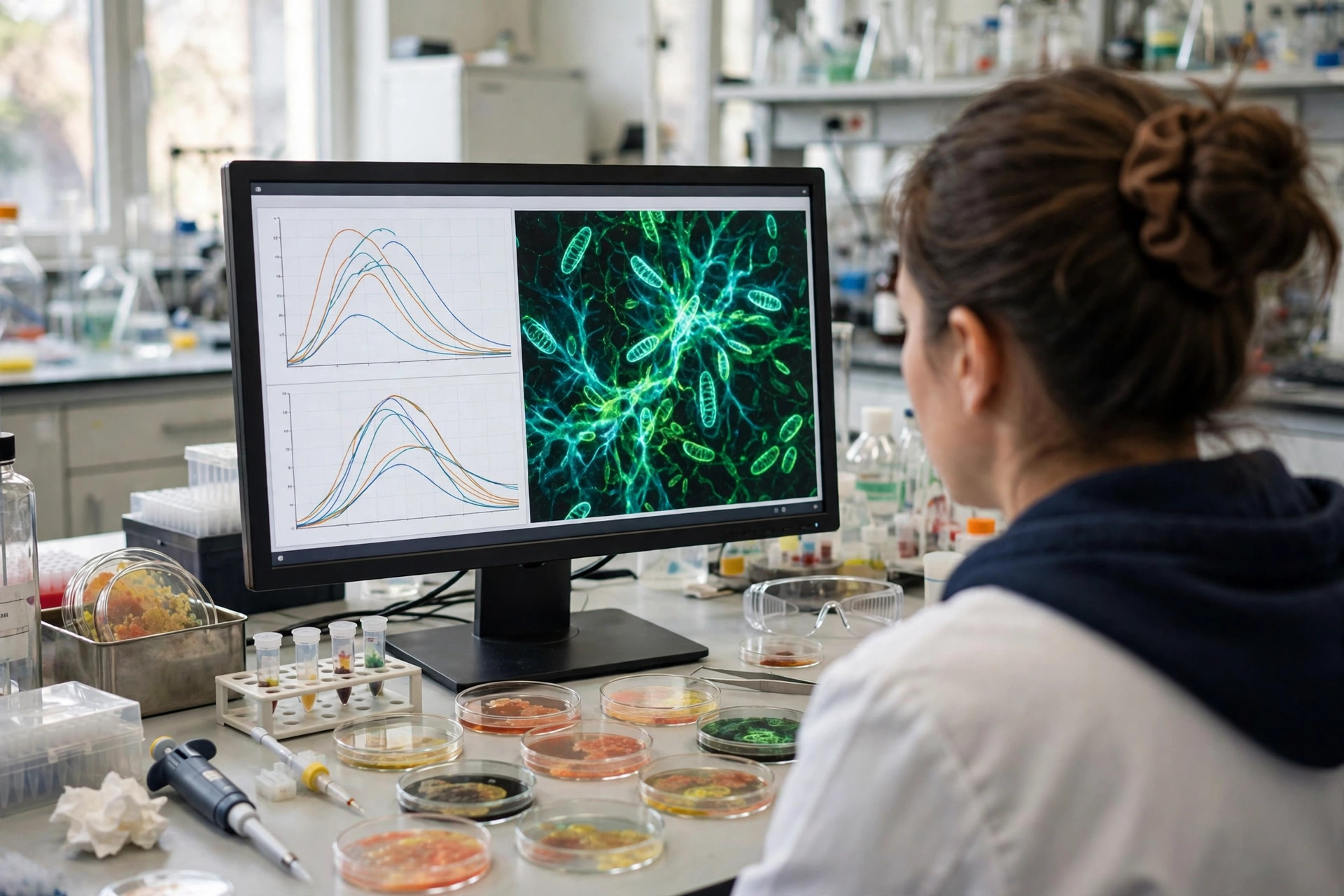
Forcing tumor mitochondria back to work countered the Warburg effect — in lab models
Edited by Samael A. Tejada, Founder & Editor-in-Chief
·Tip: press play, then lock your phone or switch apps — the article keeps reading.
Cancer metabolism research has a blunt question it could never answer cleanly: if you force a tumor cell's mitochondria back into full respiration, what happens to the tumor? Drugs that nudge metabolism are too messy to isolate the effect. Bass, Potekhina, Ivanenko and colleagues built a switch instead.
What is Grubraw, in plain terms?
Grubraw is a genetically encoded, mitochondria-targeted enzyme system derived from a bacterial D-amino-acid dehydrogenase (DadA). Add its trigger, D-alanine, and the tool becomes active inside mitochondria, altering pyruvate handling and pushing carbon toward mitochondrial oxidative phosphorylation — the respiration route Warburg metabolism restricts. Remove the trigger, or use an inactive mutant version as the control, and the effect switches off. The plasmids encoding Grubraw have been deposited with Addgene for other labs to use.
What did switching it on do to tumor cells?
Per the Nature Chemical Biology paper (published October 22, 2026), chemogenetic activation of mitochondria counteracted the Warburg effect in tumor cells: metabolic flux measurements showed increased mitochondrial respiration and reduced reliance on glycolysis, and proliferation assays across several cell lines — including HeLa, HT29, MDA-MB-231 and melanoma models — showed growth inhibition when Grubraw was active, with experiments extending to mouse melanoma xenografts. The authors also tracked by-products such as ammonia, a reminder that forcing respiration is a metabolic intervention with costs, not a free lunch.
Why is a gene-delivered tool not a cancer treatment?
Because delivering a bacterial enzyme gene to every tumor cell in a patient, safely and only to tumor cells, is an unsolved problem — and this study does not claim to solve it. What it does is cleaner and, for the field, arguably more useful: it proves the Warburg effect is not a one-way street in living tumor models, and gives researchers a precise on/off instrument to find which cancers, and which metabolic conditions, are actually vulnerable to mitochondrial reactivation before anyone designs a drug around the idea.
Frequently asked questions
What is Grubraw?
Grubraw is a research tool — a genetically encoded enzyme system, derived from a bacterial enzyme, that sits inside mitochondria and can be switched on with a trigger molecule, D-alanine. When active, it pushes pyruvate back into mitochondrial respiration, countering the Warburg effect in tumor cells.
What is the Warburg effect?
Many tumor cells sideline their mitochondria and ferment sugar for energy instead of using full mitochondrial respiration — that preference is called the Warburg effect. Restricted pyruvate flow into mitochondria is one major mechanism behind it.
What happened when researchers switched Grubraw on?
In tumor cell models — including HeLa, HT29, MDA-MB-231 and melanoma lines — activation increased mitochondrial respiration, reduced reliance on glycolysis, and slowed cell growth. The experiments extended to mouse melanoma tumors grown from implanted cells.
Is Grubraw a cancer treatment?
No. It is a gene-delivered laboratory instrument, not a drug. Delivering such a tool safely, and only to tumor cells, in a patient is an unsolved problem. Its value is proving the Warburg effect can be reversed in living tumor models and giving researchers a precise on/off switch for further study.
Where the evidence stands
- Established: The Warburg effect — upregulated glycolysis with downregulated mitochondrial oxidative phosphorylation — is characteristic of many tumor cells, and restricted pyruvate flux into mitochondria is one major mechanism behind it.
- Preliminary: In tumor cell models and mouse xenograft experiments (Nature Chemical Biology, Oct 22, 2026), activating the chemogenetic mitochondrial tool Grubraw counteracted Warburg metabolism, increased mitochondrial respiration and inhibited proliferation under the conditions tested.
- Absent: Any human data, any drug candidate acting this way, and a safe method to deliver such a tool to tumors in patients.
Join the discussion
To get the conversation started: What questions does this story raise for you? Share them below — every comment is reviewed by our moderators before it appears.
Community discussion only — not medical advice. Every comment is reviewed by our moderators before it appears. Sign in with Google or a free Hyvor account to join in.