
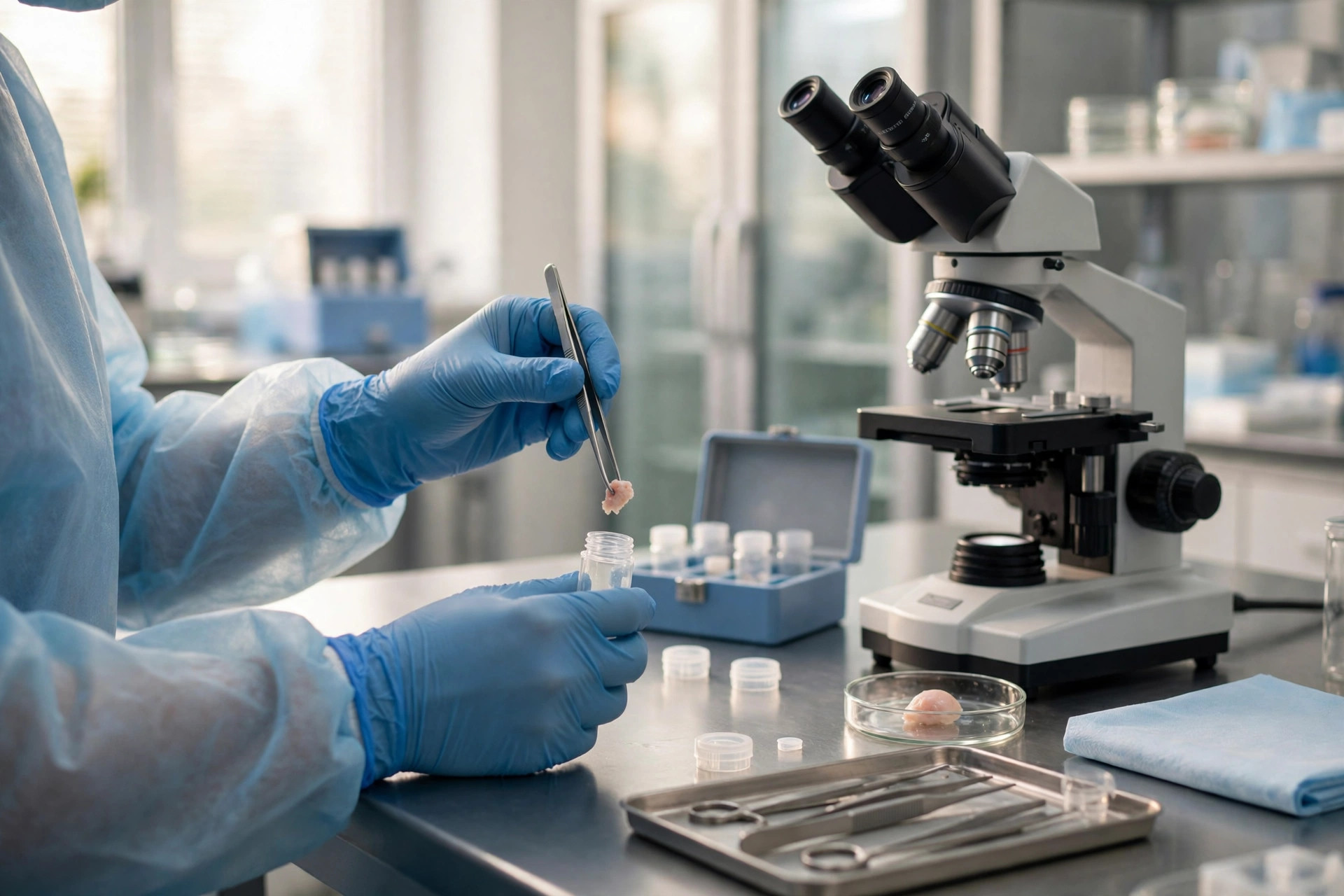
A mitochondria-targeted peptide gel helped frozen ovarian tissue survive transplant and restart hormone function — in rabbits
Edited by Samael A. Tejada, Founder & Editor-in-Chief
·Tip: press play, then lock your phone or switch apps — the article keeps reading.
Ovarian tissue freezing fails, when it fails, at the mitochondrion: the freeze–transplant cycle starves tissue of blood, then floods it back, and the oxidative burst kills the follicles the procedure exists to save. Delivering a cardiolipin-stabilizing peptide slowly, exactly where the graft lands, is a rational answer to that specific failure — and the endocrine recovery at eight weeks says the grafts did not merely survive, they worked, in rabbits.
Why do transplanted ovarian grafts lose follicles?
Ovarian tissue cryopreservation and transplantation preserves fertility by removing, freezing and later regrafting tissue containing primordial follicles. The vulnerable window is the transplant itself: before new blood vessels grow in, the graft is ischemic, and when circulation returns, ischemia-reperfusion injury generates oxidative stress that damages mitochondria and triggers follicle loss and burnout. Generic antioxidants have been tried, but the authors note their efficacy is constrained by non-specificity and by the inability to sustain release at the graft site — a systemic antioxidant at the wrong place and time does little for a graft in its first critical days.
What did the SS-31 gel combination do in rabbits?
Elamipretide (SS-31) is a small peptide that concentrates in the inner mitochondrial membrane and stabilizes cardiolipin, the signature lipid of that membrane — the same target class this site covered in the aging-muscle literature. Embedding it in a recombinant human GM-CSF gel kept the peptide localized at the transplantation site with sustained release. In the rabbit model, the combination acted synergistically: oxidative stress fell, mitochondrial function improved, follicular survival rose, and reproductive endocrine function was restored eight weeks post-transplantation — evidence the surviving follicles were functioning, not just present. Proteomic and metabolomic analyses attributed the gains primarily to activation of energy-metabolism pathways.
What would it take to reach patients?
Ovarian tissue transplantation is already performed in humans, which shortens one part of the path: an adjunct gel would be added to an existing procedure rather than inventing one. What remains is everything that distinguishes a rabbit result from a protocol — dose and release kinetics in human tissue, safety of the gel and the growth-factor component in graft recipients (many of them cancer survivors, where growth-factor exposure deserves particular care), and ultimately the outcomes patients care about: hormone restoration, pregnancies and live births. Elamipretide itself carries a growing human safety record from other indications, including an FDA accelerated approval in Barth syndrome — helpful context for translation, and not a substitute for fertility-specific trials.
Frequently asked questions
What is ovarian tissue cryopreservation?
A fertility-preservation method in which ovarian tissue containing immature follicles is removed and frozen, then transplanted back later. It is an option when egg freezing is not possible — for example before urgent cancer treatment.
What did the SS-31 gel do in this study?
In rabbits, elamipretide (SS-31) released slowly from a GM-CSF gel at the transplant site reduced oxidative stress, improved mitochondrial function, increased follicle survival, and reproductive hormone function was restored eight weeks after transplantation.
Is this available for patients now?
No. This specific combination has been tested only in rabbits. Ovarian tissue transplantation itself is performed in humans, but the SS-31 gel adjunct would need human safety and outcome trials first.
Where the evidence stands
- Established: Ovarian tissue cryopreservation and transplantation is an established fertility-preservation option; graft follicle loss is driven substantially by ischemia-reperfusion oxidative injury; and elamipretide (SS-31) is a mitochondria-targeted peptide that stabilizes cardiolipin, with human use in other indications.
- Preliminary: In rabbits (npj Regenerative Medicine, Oct 28, 2026; DOI 10.1038/s41536-026-00521-7), sustained local release of SS-31 from a rhGM-CSF gel at the graft site reduced oxidative stress, improved mitochondrial function, increased follicular survival, and restored reproductive endocrine function at eight weeks.
- Absent: Human data for this combination — dosing, safety in cancer-survivor graft recipients, pregnancy and live-birth outcomes.
Join the discussion
To get the conversation started: What questions does this story raise for you? Share them below — every comment is reviewed by our moderators before it appears.
Community discussion only — not medical advice. Every comment is reviewed by our moderators before it appears. Sign in with Google or a free Hyvor account to join in.