
Declining phosphatidylcholine drives mitochondrial aging — and restoring it reversed the decline in worms
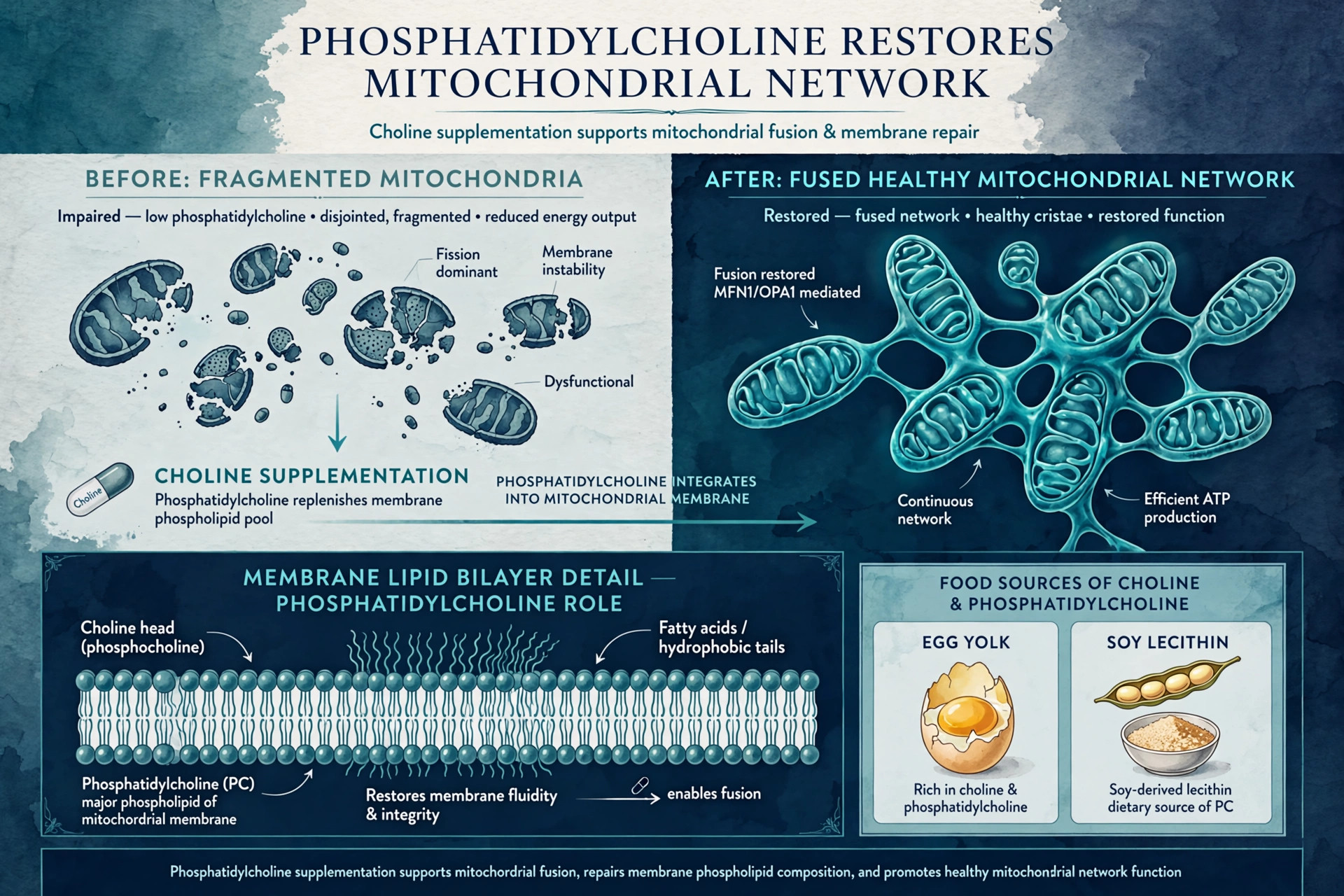
·Phosphatidylcholine (PC) makes up 40–50% of every cell membrane — and mitochondria need its flexibility to fuse into connected, energy-sharing networks. A Nature Communications study from the Leibniz Institute on Aging (Poliezhaieva et al., April 2026) finds that the enzymes making PC (SAMS-1, PMT-1/2) decline sharply with age — and that decline is itself a trigger of mitochondrial aging. Boosting PC through diet restored network integrity in aged worms within two days and reinstated metabolic resilience in human cell culture.
What the study found
In young worms, cutting the methyl donor SAM extended lifespan (classic mitohormesis). In aged animals, the same cut was catastrophic — severe fragmentation, lost respiratory capacity, shortened survival. Aging, in other words, removes the metabolic plasticity to buffer a lipid shortfall. Supplementing choline or PC directly rescued the aged phenotype.
The human signal
UK Biobank metabolomics mirrored the worm biology: PC levels decline with age in humans, and the steepest relative drop occurs in women near menopause — the same window when energy, cardiovascular risk, and metabolic complaints shift. Low PC tracked with higher blood lactate, slower walking speed, and poorer memory. These are associations, not a supplementation trial.
Food, supplements, and the TMAO caveat
The richest PC sources are egg yolks, liver, soybeans and soy lecithin, sunflower and sesame seeds, and seafood. PC is also sold as lecithin. Two cautions from the paper's coverage: whether ordinary dietary amounts offset the age-related synthesis decline is an open question, and PC metabolism interacts with gut bacteria to produce TMAO, a metabolite associated with cardiovascular risk. Doses in published studies are study doses — not dosing advice. This is a research finding to discuss with a clinician, not a prescription.
The honest limits
The reversal was shown in worms and cultured human cells; the human data are observational. No randomized trial has tested PC or choline supplementation for mitochondrial aging outcomes in people. The study's own framing is the right one: aging biology here looks malleable, which is a reason for targeted trials — not yet a reason for a supplement protocol.
Where the evidence stands
- Established: PC is the most abundant membrane phospholipid and is required for mitochondrial fusion; its synthesis enzymes decline with age across species.
- Preliminary: Restoring PC reversed mitochondrial fragmentation in aged C. elegans within 2 days and improved resilience in human cell culture (single study).
- Contested: The net cardiovascular effect of raising PC/choline intake is debated because gut-microbiome conversion to TMAO may offset benefits.
- Absent: No human RCT tests PC supplementation for mitochondrial function, energy, or longevity outcomes.