
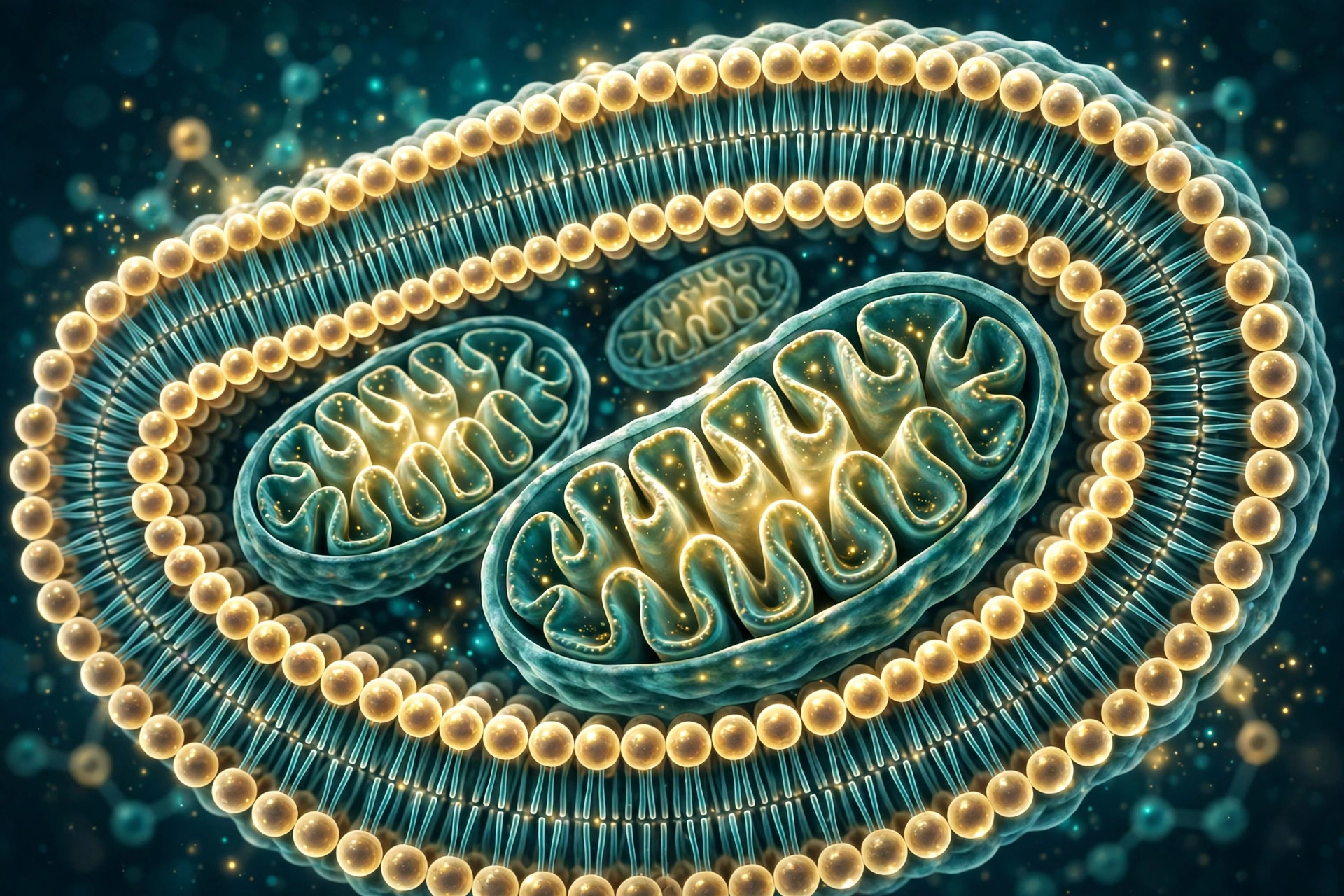
Phosphatidylcholine and mitochondrial aging: what the evidence shows
A September 22 explainer walks through one of the year's more striking membrane findings: the April 2026 Nature Communications study (Ermolaeva lab, Leibniz Institute on Aging) showing that age-related decline in phosphatidylcholine (PC) synthesis drives mitochondrial network fragmentation — and that restoring PC/choline rebuilt youthful mitochondrial structure in worms and human cell cultures within about two days. The finding connects a familiar nutrient (choline) to a precise mitochondrial mechanism.
What did the study find?
As organisms age, PC synthesis declines; mitochondrial networks fragment as a result. Supplying PC or its precursor choline restored youthful mitochondrial architecture in nematode worms and human cell cultures — fast, within roughly two days. UK Biobank data correlated the pattern in humans.
Why does phosphatidylcholine matter for mitochondria?
PC is the most abundant phospholipid in mitochondrial membranes. Membranes are not packaging — they are the machinery: cristae shape, respiratory-chain organization, and fission/fusion dynamics all depend on membrane composition. A membrane lipid that controls network structure is a mitochondrial lever by definition.
What about PPC and Plaquex protocols?
Polyenylphosphatidylcholine (PPC) IV protocols like Plaquex are an established clinical concept in membrane lipid replacement, but there is no fresh trial news on PPC in the current window — only clinic marketing and training materials. The new science is about PC biology, not a new PPC protocol.
Where does the evidence stand?
The biology is established in worms and human cells with human correlation data; dietary PC as a human anti-aging intervention has no interventional trial. Worth watching precisely because the mechanism is this specific — and worth grading honestly because the human data stop where the worm data end.
Where the evidence stands
- Established: The April 2026 paper's core finding — PC-synthesis decline driving mitochondrial fragmentation, reversible by PC/choline in worms and human cell cultures — plus UK Biobank correlation.
- Preliminary: Dietary PC/choline as a human intervention for mitochondrial aging: no interventional trial exists.
- Absent: Fresh PPC/Plaquex clinical-trial news in the current window.