
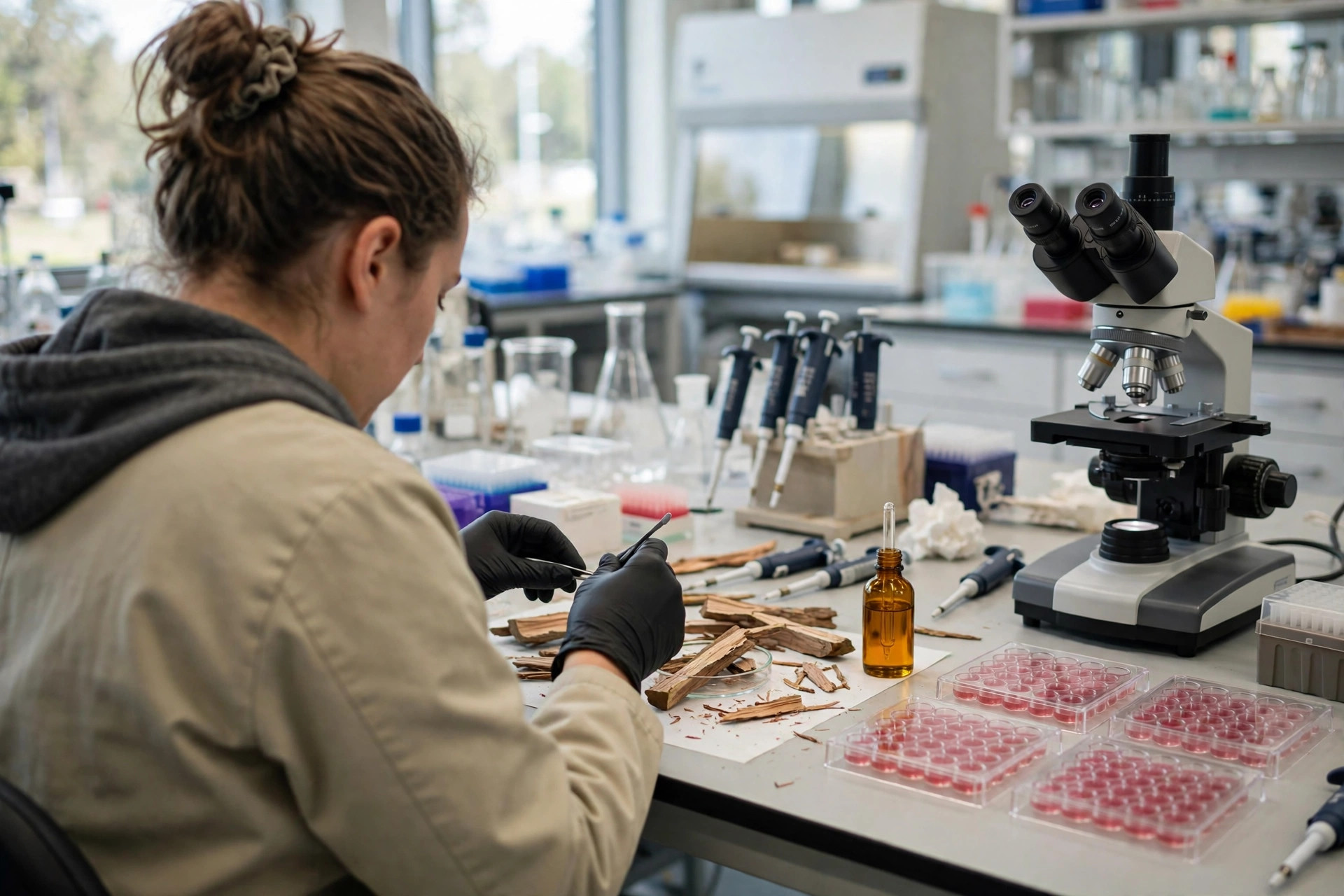
A sandalwood compound blocked colorectal cancer's spread to the lungs by driving mitochondrial cell death — in lab models
·Tip: press play, then lock your phone or switch apps — the article keeps reading.
Metastasis, not the primary tumor, is what usually makes colorectal cancer lethal, and the lungs are a common destination. Researchers at Wonkwang University in South Korea tested whether santalol — best known as the fragrance backbone of sandalwood oil — could push metastatic CRC cells into the mitochondria-mediated death program they normally evade.
What did santalol do to the cancer cells?
In metastatic CRC cell lines, santalol significantly reduced cell viability and colony-forming capacity in a dose-dependent manner. It lowered the cells' total antioxidant capacity while increasing intracellular ROS, enhanced mitochondrial depolarization, and induced mitochondria-mediated apoptosis by regulating caspases and PARP — the execution machinery of programmed cell death.
Did it hold up in a living animal?
Yes, at the preclinical level: in an in vivo murine model, santalol restricted the pulmonary dissemination of CRC cells — fewer cancer cells successfully colonized the lungs. That combination (a defined mitochondrial mechanism in cells plus an anti-metastatic signal in mice) is what makes the paper worth covering rather than filing under fragrance folklore.
Why is sandalwood oil not a cancer treatment?
Because everything shown here is cells and mice, at laboratory exposures, with no human pharmacokinetics, dosing, safety or efficacy data — and ROS-raising strategies can harm healthy cells as readily as cancer cells. Santalol is a candidate molecule with a plausible mechanism, not a therapy; anyone marketing sandalwood products against cancer is running far ahead of this evidence.
Where the evidence stands
- Established: Metastatic colorectal cancer is frequently lethal, the lungs are a common metastatic site, and mitochondrial apoptosis evasion is a core cancer survival strategy.
- Preliminary: In metastatic CRC cell lines and a mouse model (Antioxidants, Oct 21, 2026), santalol reduced viability and clonogenicity dose-dependently, raised ROS, depolarized mitochondria, activated caspase/PARP-mediated apoptosis, and restricted pulmonary dissemination in vivo.
- Absent: Human data of any kind — pharmacokinetics, safety, dosing or efficacy — for santalol in colorectal cancer.
Join the discussion
To get the conversation started: What questions does this story raise for you? Share them below — every comment is reviewed by our moderators before it appears.
Community discussion only — not medical advice. Every comment is reviewed by our moderators before it appears. Sign in with Google or a free Hyvor account to join in.