
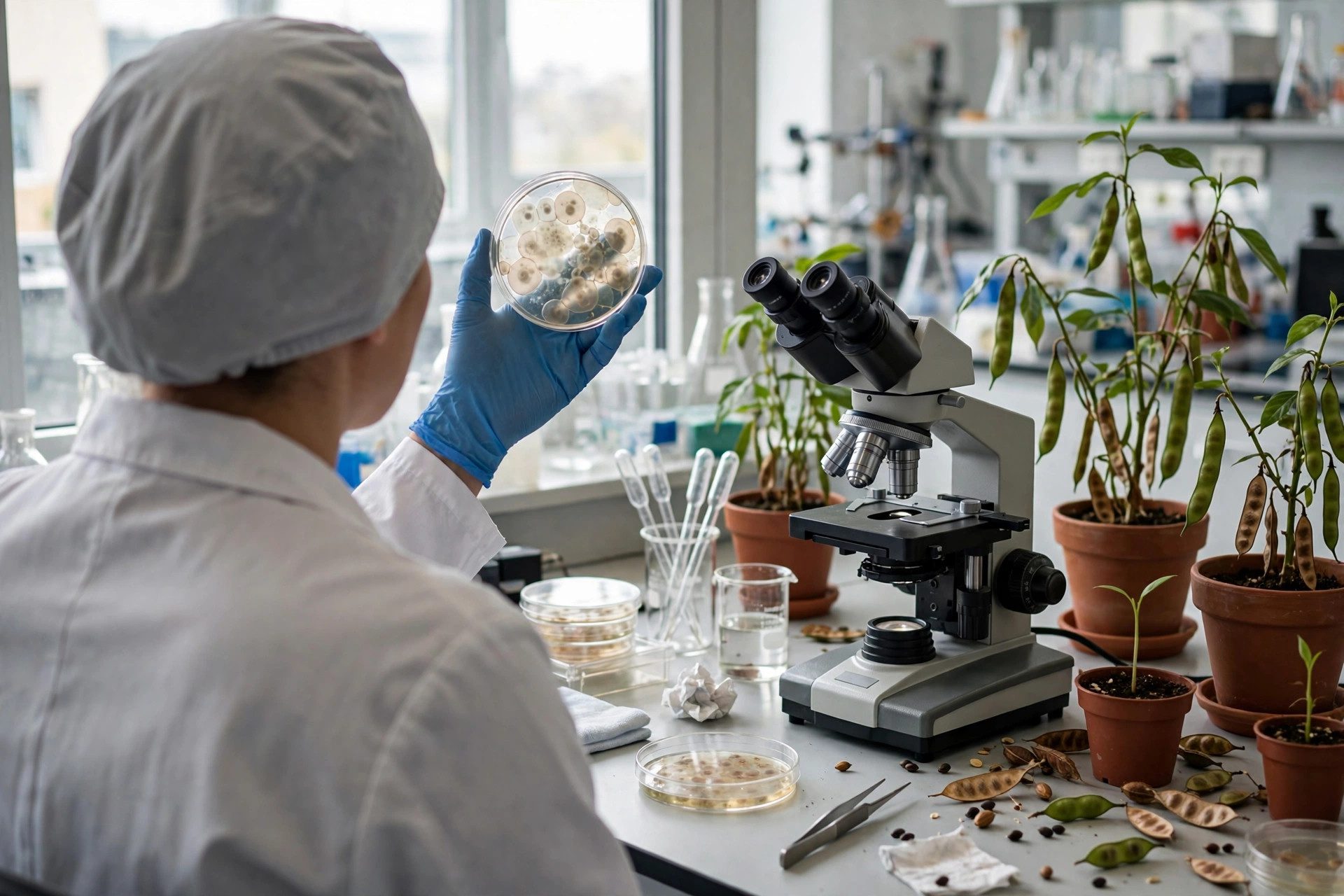
A plant sterol in nuts and seeds disrupts glioblastoma mitochondria — in lab models
·Tip: press play, then lock your phone or switch apps — the article keeps reading.
Glioblastoma's median survival is still measured in months, and its cells survive by rewiring their metabolism. A study in BMC Cancer by Gao, Yun and Liang (Department of Neurosurgery, First Affiliated Hospital of Xi'an Jiaotong University) tested whether stigmasterol — a phytosterol eaten routinely in plant foods — could attack that rewiring at the mitochondria.
What did stigmasterol do to tumor mitochondria?
In human glioblastoma cells (U87-MG, validated in U251) stigmasterol reduced the cells' ability to form colonies, and in U87-MG xenografts it significantly inhibited tumor growth. Inside the cells, mitochondrial membrane potential fell, complex I activity dropped, and mitochondrial reactive oxygen species accumulated — simultaneous energy failure and oxidative stress. Gene-expression profiling showed the TCA-cycle enzyme ACO2 and the fatty-acid gene HACD2 switched down.
What is the NDUFA4L2 escape hatch?
One gene switched up: NDUFA4L2, a complex I modulator involved in redox balance. When the researchers silenced it, complex I activity partially recovered yet ROS rose further and stigmasterol's colony suppression grew stronger — evidence that NDUFA4L2 is a compensatory shield the tumor raises against mitochondrial stress, and that blocking the shield could deepen the attack. That makes mitochondrial metabolic adaptation itself, not just the sterol, the study's therapeutic point.
Why is this not a reason to self-treat with supplements?
Because none of the patient questions are answered: the work is cell culture and animal xenografts, with no human pharmacokinetics, bioavailability or safety data, and the blood-brain barrier — the obstacle that defeats most brain-tumor drugs — untested. Dietary stigmasterol intake is not equivalent to experimental dosing, and glioblastoma patients should not read a preclinical proof of concept as a treatment lead outside trials. (A separate glioblastoma-mitochondria study, on dual compounds acting through p62, was covered here on October 17; this is a different compound and mechanism.)
Where the evidence stands
- Established: Glioblastoma cells rewire mitochondrial metabolism to survive hypoxia and fuel growth, and mitochondrial dysfunction plus oxidative stress can kill tumor cells in preclinical models.
- Preliminary: In glioblastoma cell lines and a mouse xenograft model (BMC Cancer, 2026), stigmasterol inhibited tumor growth, reduced mitochondrial membrane potential and complex I activity, raised mitochondrial ROS, and induced an NDUFA4L2 adaptive response whose silencing enhanced the effect.
- Absent: Human pharmacokinetics, bioavailability, blood-brain barrier penetration, safety and any clinical efficacy for stigmasterol in glioblastoma.
Join the discussion
To get the conversation started: What questions does this story raise for you? Share them below — every comment is reviewed by our moderators before it appears.
Community discussion only — not medical advice. Every comment is reviewed by our moderators before it appears. Sign in with Google or a free Hyvor account to join in.