
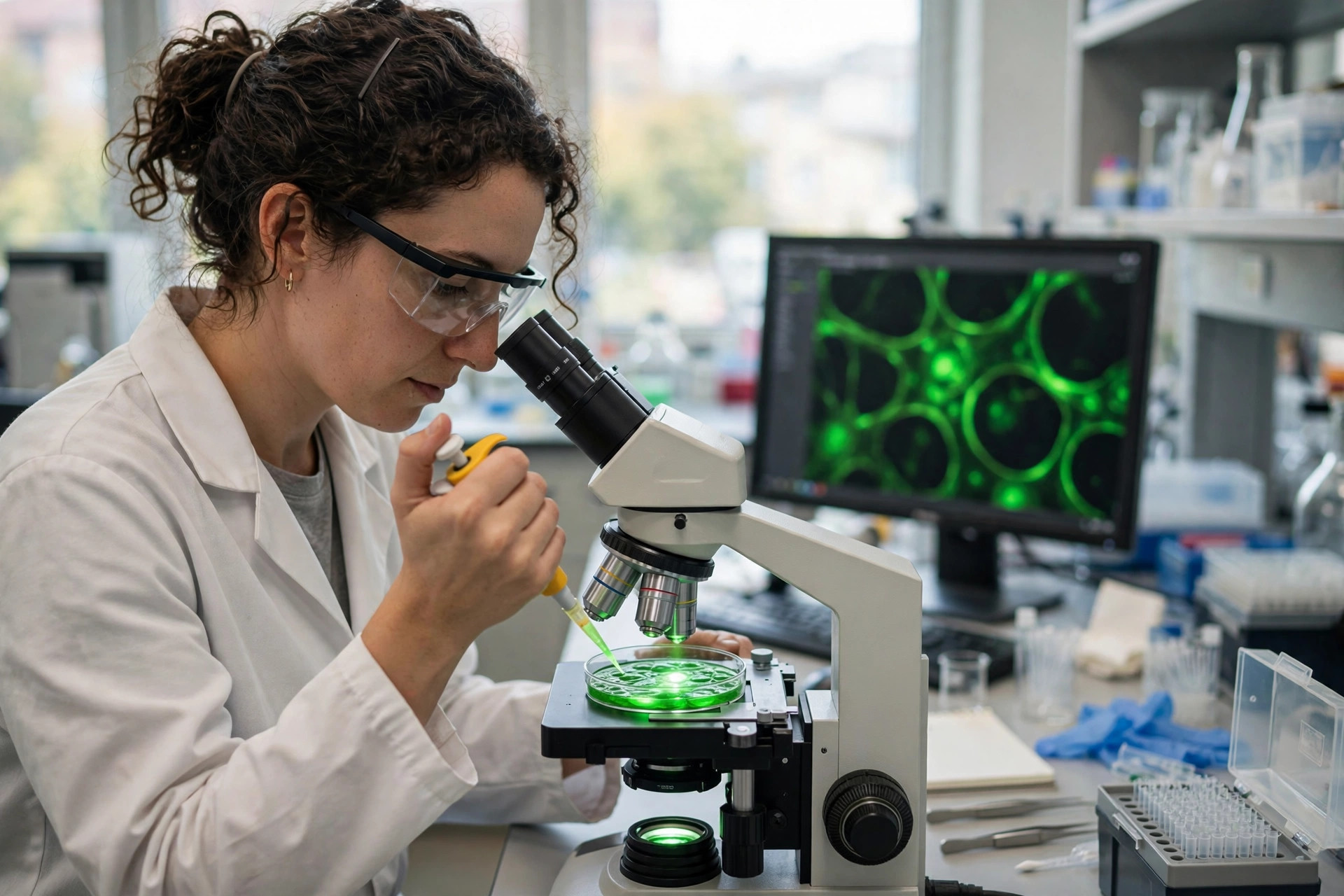
Transplanted healthy mitochondria took up residence in MELAS cells and restored their energy — in lab-grown cells
Edited by Samael A. Tejada, Founder & Editor-in-Chief
·Tip: press play, then lock your phone or switch apps — the article keeps reading.
Organelle transplantation sounds like science fiction until a paper shows the transplanted organelles unpacking, switching on their own genes, diluting the mutant genomes and staying. This study does the careful version of that demonstration — including the controls that prove intact, healthy mitochondria, and nothing less, did the work. It is a mechanism in a dish, and an unusually complete one.
What did the transplanted mitochondria actually do inside MELAS cells?
The team added healthy donor mitochondria to MELAS endothelial cells — the cells lining blood vessels, a cell type central to MELAS's stroke-like episodes — and tracked what happened. The recipient cells took the mitochondria up, and the donor mitochondrial genes were expressed, meaning the transplants were not merely present but working. Metabolic and functional improvements appeared at early time points and persisted at prolonged ones. Critically, the retained healthy mitochondria decreased the recipient cells' heteroplasmy — the proportion of mutant mitochondrial DNA — shifting the genetic balance of the cells toward the healthy genome, which is the deepest change a therapy for a mitochondrial-genome disease could aim for.
Why do the control experiments matter so much here?
Mitotherapy claims invite an obvious objection: perhaps any cellular debris, or the act of treatment itself, perks cells up. This study ran the two controls that answer it. MELAS cells treated with mutant mitochondria — organelles carrying the disease genome — did not show the same improvements, and neither did cells treated with healthy mitochondria that had been sonicated, physically destroyed before delivery. Only intact, healthy, functioning mitochondria produced the sustained rescue. That pattern is what separates a biological mechanism from a handling artifact, and it also sets a hard engineering requirement for any future therapy: the organelles must arrive alive and whole.
What is the protein-translation finding, and what are the limits?
Transcriptomic analysis offered a route for how better energetics becomes better cell function: the treated cells upregulated their translation machinery, potentially counteracting the translational deficiencies characteristic of MELAS, in which faulty mitochondrial gene expression leaves cells short of correctly made proteins. The limits are the standard ones, stated plainly: these are cultured endothelial cells, not a blood vessel, a brain, or a person. Delivery to tissues, immune reactions to donor organelles, dosing, durability in a living body and safety all remain unaddressed, and no human being has received mitochondria transplantation for MELAS. What the paper contributes is the mechanistic foundation — proof in vitro that transplanted mitochondria integrate selectively, persist, lower mutant load and restore function — on which any serious translational attempt would have to build.
Frequently asked questions
What is mitotherapy?
The transfer of healthy donor mitochondria into diseased recipient cells. In this study, MELAS endothelial cells took up healthy mitochondria, expressed the donor genes, and improved metabolically and functionally.
What is heteroplasmy, and why does lowering it matter?
Heteroplasmy is the share of mutant mitochondrial DNA within a cell. Disease severity in mitochondrial-genome disorders tracks that share, so the transplanted healthy mitochondria reducing it means the cells' genetic balance shifted toward healthy.
Is mitochondria transplantation a treatment patients can get for MELAS?
No. This is an in-vitro study in cultured cells. Delivery, safety and efficacy in a living person have not been tested.
Where the evidence stands
- Established: MELAS is caused by mitochondrial-genome mutations that impair respiration and ATP generation; cells carry a mixture of mutant and healthy mtDNA (heteroplasmy) whose balance shapes disease severity; and transfer of healthy mitochondria into cells ('mitotherapy') can boost recipient metabolism.
- Preliminary: In cultured MELAS endothelial cells (Cell Death Discovery, Oct 30, 2026; DOI 10.1038/s41420-026-03421-3), healthy donor mitochondria were taken up, expressed their genes, durably improved metabolism and function and reduced heteroplasmy, with upregulated protein translation — effects absent with mutant or sonicated mitochondria.
- Absent: Any in-vivo or human evidence — delivery, safety, durability and efficacy of mitochondria transplantation in a living patient are all untested for MELAS.
Join the discussion
To get the conversation started: What questions does this story raise for you? Share them below — every comment is reviewed by our moderators before it appears.
Community discussion only — not medical advice. Every comment is reviewed by our moderators before it appears. Sign in with Google or a free Hyvor account to join in.