
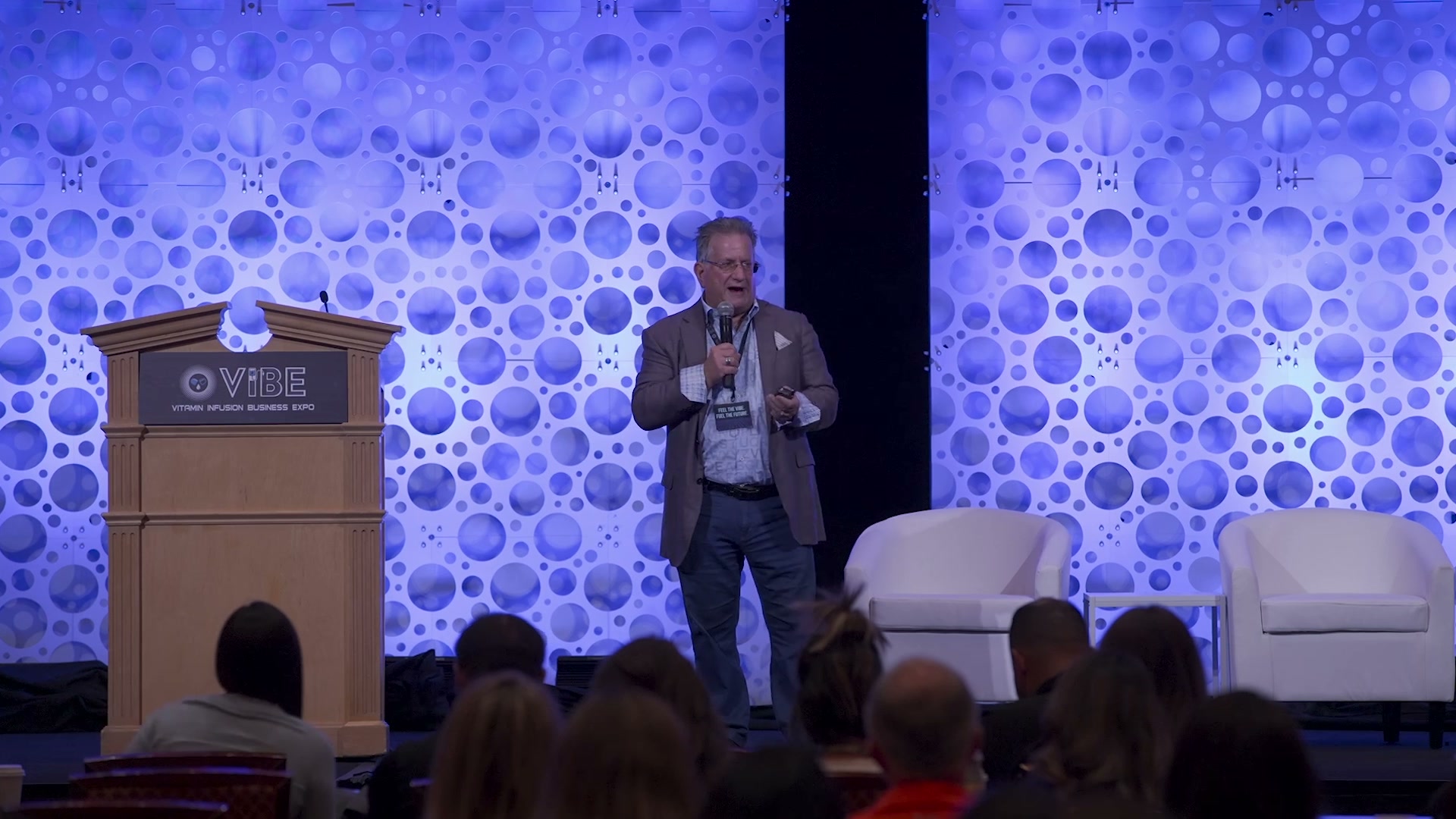
Photo: Vibe Expo 2026
"Stage Zero": Dr. Mitch Ghen Brought His Circulating-Tumor-Cell Case to Vibe Expo 2026
·Tip: press play, then lock your phone or switch apps — the article keeps reading.
The introduction was personal before it was clinical. Tejada, founder of Liquivida and host of the conference session, told the room his own start in longevity medicine came at 19, under Dr. Robert Willix, the former heart surgeon who left the operating room for prevention and became a founding partner at Cenegenics, where he worked with its founder, Dr. Alan Mintz. Ghen knew Willix. "This is someone that I would consider a very close mentor," Tejada said, crediting Ghen's IV-therapy courses — taken two decades ago, when a seminar might draw ten people — and his textbooks. Then came the hook: "What if I were to tell you that there's a blood test that can basically diagnose someone with stage zero cancer?"
Ghen, a DO with a PhD in nutrition and psychoneuroimmunology and more than four decades in integrative and anti-aging medicine, opened with a joke — he'd always assumed "OG" meant "old guy" — and then delivered what he called the bad news. He asked the audience to look at the person on their right and their left: "Everyone that you saw either has cancer now or will be getting cancer." Cancer, he said, takes 15 to 20 years to grow, and the survival statistics patients are quoted are skewed by lead-time bias, overdiagnosis bias and death-certificate bias. His lifetime-risk figures (roughly 40% for men and women) are in line with American Cancer Society estimates. His five-year survival figures — about 69% at stage one, about 35% once metastatic, as he stated them — were offered as proof the numbers themselves can't be trusted at face value.
The case he built
Ghen's core argument is about timing. A tumor typically isn't visible on MRI, CT or ultrasound until it reaches about a centimeter — already, he noted, more than a billion cells. "That is a late start to begin with." Worse, he argued, tumors shed cells into the bloodstream long before they can be imaged. He told the room he had diagnosed his own father with prostate cancer; the tumor was removed by a top team at Mayo, and 30 years later the disease was in his father's bones.
Those shed cells — circulating tumor cells, or CTCs — sat at the center of the talk. Only a tiny fraction of a tumor (0.01% to 0.001%, he said) can reproduce itself, but detached cells that survive are dangerous: normal detached cells are destroyed by a process called anoikis, while cancer cells can block it. The surviving CTC, he said, "actually is the mama" — able to lie quiet for months or years, and responsible, in his telling, for more than 90% of cancer deaths.
Where mitochondria come in — he went there himself
This was not a mitochondria talk with a cancer segment bolted on. Ghen structured cancer causation into three buckets: inherited genetics (5–10%, he said), virus-induced cancers such as EBV- and HPV-related disease (about 10%), and "the biggest category, which is mitochondrial failure" — roughly 85% of cancers, in his model. A cell that can't make its own energy, he argued, either dies or switches fuel — the Warburg effect — burning sugar, then glutamine, then fat. The root cause is cumulative toxic burden: "The more allostatic loading you have, the more likely the mitochondria will fail." Toxic metals, nanoplastics and mycotoxins were his named drivers, and he was blunt that regenerative therapies won't rescue the situation if the burden isn't addressed: you can give as much stem cell as you want, he said, and "you will not change the outcome."
That 85% figure is Dr. Ghen's position, drawn from the metabolic theory of cancer — a real, debated scientific framework, but not the mainstream consensus, which treats most cancers as driven primarily by accumulated genetic mutations, with metabolic reprogramming as a hallmark rather than the root cause. Read it as his argument, not an established statistic.
What RGCC testing is
Ghen disclosed on stage that he is a spokesperson for RGCC (Research Genetic Cancer Centre); its laboratory work, he said, is done in Greece from a blood draw — a "liquid biopsy." RGCC's published test menu includes CTC enumeration and phenotyping (Oncotrace), and chemosensitivity panels (Onconomics and Onconomics Plus) that expose a patient's isolated circulating tumor cells to chemotherapeutic agents, targeted drugs and natural substances in the lab and report which ones kill the cells. As Ghen described it to the room: tell the lab the cancer type, and "they'll take 46 nutrients and plate them," reporting how much kill each produced — vitamin C and vitamin D among them — so a clinic can choose accordingly. He also described a 90-gene expression test for people without a diagnosis, reporting whether transcription-factor patterns suggest a proclivity toward cancer; he claimed four or five of every ten people tested will show "something could be coming" within two to four years.
His recommendations were sweeping: screen everyone in the room, screen "every single one of your patients," and treat a patient as not healthy "until you can prove there are no circulating tumor cells." He dismissed DNA-based liquid biopsies and EpCAM-based tests such as Maintrac, presented RGCC's negative-selection method as the only real option, and made his most contested claim: that chemotherapy, targeted therapy and immunotherapy do not kill circulating tumor cells, that chemotherapy makes them "more hardy," and that laboratories obtain CTCs by exposing tumors to cytotoxic chemotherapy, which sheds them within one to two weeks.
The takeaway
Ghen closed the way he opened, with good news and bad news — this time a joke about two 95-year-old baseball fans, one of whom returns from heaven reporting fields that are always lit and baseball 24 hours a day. The bad news: "You're pitching next Wednesday."
Strip away the salesmanship — and there was some, aimed at clinic owners in the room — and the talk posed a question worth taking seriously: if cancers shed detectable cells years before a scan can see them, what should medicine do with that information? Dr. Ghen's answer is a specific company's test, offered to everyone, interpreted through a metabolic lens. The evidence supports a narrower conclusion: the biology he described is real, the testing is commercially available and scientifically interesting, and his strongest claims await the prospective trials guidelines require. That gap — between a compelling stage presentation and proven clinical utility — is where patients should ask their oncologist, not their conference badge, for guidance.
Disclosure: Dr. Ghen stated on stage that he is a spokesperson for RGCC. This article is event coverage, not medical advice.
Where the evidence stands
- Established: Circulating tumor cells are real, and CTC counts are prognostic: higher counts track with worse outcomes across many cancers in large meta-analyses. Ghen's detection-lag point is also sound: imaging finds tumors late relative to their biology, and metastasis, not primary tumors, accounts for the great majority of cancer deaths.
- Preliminary: Chemosensitivity profiling — testing a patient's own cancer cells against drugs and natural substances in a dish — is an appealing idea with decades of research behind it, but evidence that choosing treatment this way improves outcomes remains thin. RGCC points to a retrospective analysis in ovarian cancer suggesting CTC-guided choices extended time on treatment; retrospective, company-announced results are hypothesis-generating, not proof.
- Contested / not guideline-supported: The American Society of Clinical Oncology's guideline update on chemotherapy sensitivity and resistance assays concluded that no assay had sufficient evidence for use in practice and that their use to select chemotherapy for individual patients "is not recommended outside of the clinical trial setting." No major guideline body recommends screening all asymptomatic patients with CTC tests, and the claim that chemotherapy cannot kill circulating tumor cells — and instead makes them hardier — goes beyond what clinical evidence supports; treatment-induced shedding is a documented research phenomenon, not evidence that standard therapy worsens outcomes. Patients should not delay or decline standard oncology care based on a conference presentation — including this one.
Join the discussion
To get the conversation started: What questions does this story raise for you? Share them below — every comment is reviewed by our moderators before it appears.
Community discussion only — not medical advice. Every comment is reviewed by our moderators before it appears. Sign in with Google or a free Hyvor account to join in.