Synapsin Nasal Spray, Explained: Rg3, NAD+, and the Road From Nose to Brain
Edited by Samael A. Tejada, Founder & Editor-in-Chief
·Tip: press play, then lock your phone or switch apps — the article keeps reading.
The short answer: Synapsin is a prescription-only compounded nasal spray built around ginsenoside Rg3 — a rare molecule from Panax ginseng — typically blended with nicotinamide riboside (NR), the NAD+ precursor. The idea is genuinely clever: Rg3 is absorbed terribly by mouth (about 2.6% bioavailable in animal studies), so spraying it up the nose aims it at the brain along the olfactory and trigeminal pathways instead, while the NR half feeds the NAD+ system your mitochondria run on. The underlying science is real but early: Rg3 calms over-activated microglia and protects neurons in cell and rodent studies, and NR reliably raises NAD+ in human blood. What does not exist — anywhere — is a single published human trial of the spray itself, or of Rg3 for cognition, focus, or energy. This guide walks through what is established, what is plausible, what is marketing, and the questions worth asking before you spend money on it.
What is Synapsin, exactly?
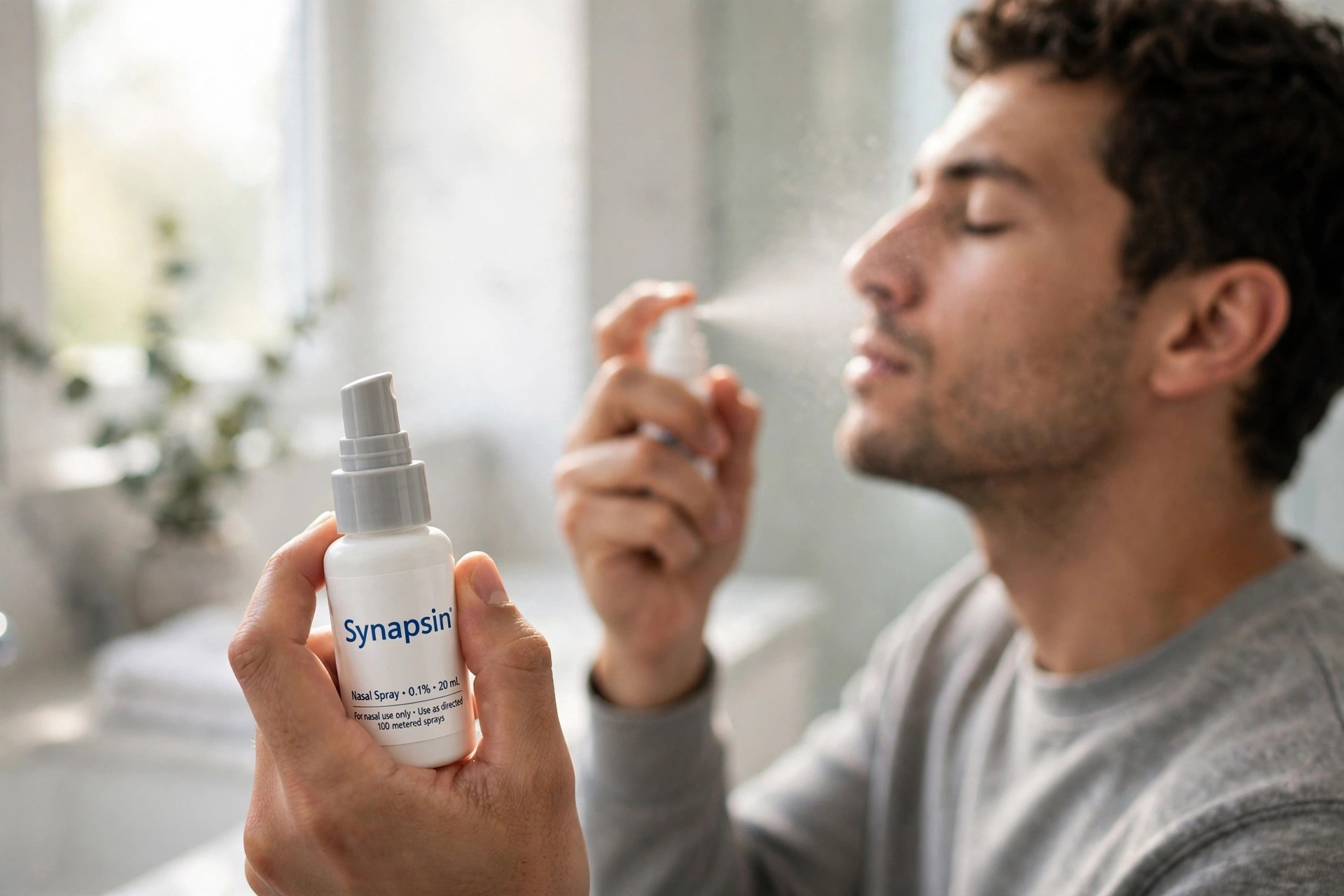
Synapsin is not a brand-name drug you can buy off a shelf. It is a compounded preparation — made to order by a compounding pharmacy against a prescription — whose core formula is a powder blend of ginsenoside Rg3 and nicotinamide riboside, reconstituted for intranasal use. Compounding-pharmacy literature describes it as “an innovative, patent-pending powder blend of ginsenoside Rg3 and nicotinamide riboside along with components to aid in solubilization and dispersion,” notes that it must be refrigerated (the NR is the fragile part), and states plainly that preparations require a prescription. It is not FDA-approved as a finished product — no compounded product is — and we will come back to what that does and does not mean.
Two cautions about the name itself. First, “Synapsin” on different pharmacy labels may not be the same product. Some pharmacies compound the spray with methylcobalamin (vitamin B12) added; at least one pharmacy network describes a version paired with ultra-low-dose naltrexone; the originator materials describe Rg3 + NR and nothing else. Second, the spray’s Rg3 concentration is not standardized across the industry, and the best-known source, PD Labs of Cedar Park, Texas, does not publish its concentration, dose per spray, or dosing schedule on its product page at all. A comparable European Rg3 nasal spray lists 2.24 mg of Rg3 across a full day’s eight sprays — a useful sense of scale, and a reminder of how small these doses are next to the 40 mg a day used in oral Rg3 cancer trials.
Why put it up the nose? The oral problem is real — and measured
If you swallow Rg3, almost none of it reaches your blood. In rat studies, an oral dose of Rg3 showed an absolute bioavailability of 2.63%; in another rat study, Rg3 given orally at 100 mg/kg was not detectable in plasma at all, because gut bacteria strip its sugar groups and convert it to other compounds (Rh2, then protopanaxadiol) before it can be absorbed. An early human study of oral Rg3 found peak blood levels around 15 nanograms per milliliter — homeopathic-looking numbers for a molecule with real pharmacology. A 2025 review in Pharmacological Research states the field’s consensus flatly: Rg3’s “poor water solubility and low permeability result in limited bioavailability, restricting its clinical application.” An entire sub-industry of liposomes, nanoparticles, and micelles exists to work around this.
The nose offers a theoretical shortcut. The upper nasal cavity is the only place in the body where the central nervous system nearly touches the outside air: olfactory and trigeminal nerve fibers run from the nasal lining toward the brain, and substances applied intranasally can travel along the perineural and perivascular spaces around those nerves, bypassing the blood-brain barrier. This is established science — Established for the pathway itself, demonstrated in animal tracer studies (Lochhead and Thorne’s work is the standard reference) and exploited by approved intranasal drugs. But two honest qualifications belong here:
- The nose-to-brain evidence is built mostly on tracers and proteins in rodents and primates. The fractions that reach the brain are small, and results depend heavily on depositing the dose high in the nose, near the olfactory region — not where an ordinary spray pump puts most of it.
- No published pharmacokinetic study of intranasal Rg3 exists — in animals or humans. Nobody has yet measured how much Rg3 from a spray like this reaches the brain, the blood, or anywhere else. The route is a rational bet, not a demonstrated delivery.
How Rg3 is proposed to work in the brain
The spray’s rationale, as laid out in the originator’s own patent filing, centers on microglia — the brain’s resident immune cells. When microglia over-activate (after concussion, in neuroinflammatory states, in Alzheimer’s models), they pour out TNF-α and other inflammatory signals that damage the neurons around them. Rg3’s best-documented effects push in the opposite direction:
- Microglial calming — Preliminary. In BV-2 microglial cells activated by amyloid-beta, Rg3 suppressed NF-κB binding, cut TNF-α expression, increased a scavenger receptor (MSRA) associated with clearing debris, and neurons pre-treated with Rg3 survived TNF-α exposure better (Joo et al., 2008). Related work showed Rg3 and its metabolite Rh2 dampening inflammatory signaling in stimulated microglia. In live mice, oral 20(S)-Rg3 at 20–30 mg/kg reduced TNF-α, IL-1β, IL-6, iNOS, and COX-2 in an inflammation model, an effect attributed to suppressed microglial activation — and in a 2024 mouse study, Rg3 reduced neuroinflammation and hippocampal damage after traumatic brain injury via the SIRT1/NF-κB pathway. Consistent, mechanistically coherent — and entirely preclinical, at doses and by routes that do not map cleanly onto a ~2 mg/day nasal spray.
- Glutamate/NMDA modulation — Preliminary. Rg3 attenuates NMDA receptor-mediated currents and NMDA-driven neurotoxicity in cell studies (the finding dates to Kim et al., 2004, and is cited in the spray’s patent filing). Excess glutamate signaling is a plausible contributor to the “wired but foggy” state after brain injury and in neurodegeneration; a molecule that turns that volume down without shutting signaling off would be valuable. No human study has tested whether Rg3 does this in a person.
- Synaptic protection — Preliminary. Researchers at Columbia identified (20S)-Rg3 as an activator of the enzyme PI4KIIα, which restores a membrane lipid (PI(4,5)P2) that amyloid-beta depletes; Rg3 treatment reversed synaptic and memory deficits in an Alzheimer’s mouse model. Elegant mechanism, animal data.
- Antioxidant action — Preliminary. Reviews of Rg3’s pharmacology describe Nrf2-pathway activation, increased antioxidant enzymes, and reduced oxidative damage across many models — again, preclinical.
- Lysosomal repair — Extrapolated. Our news desk covered a November 2026 Aging Cell study in which Rg3 restored lysosomal “recycling” and extended lifespan and function in C. elegans worms. It is a genuinely interesting result about cellular housekeeping — in a worm, at the whole-organism level, with no direct line to a human nasal spray.
The mitochondria connection — the honest version
This is a mitochondria publication, so here is the part we care most about getting right. The claim you will see in marketing — “supports healthy mitochondrial function” — rests on two separate legs, and they are not equally strong.
Leg one: the NR half. Established pharmacology, Preliminary outcomes. Nicotinamide riboside is a precursor to NAD+, the coenzyme your mitochondria need to turn food into ATP and that sirtuin enzymes (SIRT1, SIRT3) use to run mitochondrial maintenance. In the first human NR trial (Trammell et al., 2016), single oral doses raised the blood NAD+ metabolome dose-dependently; in a six-week trial (Martens et al., 2018), 500 mg twice daily raised NAD+ in blood cells by about 60% and was well tolerated. Raising NAD+ in humans: established. That doing so improves cognition or energy in healthy people: not yet shown. And every one of those trials used oral NR — there are no human data on intranasal NR at all.
Leg two: the ginseng half. Extrapolated. Red ginseng extract — a mixture of many ginsenosides, of which Rg3 is one — improved exercise endurance in mice by roughly 30% while switching on the AMPK/PGC-1α program that builds new mitochondria, and improved muscle mitochondrial measures in a mouse chronic-fatigue model. 20(R)-Rg3 alone has shown anti-fatigue effects in rodents on blood biomarkers. But an extract is not Rg3, a mouse is not a person, and a swallowed gram-scale extract dose is not a milligram-scale nasal one. There is no study — none — of intranasal Rg3 and mitochondria.
Synthesis: the mitochondria claim for this spray is a two-step inference across species, formulations, and routes. It is not nonsense; the ingredients point in a coherent direction. It is also not evidence about the product in anyone’s medicine cabinet. On our labels, that is Extrapolated.
What the human evidence actually shows
Here is the part of the story most marketing leaves out. Rg3 does have a real human track record — in China, by mouth, for cancer. Purified Rg3 (brand name Shenyi) is approved there as an adjuvant cancer therapy, typically 20 mg twice daily. A randomized, double-blind, placebo-controlled phase 3 trial enrolled 480 liver-cancer patients after curative resection to test whether Rg3 prevented recurrence. Meta-analyses of Rg3 combined with chemotherapy (18 trials, 1,531 patients in one 2019 analysis) found improved tumor response rates and fewer blood and GI side effects than chemotherapy alone. A 2025 overview of those reviews adds the necessary cold water: none of the systematic reviews rated high-quality, bias risk was high, and the underlying evidence graded out mostly low to very low. What this literature genuinely establishes is narrower and still useful: oral Rg3 at 40 mg/day has been taken by large numbers of patients with a generally acceptable tolerability record — dry mouth and throat among the tracked complaints. Human safety exposure: real. Human efficacy for the brain: untested.
For cognition, focus, fatigue, concussion recovery, or neuroprotection — the uses Synapsin is actually prescribed for — the human evidence base is empty. As of this writing there is no published clinical trial of the Synapsin spray, no trial of intranasal Rg3 for any condition, and no trial of Rg3 (any route) for a brain outcome. Anyone who tells you the spray is “clinically proven” for brain fog or focus is describing cell cultures and mice. The experiences of long-term users — including clinicians who prescribe it and patients who swear by it — are anecdotes: sometimes the first signal of something real, never a substitute for a trial.
Who invented it? Two claims, one document
Dr. James LaValle — pharmacist, clinician, and a guest on our podcast — says he invented the spray, and the paper trail is unusually good for a claim like this. A published international patent application, WO2016122832A1, names James B. LaValle as sole inventor and his company, Natural Formulations, as assignee; filed in January 2016, it covers exactly this combination — ginsenoside Rg3 plus nicotinamide riboside, explicitly including intranasal formulations — for microglia-driven inflammation, neurodegenerative disease, and brain injury. LaValle’s own account, given on the Flex Diet Podcast, is that he developed the Rg3 spray while working with Corvette Racing drivers, whose core temperatures rose and reflexes slowed in the car; he and Dr. Andy Heyman sprayed drivers before races, and a tablet version came later. Pharmacy pages across the compounding industry repeat the same credit line — “Synapsin was invented by Jim LaValle” — and the phrase traces back through the ingredient’s own distribution channel.
Three qualifications keep this honest. First, LaValle’s application never became a granted U.S. patent on the public record — the application family is listed as “ceased,” with no entry into national phases; “patent-pending,” the phrase in period marketing, was accurate while it lasted. Second, PD Labs claims the opposite on its product page — that it “developed and patented the original RG3 nasal spray” and holds “the use patent” — yet publishes no patent number, and no patent naming PD Labs or its founder was found in patent-database searches for this article. (The two camps are not strangers: PD Labs’ founder Ray Solano has hosted LaValle on his radio show to discuss Synapsin, with LaValle presented as its originator. A fair reading is inventor versus early commercial compounder — but neither side says it that way.) Third, the more colorful detail — that the NFL hired LaValle to run a concussion-recovery facility for players — circulates in pharmacy blogs recounting his interviews; we could not independently verify it. Bottom line: the inventor claim is supported by a primary document, which is more than most supplement-origin stories can say — and the “patented” language used by everyone in this market overstates what the record shows.
What PD Labs says — and what it doesn’t say
Because PD Labs is the name most associated with this spray in the U.S., its page deserves a direct read. What PD Labs claims: it developed and patented the original RG3 spray, was first to the formulation, holds a use patent, and hears from practitioners and patients that “they can tell the difference.” Its listed practitioner-use areas are mild cognitive impairment, post-concussion support, neuroinflammatory conditions, chronic fatigue, and age-related cognitive change, under an educational disclaimer.
What PD Labs does not publish on that page: any citation to any study; the Rg3 concentration; the NR amount; the dose per spray or per day; potency or third-party testing results; or the patent number behind its patent claim. That is not an accusation — compounding pharmacies are not required to market like drug companies — but it means a patient cannot verify from the source what is actually in the bottle, and should ask the pharmacy directly (see the checklist below).
One further fact belongs in any complete account, stated neutrally: in a July 30, 2019 warning letter, the FDA told PD Labs that drug products it compounded using bulk nicotinamide riboside chloride and Panax ginseng (RG3) were not eligible under the section 503A compounding exemptions, because those substances had no USP/NF monograph, were not components of FDA-approved drugs, and were not on FDA’s 503A bulks list (the letter notes they had not been nominated for it). FDA’s position was that such products were unapproved new drugs; the letter also records that PD Labs stated it would continue compounding both substances. A warning letter is an enforcement position, not a court judgment, and it is now years old — but it is a primary regulatory document naming both of this spray’s active ingredients, and it is the clearest illustration of what “compounded, not FDA-approved” concretely means in this market.
Safety, and who should be cautious
- Rg3, oral: generally well tolerated in the Chinese cancer-trial literature at 40 mg/day; mild effects such as dry mouth/throat were tracked. That record is for oral dosing in a different population — reassuring about the molecule, silent about the spray.
- The spray itself: no published tolerability data. Any chronically used nasal product can irritate the nasal lining or cause nosebleeds; that is a class-level statement, not Synapsin-specific data.
- Bleeding medications — talk to your clinician first: ginsenosides can reduce platelet aggregation in laboratory studies, and standard interaction references advise caution combining ginseng products with anticoagulants and antiplatelet drugs (warfarin, clopidogrel, aspirin therapy, DOACs). The warfarin literature is actually contradictory — a case report of reduced effect, a small trial of a related ginseng showing reduced effect in the other direction — which is precisely why this belongs in a medication review rather than self-experimentation.
- Diabetes medications: ginseng-family products can lower blood sugar and may add to hypoglycemic drugs.
- Pregnancy and breastfeeding: no safety data; ginseng products are generally advised against.
- Surgery: disclose any ginseng product to your surgical team; many advise stopping such products beforehand because of the bleeding and blood-sugar questions above.
- NR: well tolerated in human trials at supplement doses, with mild GI effects the most common complaint.
Questions worth asking before you use it
- What exactly is in my bottle? Which actives (Rg3 + NR only, or methylcobalamin/naltrexone added), and what is the Rg3 concentration per spray?
- Which Rg3? The research literature splits between the 20(S) and 20(R) forms, which behave differently; the inventor’s filing prefers 20(R). Ask which epimer your pharmacy uses.
- How was potency verified? Is there a certificate of analysis for the batch — identity and potency testing on the Rg3 raw material and the finished spray?
- What outcome are we measuring, and by when? Focus and energy are easy to imagine improving. Agree on a concrete marker (a symptom scale, sleep or cognitive testing, a simple daily rating) and a stop date if it is not working.
- What does it interact with in my current regimen? Bring the full medication and supplement list — especially blood thinners, diabetes drugs, and stimulants.
- What does it cost, and what is the beyond-use date and storage? Compounded sprays commonly run $100–$300 a month, are prescription-only, and the NR component is why refrigeration is specified.
This article is educational and is not medical advice. Synapsin is a prescription compounded product whose brain-related uses rest on preclinical evidence; whether it belongs in your regimen is a decision for you and your own clinician.
Frequently asked questions
Is Synapsin FDA-approved?
No. It is a compounded preparation made by a pharmacy from bulk ingredients; compounded products are not FDA-approved as finished products, and FDA does not verify their safety or effectiveness before they are dispensed. In 2019 the FDA specifically told the spray's best-known source pharmacy that its Rg3 and nicotinamide riboside bulk substances did not qualify for the usual compounding exemptions — the pharmacy stated it would keep compounding them. Regulation of compounding pharmacies is primarily by state boards under federal section 503A.
Has the spray been tested in people?
No published trial of Synapsin or of intranasal Rg3 exists, for any condition. The human data on Rg3 are oral, from Chinese cancer care. The brain claims rest on cell and animal studies, plus the nose-to-brain delivery literature built on other molecules.
Why do people report feeling sharper on it?
Honestly: we don't know. The proposed mechanisms (calmer microglia, NMDA modulation, NAD+ support) are biologically plausible, expectancy effects on focus and energy are powerful, and both can be true at once for the same person. Long-term users' reports are the reason the product deserves a proper trial — they are not a substitute for one.
Is the mitochondria claim real?
Partly grounded, mostly extrapolated. The NR ingredient reliably raises NAD+ in human blood (oral data), and NAD+ is central to mitochondrial maintenance. Ginseng-extract studies in mice show mitochondrial-biogenesis effects, but extract data can't be credited to Rg3 or to a nasal spray. No study has measured mitochondrial outcomes from this product.
Who actually invented Synapsin?
The documentary record points to Dr. James LaValle: a 2016 patent application names him sole inventor of the Rg3 + NR composition including nasal delivery, and his first-person accounts describe developing the spray for race-car drivers. PD Labs separately claims it developed and patented the spray, without publishing a patent number. LaValle's application never issued as a U.S. patent on the public record.
What does it cost, and do I need a prescription?
Yes — it is prescription-only, compounded to order. Pharmacy listings put typical cost around $100–$300 per month. Concentrations and co-ingredients vary between pharmacies, so the questions in the checklist above matter.
Where the evidence stands
- Established: The delivery problem is real and measured: oral Rg3 showed 2.63% absolute bioavailability in rats and was undetectable in plasma at a 100 mg/kg oral dose; the nose-to-brain pathway itself is established science for other molecules.
- Established: NR raises NAD+ in humans: single oral doses raised the blood NAD+ metabolome (Trammell et al., 2016), and 500 mg twice daily raised NAD+ in blood cells by about 60% over six weeks (Martens et al., 2018) — oral data only.
- Preliminary: Rg3 calms activated microglia and protects neurons in cell and rodent studies (NF-κB / TNF-α pathways; Joo et al., 2008; a 2024 traumatic-brain-injury mouse study) — consistent and mechanistically coherent, and entirely preclinical.
- Preliminary: Human exposure to oral Rg3 is substantial — 40 mg/day in Chinese cancer care, including a 480-patient phase 3 trial — with a generally acceptable tolerability record. That establishes safety exposure, not brain efficacy.
- Extrapolated: The mitochondria claim rests on two inferences: NR→NAD+ pharmacology plus red-ginseng-extract mouse data (AMPK/PGC-1α). Extract is not Rg3, oral is not intranasal, and no study of intranasal Rg3 and mitochondria exists.
- Absent: No published clinical trial of Synapsin, of intranasal Rg3 for any condition, or of Rg3 for cognition, focus, or energy — and no pharmacokinetic study of intranasal Rg3 in any species. The spray’s brain claims are untested in humans.
Join the discussion
To get the conversation started: Have you used a compounded nasal spray like Synapsin — and if so, how did you decide whether it was actually doing anything?
Community discussion only — not medical advice. Every comment is reviewed by our moderators before it appears. Sign in with Google or a free Hyvor account to join in.