
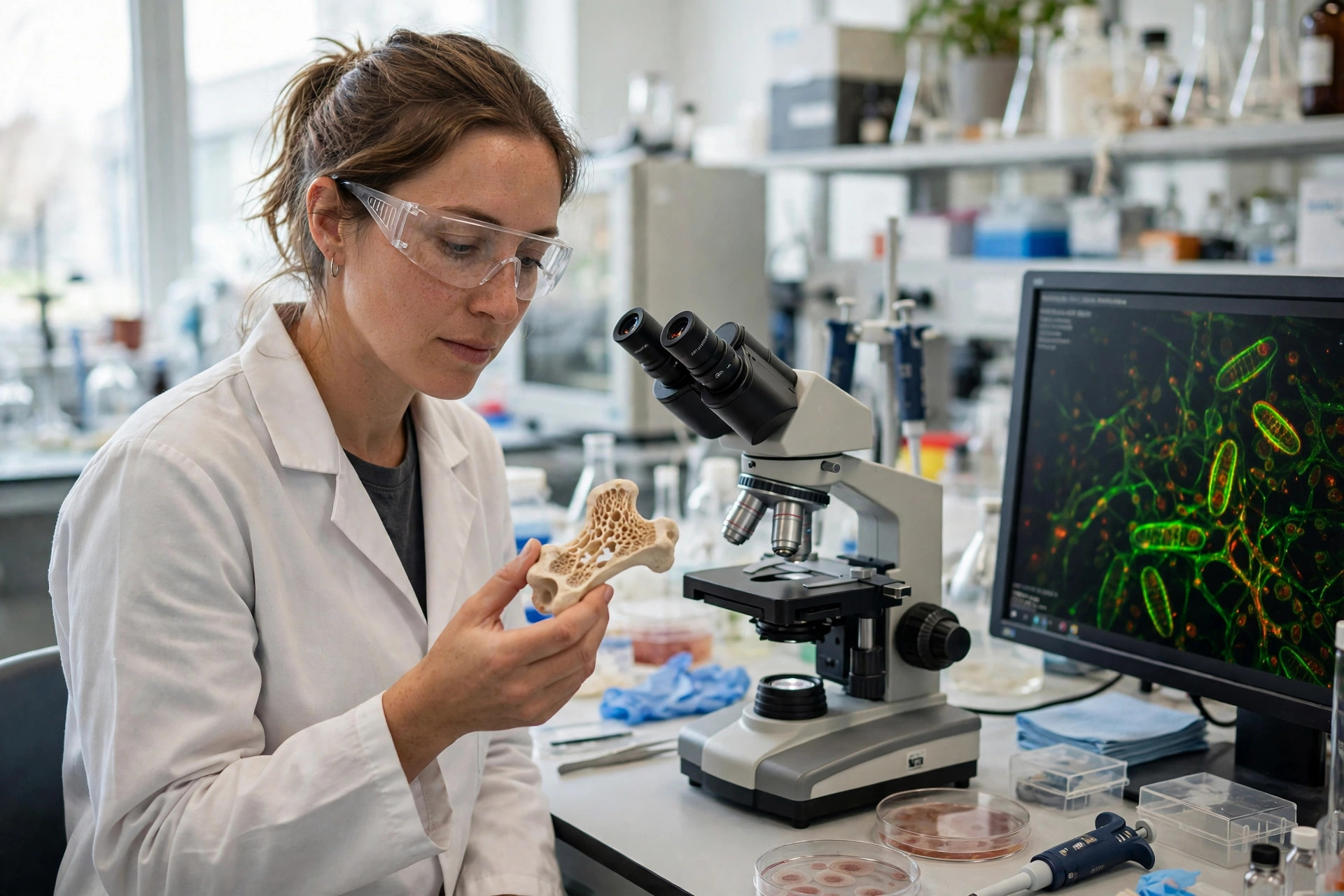
A mitochondrial enzyme switch drove bone loss under diabetes and alcohol stress — in male mice
Edited by Samael A. Tejada, Founder & Editor-in-Chief
·Tip: press play, then lock your phone or switch apps — the article keeps reading.
ACSS1-driven mitochondrial hyperacetylation inactivated the enzyme ME2 and suppressed bone formation under glucose, alcohol and acetate stress, a Nature Communications study in male mice found (October 20, 2026). Deleting ACSS1 or expressing a protected ME2 variant restored bone formation in the mouse models; no human data exist.
Bone is built by stem cells whose mitochondria decide their fate. This study finds the switch that metabolic stress flips — and shows, in mice, that flipping it back rescues the bone.
What is the cascade the study describes?
A complete chain, tested step by step: metabolic stress raises mitochondrial reactive oxygen species, which engage the integrated stress response and the transcription factor CEBPB, which upregulates ACSS1 in bone marrow skeletal stem cells. Excess ACSS1-derived acetyl-CoA hyperacetylates mitochondrial proteins — specifically inactivating malic enzyme 2 (ME2) at lysine 94 — disturbing the malate-aspartate shuttle, producing redox dyshomeostasis and oxidative stress, and tipping the stem cells away from bone formation toward fat.
What rescued the bone in the models?
Two interventions, both genetic: conditional deletion of Acss1 in bone-lineage cells preserved bone mass in diabetic and alcohol-exposed mice, and AAV-delivered expression of a non-acetylatable ME2 variant (K94R) in osteoprogenitors mitigated bone loss in both disease models, with the bone-formation marker PINP confirming the rescue biochemically. The work is the subject of a pending patent application by the Shenzhen Institutes of Advanced Technology covering the ME2 variant approach, which the authors declare.
What stands between this and a treatment?
Species, for a start: every in-vivo result is in male mice, and the authors themselves flag discrepancies between mouse skeletal physiology and human bone biology. There is no drug, no human tissue validation of the full cascade, and no safety data for the gene-therapy approach. What the study delivers is a named, mechanistic target — ACSS1 — for metabolic bone disease, at the earliest stage such targets exist.
Frequently asked questions
What is ACSS1?
Acetyl-CoA synthetase 1, the mitochondrial enzyme that converts acetate into acetyl-CoA — the molecule that feeds energy production and, in excess, attaches acetyl tags to proteins.
What is hyperacetylation?
Excessive attachment of acetyl groups to proteins, which can switch their activity off or on. Here it inactivated ME2, a mitochondrial enzyme, at one specific site.
Was this tested in people?
No. The animal work was in male mouse models of type 2 diabetes and chronic alcohol consumption, supported by stem-cell experiments.
Where the evidence stands
- Established: Type 2 diabetes and chronic alcohol use are major risk factors for secondary osteoporosis, and mitochondrial dysfunction in skeletal stem cells impairs bone formation.
- Preliminary: The ACSS1-ME2 cascade and both genetic rescues: one study (Nature Communications, 2026) in stem cells and male mouse models.
- Absent: Human evidence for the cascade, any ACSS1-targeting drug, and safety or efficacy data for the ME2 gene-therapy approach.
Join the discussion
To get the conversation started: What questions does this story raise for you? Share them below — every comment is reviewed by our moderators before it appears.
Community discussion only — not medical advice. Every comment is reviewed by our moderators before it appears. Sign in with Google or a free Hyvor account to join in.