
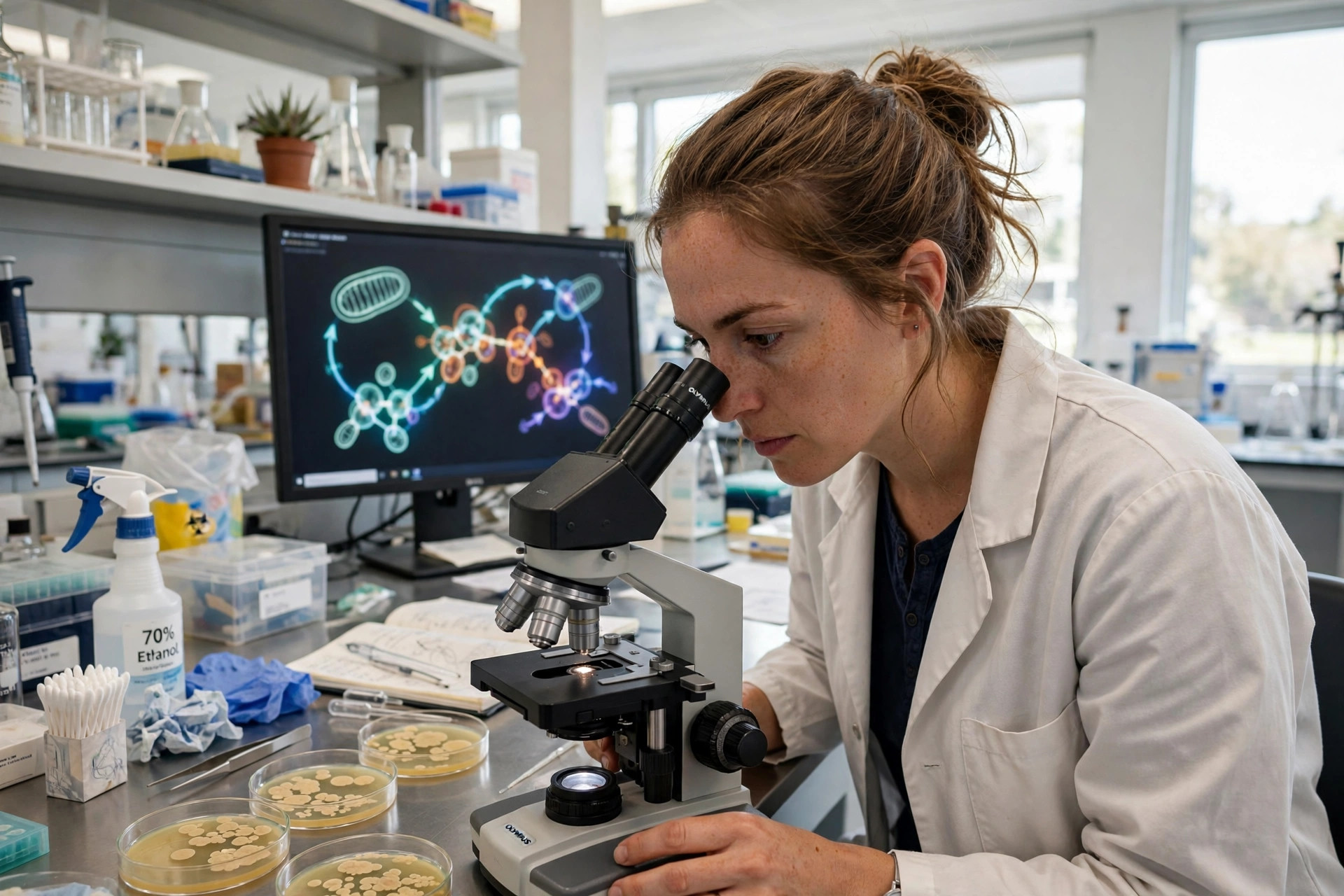
A four-protein assembly line builds two of the cell's energy machines at once — in yeast, with a human counterpart
Edited by Samael A. Tejada, Founder & Editor-in-Chief
·Tip: press play, then lock your phone or switch apps — the article keeps reading.
Every ATP molecule a reader has ever spent was made by a machine that first had to be built. AMIGa is part of the construction crew for two of those machines at once, and its human counterpart already exists. That is how fundamental discovery works: today's yeast complex is tomorrow's explanation for a patient's unexplained mitochondrial disease.
What is the AMIGa complex?
AMIGa is a newly characterized assembly of four proteins in the mitochondrial inner membrane of baker's yeast: Aim11, Mtc3, Gep7 and Iai11. The team, led by Ulrik Pedroza-Dávila and Xochitl Perez-Martinez, showed the complex sits at the crossroads of cytochrome c oxidase and ATP synthase biogenesis — coordinating the construction of both machines rather than serving one assembly line. The study grew out of a puzzle left by large-scale protein-interaction surveys, which had hinted these proteins interact without establishing what the interaction was for.
Why does the human protein TMEM242 matter?
Yeast findings earn clinical attention when a human counterpart exists and behaves the same way. The researchers identify TMEM242 as the human orthologue of Aim11, and report that TMEM242 was able to compensate for the loss of Aim11 in yeast — functional conservation across a billion years of evolution, which usually marks machinery a cell cannot do without. Human defects in respiratory-chain and ATP synthase assembly factors are an established cause of mitochondrial disease, so each mapped assembly factor is a candidate gene for undiagnosed cases and a handle for understanding how the machines fail.
What are the limits of a yeast study?
Complete ones, for now: this is discovery biology in a model organism. No human patient, variant or treatment is reported, and most yeast assembly findings refine understanding for years before they touch a clinic. The value claimed here is exactly the value the work has — a clearer map of how the energy machinery is built, with a named human protein on it. Readers should file it as foundational, not actionable.
Frequently asked questions
What does the AMIGa complex do?
In yeast mitochondria, it coordinates the assembly of two energy machines: cytochrome c oxidase (complex IV) and ATP synthase, the enzyme that produces most cellular ATP.
Is there a human version of any AMIGa protein?
Yes. The human protein TMEM242 corresponds to yeast Aim11, and in the study it compensated for the loss of Aim11 in yeast, suggesting the machinery is conserved.
Does this discovery change any treatment today?
No. It is foundational discovery biology in yeast. Its near-term value is a clearer map of mitochondrial assembly and a candidate factor for understanding mitochondrial disease.
Where the evidence stands
- Established: Cytochrome c oxidase and ATP synthase are assembled inside mitochondria from many subunits with dedicated assembly factors, and human defects in such factors cause mitochondrial disease; TMEM242 is the human counterpart of yeast Aim11.
- Preliminary: In baker's yeast (EMBO Reports, 2026; DOI 10.1038/s44319-026-00946-7), the four-protein AMIGa complex (Aim11, Mtc3, Gep7, Iai11) coordinated biogenesis of both cytochrome c oxidase and ATP synthase, and human TMEM242 compensated for Aim11 loss in yeast.
- Absent: Any human clinical finding, disease variant, diagnostic or therapeutic application.
Join the discussion
To get the conversation started: What questions does this story raise for you? Share them below — every comment is reviewed by our moderators before it appears.
Community discussion only — not medical advice. Every comment is reviewed by our moderators before it appears. Sign in with Google or a free Hyvor account to join in.