
Cardiolipin controls fiber-type adaptations in aging muscle via ERRγ — in lab models
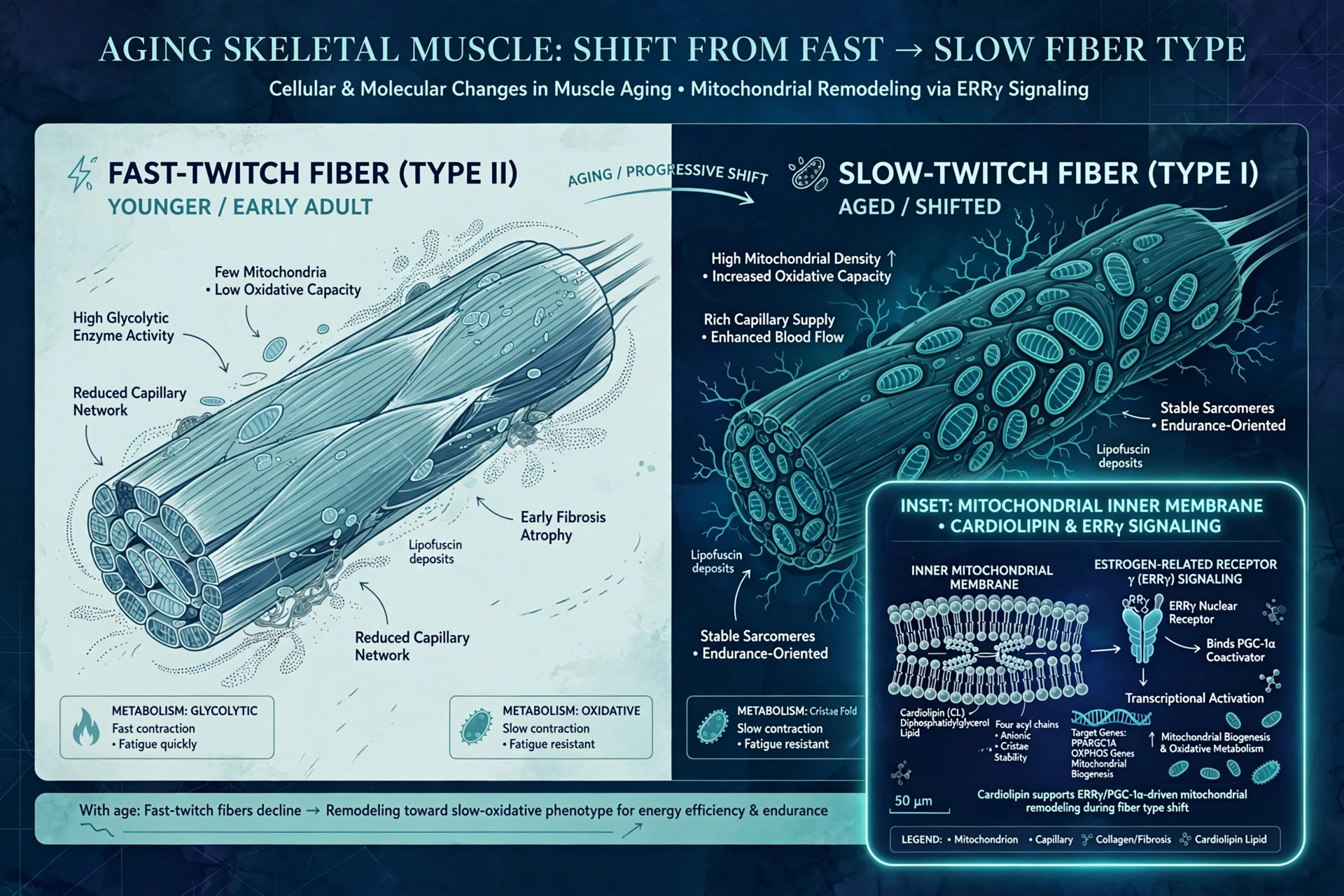
·Why does aging muscle lose its power fibers first? A new study in Nature points to a lipid inside mitochondria itself: cardiolipin, the signature phospholipid of the inner mitochondrial membrane. The team shows cardiolipin levels and remodeling control estrogen-related receptor γ (ERRγ) activity, which in turn sets whether muscle fibers stay fast and powerful or adapt toward slow, endurance-type fibers as animals age.
What the study found
In aged muscle, cardiolipin composition changed in step with a fiber-type shift. Manipulating cardiolipin in model systems moved ERRγ signaling and the fiber-type program with it — fast fibers were preserved when the lipid pathway was supported, and lost when it was disrupted. The work ties a membrane lipid directly to a nuclear receptor that programs muscle identity.
Why mitochondria sit at the center
Cardiolipin is not a bystander lipid: it stabilizes respiratory-chain supercomplexes and shapes cristae. When its abundance or acyl-chain pattern drifts with age, energy production and signaling drift too. This study adds a second job — cardiolipin as a signaling input to ERRγ, a master regulator of oxidative metabolism in muscle.
What this means for aging muscle
Sarcopenia — the age-related loss of muscle mass and power — has few drug targets. A lipid-receptor axis that can be nudged nutritionally or pharmacologically is attractive. But note the stage: this is discovery biology in lab models, not a human therapy.
The honest limits
All causal experiments were in preclinical models. Human muscle ages over decades with disuse, hormones, and disease in the mix that no mouse fully captures. Whether raising cardiolipin or tuning ERRγ in people preserves fast fibers — safely — is untested.
Where the evidence stands
- Established: Cardiolipin is essential for inner-membrane architecture and respiratory-chain stability; its composition changes with age in multiple tissues.
- Preliminary: The cardiolipin–ERRγ fiber-type mechanism is shown causally in lab models in a single Nature study; independent replication is pending.
- Contested: Whether fiber-type shift in aging is driven primarily by lipids, denervation, or activity patterns remains debated.
- Absent: No human trial has tested a cardiolipin- or ERRγ-targeted intervention for sarcopenia.