
Calcium-triggered actin cages drive mitochondrial stress–induced longevity in worms — in lab models
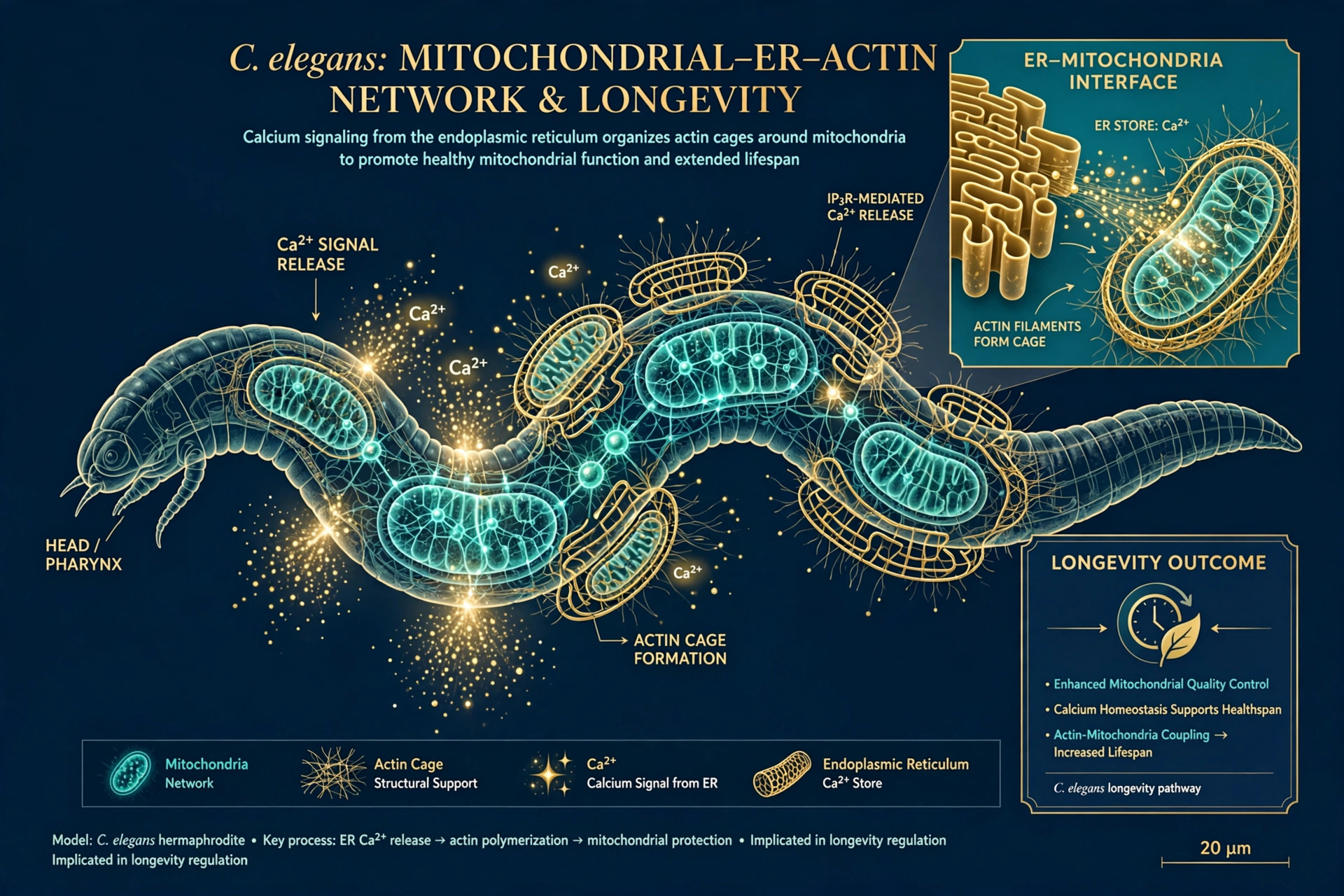
·It sounds backwards: break mitochondria a little, live longer. In the worm C. elegans, mild mitochondrial stress reliably extends lifespan — a phenomenon called mitohormesis. A new Nature Communications study (Feng et al., 2026) finds the longevity signal runs through a surprising middleman: calcium released from the endoplasmic reticulum, which remodels the actin cytoskeleton into restrictive 'cages' around mitochondria.
What the study found
ER calcium signaling through the InsP3 receptor proved essential for stress-induced longevity. Calcium triggered actin remodeling that caged mitochondria, preventing their uncontrolled expansion and tuning turnover of the network. Remove the calcium signal or the actin response, and the lifespan benefit vanished — even though the mitochondrial stress remained.
Why aging researchers care
Mitochondrial dysfunction and defective calcium signaling co-occur in Alzheimer's, Parkinson's, and normal aging. If calcium signaling normally supports mitochondrial quality control, then losing both creates the vicious cycle the authors describe: bad mitochondria plus bad calcium handling equals overt disease.
What this means
The authors are careful: they used 'simple genetic tools' with large effects on calcium. The therapeutic version would need delicate control of the timing and pattern of calcium release — converting stress into protection without tipping into damage.
The honest limits
Worms are not people. Mitohormesis is robust in invertebrates and harder to dose in mammals, where the same stress can simply cause disease. Many molecular details linking ER calcium, actin, and mitochondrial turnover remain to be filled in.
Where the evidence stands
- Established: Mild mitochondrial stress extends lifespan in C. elegans (mitohormesis); actin can form restrictive structures around mitochondria.
- Preliminary: The InsP3R–actin cage requirement for stress-induced longevity is shown genetically in worms in a single study.
- Contested: Whether controlled mitochondrial stress can be induced safely in mammals for lifespan benefit is unresolved.
- Absent: No human intervention targets this pathway.