
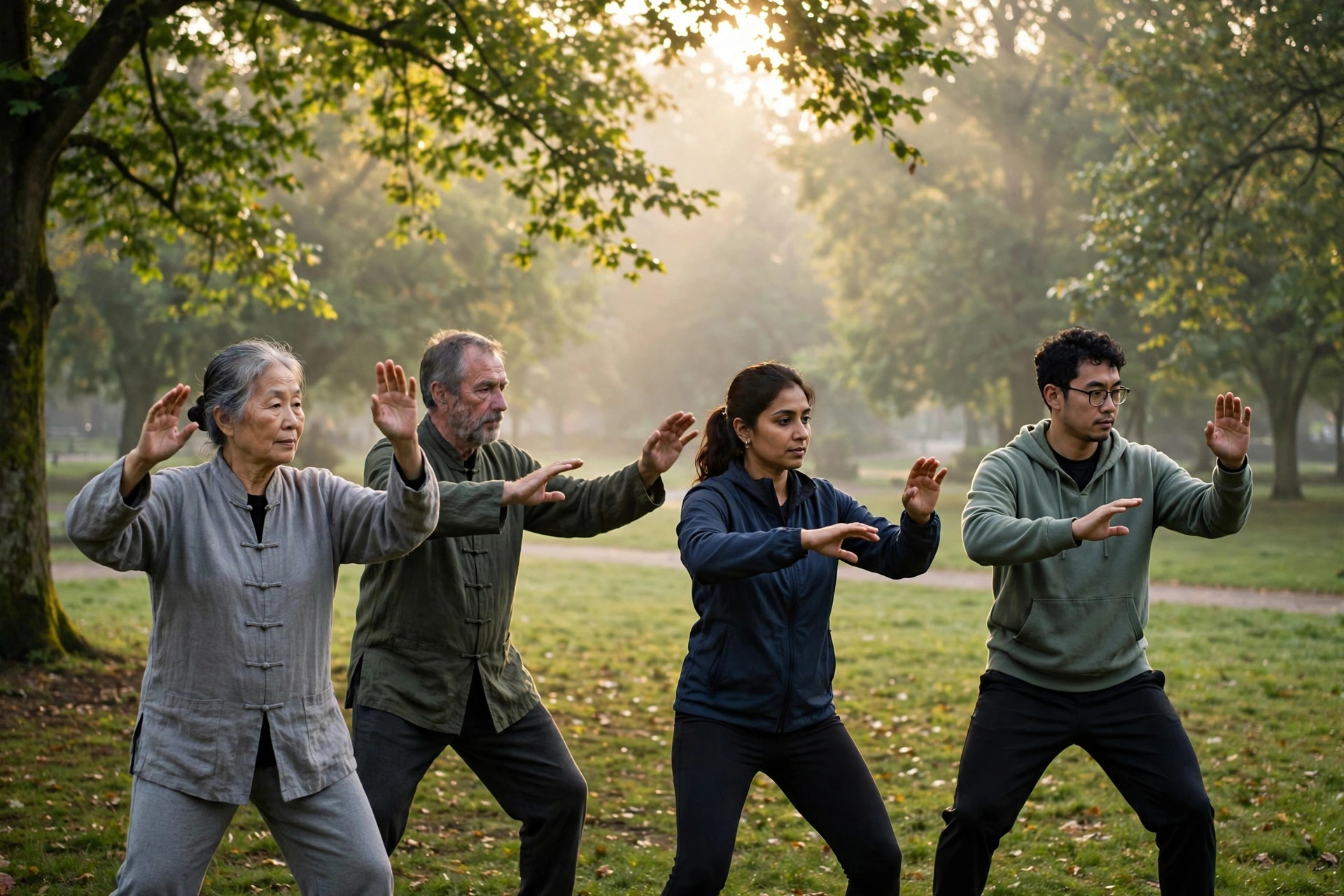
Chi and Mitochondria: What an Ancient Idea Gets Right — and Where the Evidence Stops
·Long before the microscope revealed the cell, healers in ancient China proposed that a vital energy called qi (pronounced "chee," spelled chi in the older Wade-Giles romanization) flows through every living body. Health, in this framework, is smooth and balanced flow; disease is stagnation or blockage.
Then, in the 1890s and early 1900s, biology discovered mitochondria — the organelles that convert food and oxygen into ATP, the actual energy currency of the cell. The parallel is irresistible: an ancient tradition speaking of "life energy" and modern biology locating energy production in tiny cellular power plants. Do they describe the same thing? This article looks at what the published research says. The honest answer is more interesting than either the true believers or the debunkers admit.
The idea that will not go away
The traditional picture is specific. Qi is generated by the lungs and travels through invisible tracts called meridians — twelve primary channels, arranged in yin and yang pairs, each linked to an organ system, carrying qi to roughly 365 to 400 acupuncture points. Practitioners also describe three dantian, or "elixir fields": a lower center below the navel where vital essence is refined into qi, a middle center at the heart where qi refines into spirit, and an upper center at the forehead where spirit dissolves into emptiness. Qigong, tai chi, and acupuncture are all, in this framework, technologies for cultivating and unblocking qi.
The starting point: what qi is not
Let us get the hard part out of the way first, because everything else depends on it.
Qi has no established physical measurement. No instrument detects it. There is no known anatomical or histological basis for meridians or acupuncture points — no structures under the microscope correspond to the meridian maps. The U.S. National Center for Complementary and Integrative Health (NCCIH) no longer even uses its old categories of "veritable" versus "putative" energies, because the putative ones — qi included — have never been definitively measured.
This matters for mitochondria because it sets the terms of the investigation. We cannot test whether qi "powers" mitochondria the way we test whether glucose does, because nobody can isolate, dose, or measure qi. What researchers can test is whether the practices built around the idea — qigong, tai chi, acupuncture, "external qi" healing — produce measurable biological effects, and whether any of those effects touch mitochondrial function.
So the real question becomes: when people cultivate their chi, does anything happen at the cellular level?
Qigong and the cell: small studies, one loud replication failure
No published study has directly measured mitochondrial respiration, ATP production, or oxidative phosphorylation in human qigong practitioners. That is the central gap, and it is worth stating plainly: the direct experiment has not been done.
What exists is a handful of studies on adjacent markers:
- Gene expression (Li et al., 2005). A pilot study compared neutrophils from just six Falun Gong practitioners against six controls and found roughly 250 of 12,000 genes expressed differently — enhanced immune-related genes, downregulated metabolic genes, altered apoptosis genes suggesting faster resolution of inflammation. Intriguing, but explicitly a pilot, cross-sectional (so it cannot show causation), and never replicated at scale.
- Telomerase, round one (Ho et al., 2012). A randomized trial of 64 adults with chronic fatigue found that four months of qigong raised telomerase activity — the enzyme that maintains chromosome-protecting telomeres — significantly versus a waitlist control. Telomere maintenance is closely tied to mitochondrial health and cellular aging.
- Telomerase, round two (Cheung et al., 2019). A larger, longer randomized trial — 271 participants, 22 weeks of Baduanjin qigong — found no difference in telomerase activity between the qigong and control groups. This is a direct failure to replicate the 2012 result, and in science, the larger null result carries more weight.
- Oxidative stress (2025). A small randomized trial of 50 older adults with metabolic syndrome found six months of Baduanjin improved salivary inflammatory and antioxidant markers — interleukins 1-beta and 6, total antioxidant status, and the antioxidant enzyme SOD. Single small trial, salivary markers rather than mitochondria, unreplicated.
- Meta-analyses of traditional Chinese exercise report improved antioxidant enzymes (SOD, glutathione peroxidase) and reduced oxidative damage markers, plus modulation of immune and inflammatory biomarkers — but the underlying trials are heterogeneous, mostly from China, and carry the usual risks of publication bias.
Acupuncture and mitochondria: real signals, but only in rats
Acupuncture is framed in traditional Chinese medicine as manipulating qi flow through meridians — but when researchers looked at what needling does to mitochondria, the findings pointed at ordinary physiology, not energy meridians:
- Guo and Lu (2024). In rats with induced ischemic stroke, acupuncture at standard points activated the AMPK/PGC-1α pathway in neurons — the master switch for mitochondrial biogenesis — raising levels of PGC-1α, NRF2, and TFAM, and increasing ATP and mitochondrial complex I activity while reducing oxidative damage.
- A 2025 study in diabetic rats found electroacupuncture boosted skeletal-muscle ATP production and insulin sensitivity, again apparently through AMPK/PGC-1α/TFAM-driven mitochondrial biogenesis.
- A mechanistic study of the famous ST36 point (below the knee) traced the effect to needle deformation of muscle fibers activating TRPV1 channels and CaMKII/AMPK/PGC-1α signaling — a local biomechanical and neural mechanism, explicitly not qi flow.
Two caveats: these are animal studies, and they are entirely consistent with generic responses to needling — local tissue stimulation and afferent nerve activation — rather than anything specific to meridians. Human trials comparing real versus sham acupuncture for chronic low back pain (Cochrane, 2020) found acupuncture beat no treatment but was not meaningfully better than sham needling — which directly undermines the claim that point and meridian specificity matter.
"External qi": the extraordinary claims that did not survive replication
Some practitioners claim to project qi outward to heal others — "external qi." This has been tested on cell cultures, which removes the placebo problem entirely:
- The strongest published positive comes from a single research group (Yan et al., 2013): external qi from Yan Xin Qigong practitioners arrested the growth of colon cancer cells in a dish, triggering cell-cycle arrest and apoptosis through the Akt/ERK/NF-κB pathways. Remarkably, the group also reported that saline "treated" with qi induced the same effects. It is in vitro only, from one practitioner-linked lab, with no independent replication — and "qi stored in salt water" is an extraordinary claim by any standard.
- The best-controlled Western test (Yount et al., 2004) aimed external qigong at cultured human brain cells under randomized, blinded conditions. The formal study showed increased cell proliferation (p = 0.036) — but the 60-experiment replication came back null (p = 0.465). The authors themselves declined to claim validation.
- Other reports — infrared cameras detecting palm heat during qi emission, small studies of external qi on immune cells — suffer from mundane confounds. Infrared detects heat, and the authors of the palm-heat study acknowledged it plausibly reflected ordinary autonomic blood-vessel changes, not an energy beam.
What the mainstream concludes
NCCIH's position: tai chi may improve balance in older adults and people with Parkinson's, reduce back and knee-osteoarthritis pain, and improve quality of life in chronic illness; qigong's evidence is thinner. Cochrane reviews find modest benefits for some conditions. No major scientific body affirms qi as a measurable physical entity or meridians as anatomical structures. The accepted mechanisms for the real benefits are neurophysiological — endogenous opioids, descending pain inhibition, expectancy, and the ordinary effects of exercise.
Where mitochondria actually enter the story
Here is the twist: you do not need qi to connect these practices to mitochondria. Three well-established physiological pathways do the job:
1. Movement builds mitochondria. Tai chi and qigong are moderate-intensity exercise, and exercise is the best-known stimulus for PGC-1α — the master regulator of mitochondrial biogenesis. A classic human study (Pilegaard et al., 2003) showed a single exercise bout transiently increased PGC-1α transcription in muscle by ten- to forty-fold; a 2025 meta-analysis confirmed the effect is large and consistent. Whatever "energy" practitioners cultivate through flowing movement, the mitochondria are literally multiplying.
2. Less stress means less mitochondrial wear. Chronic psychological stress drives glucocorticoid and catecholamine signaling that structurally and functionally recalibrates mitochondria — what researchers Picard and McEwen (2018) call "mitochondrial allostatic load." One striking finding: physiological cortisol exposure raised cellular energy expenditure by roughly 60 percent and accelerated cellular aging markers (Bobba-Alves et al., 2023). Qigong and tai chi are, among other things, stress-reduction practices — and the evidence that they lower cortisol is mixed but suggestive.
3. Slow breathing shifts the nervous system. Meta-analyses show tai chi and yoga improve heart-rate variability — a marker of parasympathetic, rest-and-recover dominance — and reduce perceived stress. A calmer autonomic nervous system means lower chronic inflammation, and inflammation and mitochondrial function are bidirectionally linked: inflamed cells make energy poorly, and energy-starved cells inflame.
In other words, the subjective experience of "cultivating energy" maps cleanly onto ATP, oxygen, and glucose metabolism being modulated by exercise, breathing, and stress physiology. Invoking qi adds no explanatory power — and no testable prediction made in qi's name has survived replication.
The bottom line, graded
- Qigong/tai chi improve antioxidant and inflammatory markers — promising but preliminary: small trials, heterogeneous, publication-bias risk.
- Qigong preserves telomeres via telomerase — weak: the positive pilot was directly contradicted by a larger randomized trial.
- Acupuncture boosts mitochondrial energy production — no human evidence: real signals exist, but only in rats, via ordinary needling physiology.
- External qi heals cells at a distance — no credible evidence: the best-controlled replication failed; the strongest positives are unreplicated.
- Chi is a measurable physical energy; meridians are anatomical structures — no evidence: no established measurement, no anatomical basis.
- Slow movement, deep breathing, and stress reduction support mitochondrial function — strong: established physiology: PGC-1α biogenesis, allostatic load, vagal tone.
What to do with this
The ancient physicians were observing something real: that slow, breath-coordinated movement, practiced regularly, leaves people feeling more energetic and resilient. They explained it with the best model they had — a vital energy flowing through invisible channels. Modern biology offers a better model — mitochondria responding to exercise, stress hormones, and autonomic balance — but it points to remarkably similar practices.
You do not need to believe in qi to benefit from what qi-based practices actually do. Thirty minutes of tai chi or qigong is moderate exercise with slow breathing and meditative focus: it stimulates mitochondrial biogenesis through PGC-1α, it downshifts the stress axis that wears mitochondria down, and it trains the vagal brake that keeps inflammation in check. The energy is real. It was never mystical. It was mitochondrial all along.
Where the evidence stands
- Established: Slow movement, deep breathing, and stress reduction support mitochondrial function through ordinary physiology: exercise drives PGC-1α-mediated mitochondrial biogenesis (a single bout raised PGC-1α transcription 10- to 40-fold in human muscle; Pilegaard et al., 2003), chronic stress imposes glucocorticoid-driven 'mitochondrial allostatic load' (Picard & McEwen, 2018), and tai chi/yoga improve heart-rate variability and lower perceived stress (Zou et al., 2018).
- Preliminary: That qigong improves antioxidant and inflammatory markers: meta-analyses of traditional Chinese exercise report improved SOD, glutathione peroxidase, and total antioxidant capacity with reduced oxidative-damage markers, plus modulated immune biomarkers — but the trials are small, heterogeneous, mostly from China, and carry publication-bias risk. One small 2025 RCT (n=50) found six months of Baduanjin improved salivary IL-1β, IL-6, antioxidant status, and SOD.
- Weak: That qigong preserves telomeres via telomerase: one small 2012 RCT (n=64) reported raised telomerase activity after four months of qigong, but a larger, longer 2019 RCT (n=271, 22 weeks of Baduanjin) found no difference versus control — a direct failure to replicate, and the larger null result carries more weight.
- Absent: Any published study directly measuring mitochondrial respiration, ATP production, or oxidative phosphorylation in human qigong or tai chi practitioners. The direct experiment has not been done; the cellular literature is limited to gene expression, telomerase, and oxidative/inflammatory markers.
- Absent: Human evidence that acupuncture boosts mitochondrial energy production. Real signals exist — acupuncture activated the AMPK/PGC-1α mitochondrial-biogenesis pathway and raised ATP and complex I activity in rats (Guo & Lu, 2024; electroacupuncture in diabetic rats, 2025) — but these are animal studies consistent with generic needling physiology, and human sham-controlled trials find acupuncture not meaningfully better than sham needling for chronic low back pain (Cochrane, 2020).
- Absent: Credible evidence that 'external qi' affects cells at a distance. The strongest published positive (Yan et al., 2013, colon cancer cells in a dish, including 'qi-treated' saline) comes from a single practitioner-linked lab with no independent replication; the best-controlled Western test (Yount et al., 2004, blinded external qigong on cultured brain cells) failed on replication (p=0.465 over 60 experiments).
- Absent: Chi as a measurable physical energy, or meridians and acupuncture points as anatomical structures. No instrument detects qi, and no verifiable anatomical or histological basis for meridians exists; NCCIH makes no claim that qi is measurable.
NIH NCCAM definitions of qi, yin-yang, and meridians ↗
Meridian and acupoint physiology review (Pflügers Archiv) ↗
Biofield: history and definitions (Global Advances in Health and Medicine) ↗
Li et al. 2005 — neutrophil gene-expression pilot in qigong practitioners (n=6 vs 6) ↗
Ho et al. 2012 — qigong RCT, telomerase activity (n=64; PMID 22736201) ↗
Cheung et al. 2019 — Baduanjin RCT, telomerase null result (n=271; PMID 30646209) ↗
Baduanjin oxidative-stress RCT 2025 (n=50 elderly; PMID 41316618) ↗
Traditional Chinese exercise and oxidative stress — network meta-analysis 2022 ↗
Tai chi/qigong and immunity — systematic review and meta-analysis 2020 ↗
Guo & Lu 2024 — acupuncture, AMPK/PGC-1α and mitochondrial biogenesis in MCAO rats ↗
Electroacupuncture in type 2 diabetic rats 2025 — ATP production via AMPK/PGC-1α/TFAM ↗
ST36 needling — TRPV1/CaMKII/AMPK/PGC-1α local mechanism ↗
Yan et al. 2013 — external qi of Yan Xin Qigong on colorectal cancer cells (PMID 23363659) ↗
Yount et al. 2004 — external qigong on cultured brain cells, replication null ↗
Lee, Pittler & Ernst 2007 — external qigong for pain, systematic review ↗
NCCIH — Qigong: What You Need To Know ↗
Mu et al. 2020, Cochrane — acupuncture for chronic low back pain ↗
Picard & McEwen 2018 — mitochondrial allostatic load ↗
Pilegaard et al. 2003 — exercise and PGC-1α transcription (PMID 12563009) ↗