
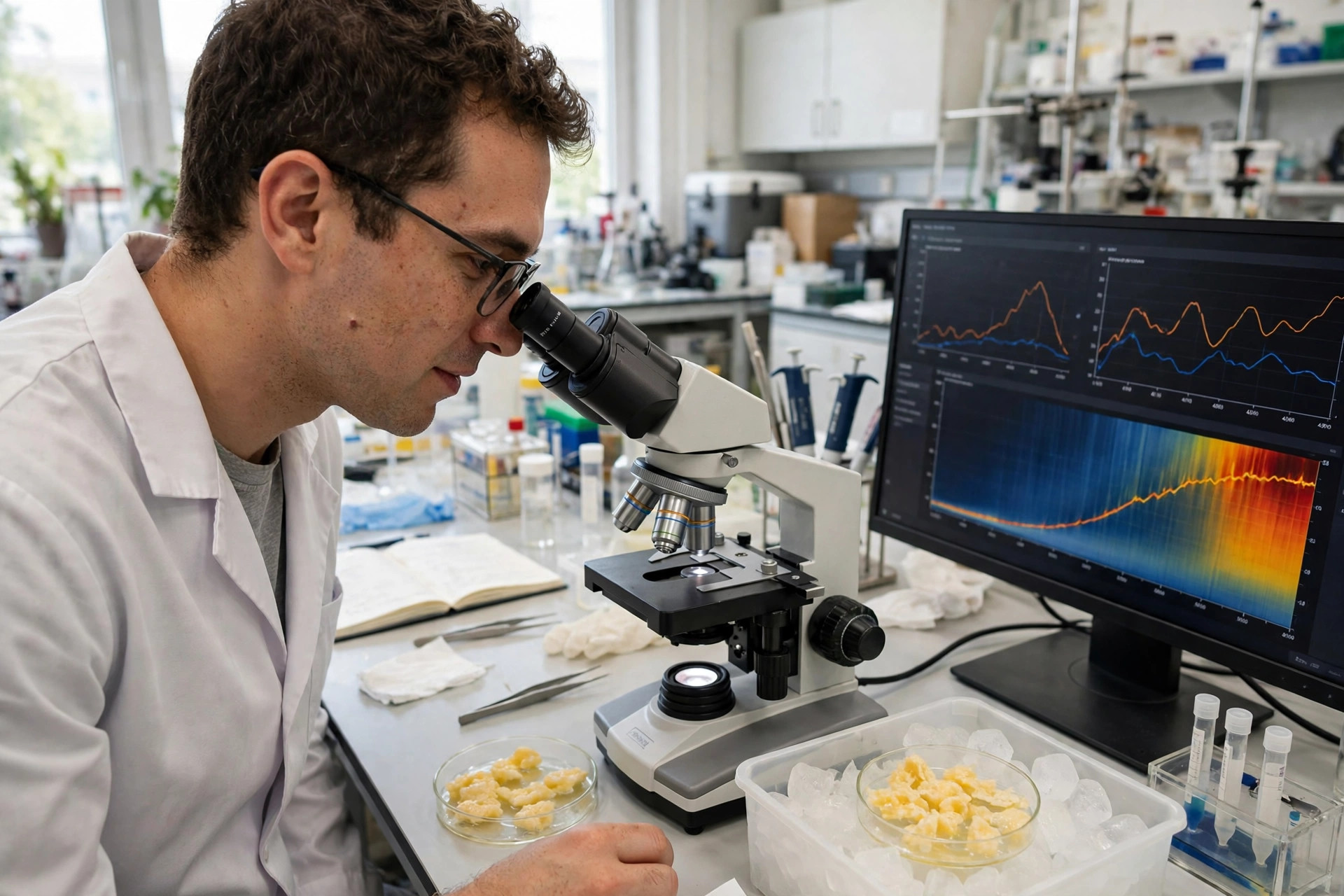
Blocking a mitochondrial cleanup protease switched on fat-cell heat production and resisted weight gain — in mice and cultured fat cells
Edited by Samael A. Tejada, Founder & Editor-in-Chief
·Tip: press play, then lock your phone or switch apps — the article keeps reading.
Inhibiting the mitochondrial protease CLPP stabilised its partner protein LETMD1, raised the heat-producing protein UCP1 and increased energy expenditure in cultured beige fat cells and mouse obesity models, an Adipocyte study from Tongji University reports. Human data are gene-expression correlations only; no person has been treated this way.
Thermogenesis is the body's sanctioned inefficiency: fuel burned for warmth instead of work. This study maps a protease-to-heat circuit inside fat-cell mitochondria — and finds the circuit has an off-switch that a plant compound can flip, at least in a dish.
What is the CLPP–LETMD1 circuit?
CLPP is a quality-control protease in the mitochondrial matrix — it shreds damaged or surplus proteins, working with its chaperone CLPX. One of its substrates is LETMD1, a protein that supports the thermogenic programme. When CLPP activity falls or is blocked, LETMD1 accumulates, UCP1 expression rises, and the fat cell's mitochondria uncouple respiration from ATP production, releasing the energy as heat instead.
What did the experiments show?
In human adipose transcriptomic data (dataset GSE70353), CLPP expression tracked with metabolic pathology. In mice, CLPP protein was significantly lower in the fat depots of high-fat-diet animals than lean controls — the system already leans on this brake in obesity. In cultured beige adipocytes, the CLPP inhibitor hinokiflavone activated thermogenic transcripts, with Ucp1 rising more than twofold and peaking at ten micromolar, confirmed at protein level, without disrupting general fat-cell development or lipid storage.
Why the caution alongside the interest?
CLPP is not a fat-only protein: inherited CLPP defects cause Perrault syndrome, with hearing loss and ovarian failure, which is why the researchers pursued local, acute inhibition in fat rather than lifelong systemic loss. A drug would need fat-targeted delivery, proof it does not disturb proteostasis elsewhere, and human evidence that raising UCP1 this way changes weight or metabolic health. None of that exists yet.
Frequently asked questions
What is thermogenesis?
Heat production by tissue. In brown and beige fat, mitochondria deliberately uncouple fuel burning from ATP production so the energy escapes as warmth.
What is UCP1?
Uncoupling protein 1, found in the inner mitochondrial membrane of brown and beige fat cells. It leaks protons across the membrane, converting their energy to heat.
Is hinokiflavone a weight-loss treatment?
No. It is a laboratory tool compound used here to inhibit CLPP in cultured cells. No human weight-loss evidence exists.
Where the evidence stands
- Established: Brown and beige fat mitochondria produce heat via UCP1-mediated uncoupling, mitochondrial proteostasis is maintained by matrix proteases including CLPP, and inherited CLPP mutations cause Perrault syndrome.
- Preliminary: The CLPP–LETMD1 thermogenic circuit and hinokiflavone's Ucp1 activation: one study (Adipocyte, 2026) in human expression data, cultured beige adipocytes and mouse models.
- Absent: Human treatment data of any kind, fat-targeted CLPP inhibitor safety, and evidence of weight or metabolic benefit in people.
Join the discussion
To get the conversation started: What questions does this story raise for you? Share them below — every comment is reviewed by our moderators before it appears.
Community discussion only — not medical advice. Every comment is reviewed by our moderators before it appears. Sign in with Google or a free Hyvor account to join in.