
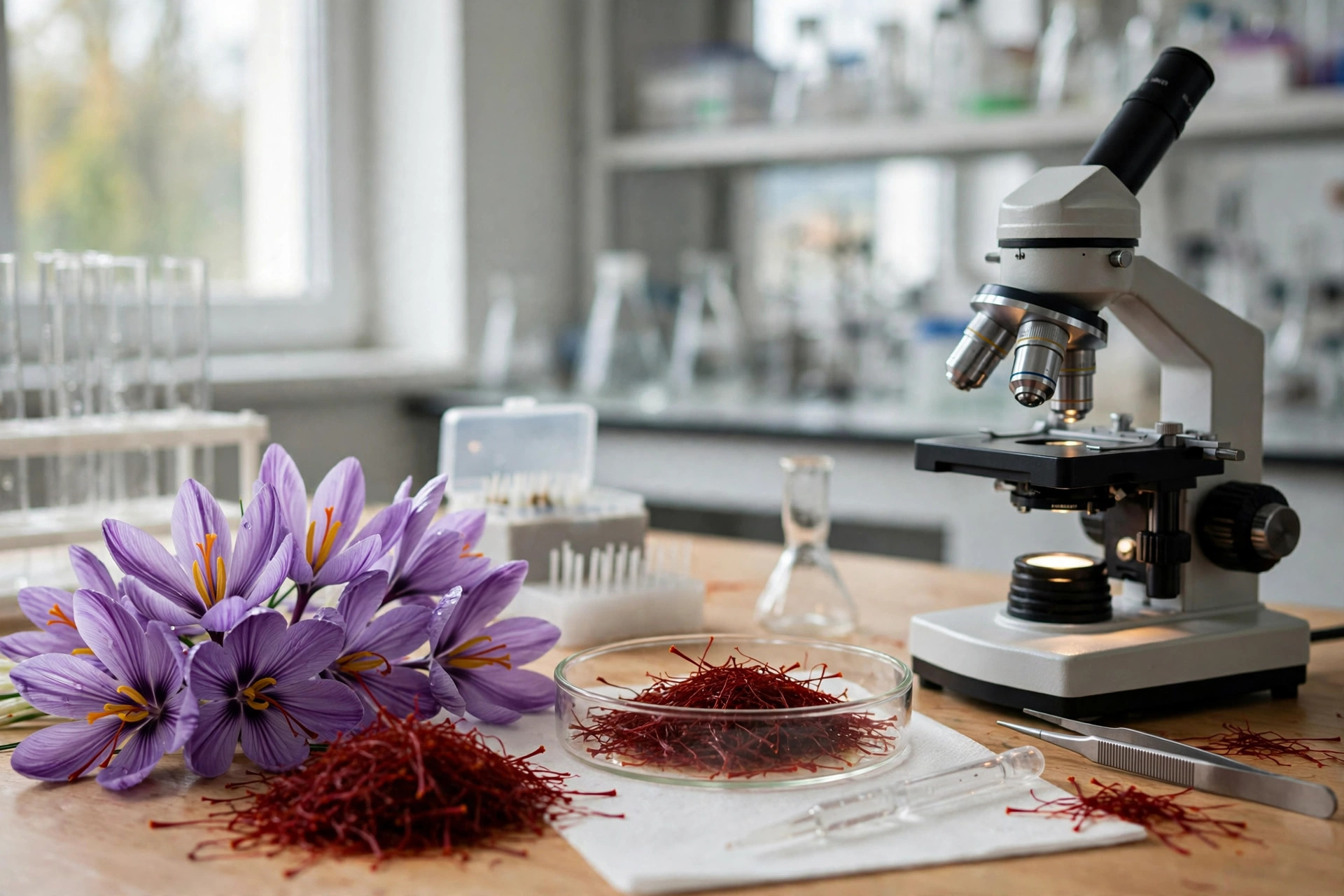
Saffron's crocin eased kidney scarring by restoring a mitochondrial master switch — in kidney fibrosis models
Edited by Samael A. Tejada, Founder & Editor-in-Chief
·Tip: press play, then lock your phone or switch apps — the article keeps reading.
What makes this paper worth reading is not 'saffron is good for kidneys' — it is the named chain underneath: a silenced transcription factor, the mitochondrial regulator it controls, and the two distinct silencing mechanisms (promoter methylation and protein destruction) that one compound appears to loosen. Named chains can be checked, replicated or refuted; supplement slogans cannot.
What is the HOXD8 to PGC-1alpha pathway?
HOXD8 is a homeobox transcription factor — a protein that switches other genes on. The team showed it binds the promoter of PGC-1alpha (PPARGC1A) and enhances its transcription. PGC-1alpha is one of the best-known regulators of mitochondrial biogenesis and oxidative metabolism, so losing HOXD8 means losing a driver of mitochondrial renewal. In the kidney fibrosis models, that is exactly the pattern found: HOXD8 and PGC-1alpha down, reactive oxygen species up, mitochondrial dysfunction and profibrotic gene expression up. Experimentally overexpressing HOXD8 reversed each element — PGC-1alpha rose, ROS fell, mitochondrial function was restored and profibrotic genes were suppressed.
How does crocin raise HOXD8?
Two separate brakes hold HOXD8 down in the fibrotic kidney, and the paper addresses both. First, the epigenetic brake: DNMT1-mediated hypermethylation of the HOXD8 promoter drives its downregulation, and crocin reduced DNMT1 enrichment and activity at that promoter. Second, the protein-stability brake: molecular docking and a cellular thermal shift assay support a potential direct interaction between crocin and HOXD8, and crocin reduced HOXD8 ubiquitination — the tagging that marks a protein for destruction. With both brakes loosened, HOXD8 and PGC-1alpha rose, and mitochondrial dysfunction and fibrosis eased in the models.
What separates this from a kidney treatment?
The usual, decisive steps: the work is in kidney fibrosis models, not in people with chronic kidney disease; the crocin exposures in models do not translate into a human dose; and saffron or crocin products sold as supplements are unstandardized and untested for fibrosis outcomes. The paper's contribution is mechanistic — a HOXD8/PGC-1alpha axis in renal fibrosis and a compound that engages it preclinically. A treatment claim would require pharmacology, safety and a randomized trial in CKD patients, none of which exist for crocin in this indication.
Frequently asked questions
What is crocin?
Crocin is a bioactive pigment compound from saffron (Crocus sativus) responsible for its deep red-gold color. It has been studied for antioxidant and tissue-protective effects in preclinical models.
What did crocin do in this study?
In kidney fibrosis models, crocin upregulated the transcription factor HOXD8 — by reducing methylation of its promoter and reducing its protein degradation — which raised PGC-1alpha, reduced reactive oxygen species, restored mitochondrial function and suppressed profibrotic genes.
Should kidney patients take saffron or crocin supplements?
No evidence supports that. This is preclinical model work with no human trial, no established dose and no tested product. Readers with kidney disease should discuss any supplement with their clinician.
Where the evidence stands
- Established: PGC-1alpha is a master regulator of mitochondrial biogenesis and oxidative metabolism, and its loss accompanies mitochondrial dysfunction in chronic kidney disease and fibrosis; DNMT1-mediated promoter methylation and ubiquitination are standard mechanisms by which cells silence or remove proteins.
- Preliminary: In kidney fibrosis models (Communications Biology, Oct 27, 2026), HOXD8 and PGC-1alpha were downregulated alongside mitochondrial dysfunction; HOXD8 restoration or crocin treatment raised PGC-1alpha, reduced ROS, restored mitochondrial function and suppressed profibrotic genes.
- Absent: Any human data: no patient was treated, no human dose is established, and no supplement product has been tested against kidney fibrosis outcomes.
Join the discussion
To get the conversation started: What questions does this story raise for you? Share them below — every comment is reviewed by our moderators before it appears.
Community discussion only — not medical advice. Every comment is reviewed by our moderators before it appears. Sign in with Google or a free Hyvor account to join in.