
The Best Diet for Mitochondrial Health: What the Evidence Says About Dietary Patterns
The honest verdict: no dietary pattern is proven best for mitochondria in head-to-head human trials — that study has never been run. But one pattern earns the top slot anyway: Mediterranean-style eating has the deepest clinical evidence for cardiovascular and metabolic health (Established) plus the most encouraging early mitochondrial signals (Preliminary), including a 2026 study linking closer adherence to higher levels of mitochondria-derived microproteins in older adults. DASH and plant-forward patterns are plausible but mitochondrially unproven; keto has intriguing mechanistic signals but contested general-use evidence. What you eat matters less than the pattern you eat it in — and this companion to our foods and supplements guide explains why.
What would actually prove a diet is best for mitochondria?
Three things, and no dietary pattern currently delivers all three: (1) randomized trials measuring mitochondrial endpoints in humans — respiratory capacity, biogenesis markers, mitophagy — not just risk factors; (2) head-to-head comparison against other patterns; (3) long-term adherence data, since a diet nobody can sustain is not a diet at all. Keep that standard in mind, because almost every "mitochondrial diet" claim online fails at least two of the three. This article grades dietary patterns, not individual foods — for specific foods, nutrients, and supplements (CoQ10, omega-3s, magnesium, polyphenols, and the rest), each with its own evidence grade, see our companion guide on foods and supplements for mitochondrial health.
Why the Mediterranean pattern leads
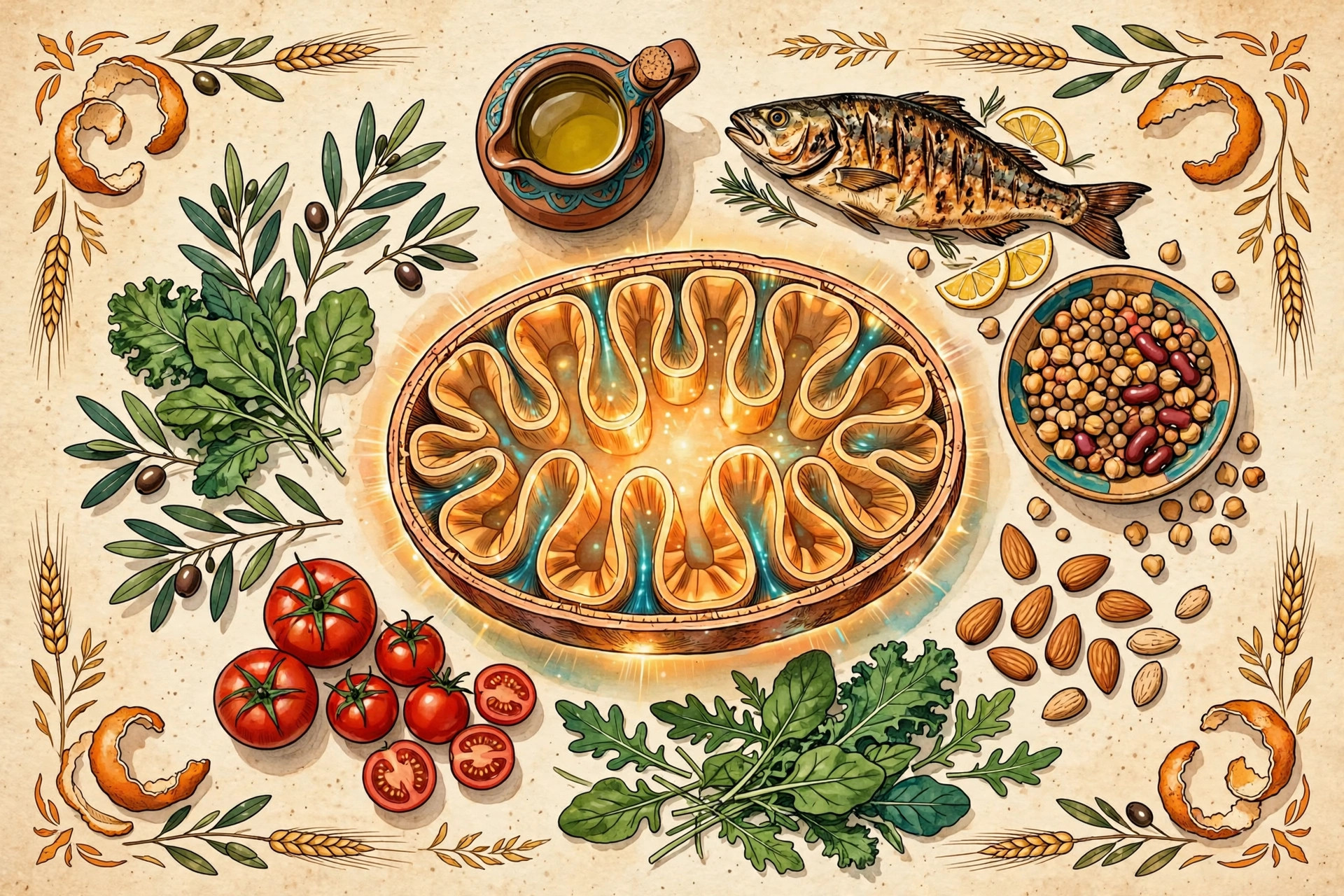
The Mediterranean pattern is not a diet in the restriction sense — it is a traditional eating pattern from olive-growing regions: vegetables, fruit, legumes, whole grains, nuts and seeds, extra-virgin olive oil as the principal fat, fish and seafood regularly, and modest amounts of dairy, poultry, and eggs. What distinguishes it mitochondrially is the combination of two evidence streams. First, the clinical evidence is the deepest of any pattern: the landmark PREDIMED trial and its successors showed reduced major cardiovascular events and metabolic benefit, and a 2018 review of PREDIMED data found the diet rich in antioxidant components reduced systemic oxidative stress — directly relevant to mitochondrial redox balance (Nutrition & Diabetes, 2018). Second, the direct mitochondrial signals, while still early, are the most encouraging of any pattern: a 2023 review (Antioxidants, PMID 37019345) summarized that Mediterranean-diet components protect mitochondrial function — lowering mitochondrial reactive oxygen species, preserving membrane potential, and supporting mitophagy — though mostly from cell and animal work. And in March 2026, USC researchers reported that older adults with closer Mediterranean-diet adherence had higher circulating levels of the mitochondria-derived microproteins humanin and SHMOOSE and lower oxidative-stress markers — an observational study, not proof of improved mitochondrial performance, but a genuine human mitochondrial signal (Medical Xpress / News-Medical, March 2026). Add a small PREDIMED-Plus pilot (n=69) suggesting Mediterranean eating prevented telomere shortening versus control (Nutrients, 2021) — adjacent to mitochondrial aging biology, not a mitochondrial endpoint itself. Grade: Established for cardiometabolic benefit; Preliminary for direct mitochondrial improvement.
What the Mediterranean pattern actually looks like
Forget percentages and pyramid charts — the pattern in practice: cook and dress food with extra-virgin olive oil instead of butter or refined seed oils; eat vegetables and fruit at most meals; legumes and whole grains several times a week; fish or seafood at least twice a week; a small handful of nuts daily; protein adequate to your needs and activity (fish, legumes, eggs, poultry, fermented dairy); red and processed meat infrequent; and — the part most people skip — fewer ultra-processed foods, refined starches, added sugars, and sugar-sweetened drinks. Wine is often pictured with the pattern in Mediterranean countries, but it is not a health recommendation: alcohol is not required, and no one should start drinking for their mitochondria.
DASH: strong heart evidence, no mitochondrial trials
The DASH pattern (Dietary Approaches to Stop Hypertension) — rich in fruits, vegetables, whole grains, and low-fat dairy, limited in sodium and saturated fat — has Established evidence for lowering blood pressure and cardiovascular risk. For mitochondrial endpoints specifically, the direct human evidence is Absent: no randomized trials measure mitochondrial function on DASH. It remains a reasonable, well-studied alternative — especially for people with hypertension — but nothing suggests it outperforms Mediterranean eating mitochondrially.
Whole-food plant-predominant: plausible, unproven mitochondrially
Vegetarian and vegan patterns rich in whole plant foods supply abundant polyphenols and fiber with lower saturated-fat load — a plausible recipe for lower mitochondrial oxidative burden, and observational cohorts link plant-rich eating to lower cardiometabolic risk. But the direct mitochondrial evidence in humans is Absent, and the mechanism is Extrapolated from antioxidant chemistry and animal work. The practical caution runs the other direction: poorly planned restrictive vegan diets can underdeliver protein, vitamin B12, iron, and creatine — nutrients with real mitochondrial relevance (see the foods and supplements guide). Plant-predominant is fine as a framework; planned inadequacy is not a mitochondrial strategy.
Ketogenic diets: intriguing signals, contested as a general mitochondrial diet
Keto generates the most polarized claims online, so the grades need care. Established: ketogenic diets have legitimate clinical uses in selected neurologic conditions (notably drug-resistant epilepsy) and can produce weight loss and glycemic improvement in some populations. Preliminary: animal studies report improved mitochondrial respiratory control ratios on high-fat ketogenic feeding, and a 2026 Journal of Hepatology-reported trial in metabolic dysfunction-associated steatotic liver disease found ketogenic eating altered liver mitochondrial metabolism while outperforming a Mediterranean plan on liver-fat reduction (Health and Family, March 2026). Contested: as a general mitochondrial diet for healthy people, the evidence fails our three-part test — no head-to-head mitochondrial trials, and long-term adherence, nutrient balance, and lipid response remain open questions. A 2025 scoping review on ketogenic diets and mitochondrial health (AKMP, Nutrients) found the human evidence base thin and mostly indirect. Keto is a therapeutic tool with real uses, not the proven best mitochondrial diet.
What every healthy pattern shares — and what the patterns can't tell you
Strip the branding off Mediterranean, DASH, and healthy plant-based patterns and the shared core is: mostly whole foods, plants at every meal, unsaturated fats over saturated ones, protein adequate to need, and far fewer ultra-processed products, refined carbohydrates, added sugars, and sugar-sweetened drinks. Chronic overnutrition itself is a mitochondrial stressor — excess substrate drives electron-transport-chain overload and reactive-oxygen-species production — so how much matters alongside what. Two pattern-adjacent claims need explicit caution: time-restricted eating has not been shown to improve mitochondrial bioenergetics in humans (the 3-month RESET trial found no change, Scientific Reports, 2025), and chronic calorie restriction's mitochondrial benefits come overwhelmingly from animal work — do not chronically under-eat in pursuit of "mitophagy." No pattern, supplement, or "superfood" overrides the fundamentals in our top 5 actions: exercise remains the most established mitochondrial intervention in human biology.
The diet bottom line
No dietary pattern is proven best for mitochondria in head-to-head human trials — that study has not been run. The Mediterranean-style pattern earns the top recommendation because it uniquely combines the deepest clinical evidence (Established for cardiovascular and metabolic health) with the most encouraging early mitochondrial signals: antioxidant protection of mitochondria, and a 2026 human study linking adherence to higher mitochondria-derived microproteins (Preliminary for direct mitochondrial improvement). DASH is a solid alternative with Absent mitochondrial data; plant-predominant patterns are plausible but mitochondrially Extrapolated; keto has real therapeutic uses but Contested evidence as a general mitochondrial diet. Whatever pattern you choose, build it from whole foods, keep protein adequate, and limit ultra-processed foods and added sugars — the shared core every healthy pattern agrees on.
Frequently asked questions
What is the best diet for mitochondrial health?
No dietary pattern is proven best for mitochondria in head-to-head human trials. The Mediterranean-style eating pattern has the strongest combined case: established benefits for cardiovascular and metabolic health plus emerging, still preliminary mitochondrial signals.
Is keto the best diet for mitochondria?
Not for general use. Ketogenic diets show intriguing mitochondrial signals in animal studies and selective clinical contexts, but long-term adherence, nutrient balance, and generalizability remain open questions, and no head-to-head trial crowns keto the best mitochondrial diet.
Does the Mediterranean diet actually improve mitochondrial function?
The direct human evidence is still preliminary — mostly cell and animal work, observational studies, and biomarker studies like the 2026 USC study on humanin and SHMOOSE. The broader clinical evidence is established. It is the best-supported pattern, not a proven mitochondrial enhancer.
Do specific superfoods or supplements matter more than the overall pattern?
The evidence favors patterns over items. Dietary patterns have far stronger trial data than any single food or supplement. Our companion guide covers specific foods and supplements for mitochondrial health, each evidence-graded.
What do Mediterranean, DASH, and plant-based diets all agree on?
Mostly whole foods, plants at every meal, unsaturated fats over saturated ones, protein adequate to need, and far fewer ultra-processed foods, refined carbohydrates, and added sugars. Chronic overnutrition itself is a mitochondrial stressor.
This article is for informational purposes only and is not medical advice, diagnosis, or treatment. Always consult a qualified health professional about medical concerns.