
Moving cancer cells shed giant vesicles carrying whole genomes and working mitochondria — in lab-grown cells
Edited by Samael A. Tejada, Founder & Editor-in-Chief
·Tip: press play, then lock your phone or switch apps — the article keeps reading.
Researchers describe a new vesicle type, MoVes, shed from the trailing edge of migrating cancer cells in the laboratory. The 2-to-5-micrometre vesicles carry genomic DNA and organelles including mitochondria with intact membrane potential, and in dishes they restored respiration in cells lacking mitochondrial DNA. All evidence is from cultured cells; any role in patients is unknown.
A migrating cell is supposed to travel light. Instead, the most mobile cancer cells appear to drop cargo containers behind them — each one, remarkably, containing mitochondria that still work. The discovery matters first as basic biology: a new way cells export genomes and organelles. What it means for metastasis is a question the paper opens rather than answers.
How do MoVes form, and what is inside them?
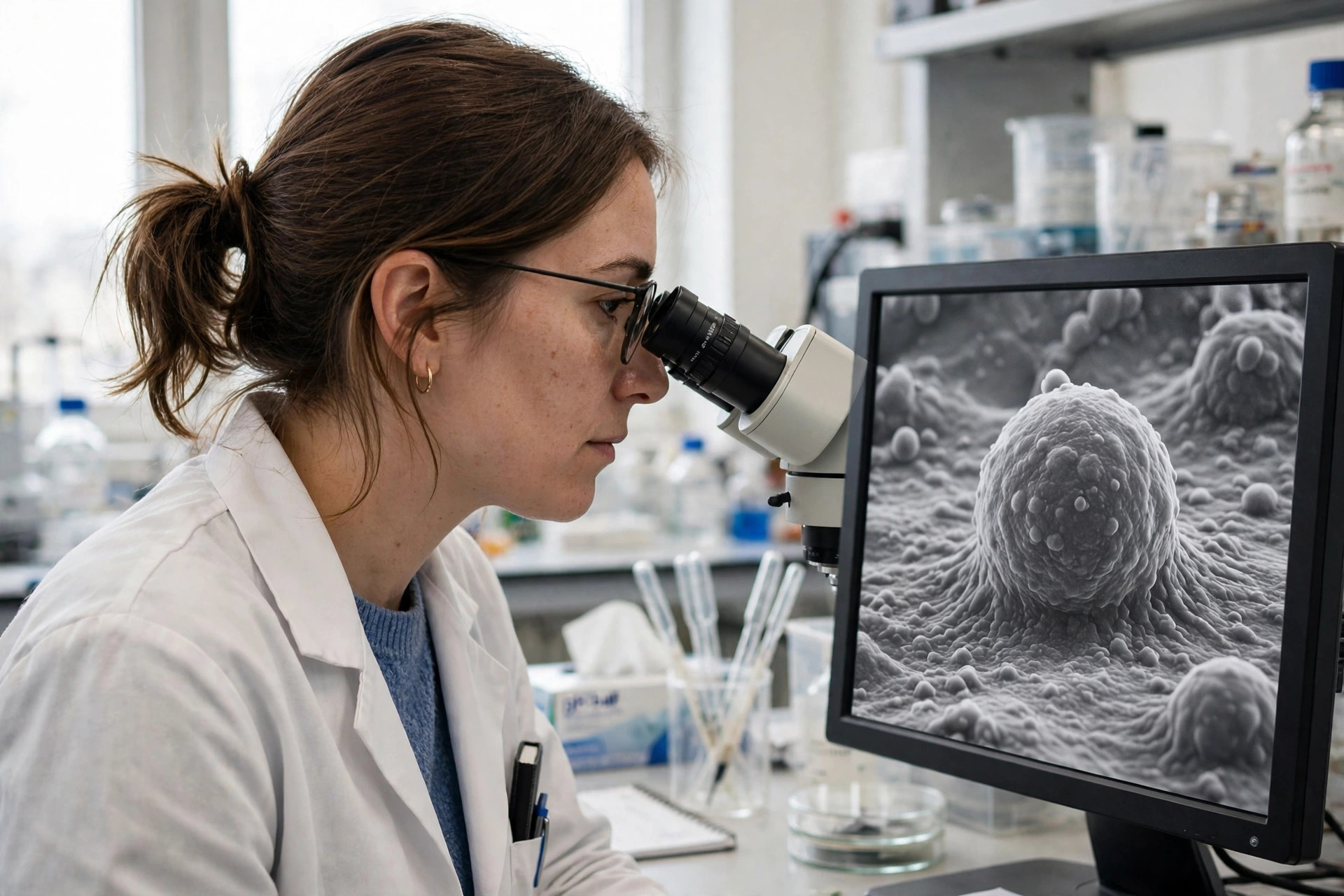
Scanning electron microscopy first spotted the structures around highly migratory breast cancer cell lines (MDA-MB-231, 4T1 and MCF7). Live-cell imaging showed the mechanism: as a cell migrates, a thin rear projection extends, a vesicle buds at its far tip, stays tethered by filamentous connections, then detaches and remains on the substrate as the cell pulls away — no free-floating MoVes were observed. Cross-sections under transmission electron microscopy showed a crowded interior: mitochondria, Golgi apparatus, endoplasmic reticulum, lysosomes and actin. Genomic and proteomic analyses found DNA spanning the parental genome with its mutational landscape, plus proteins tied to epithelial-to-mesenchymal transition and organelle biology — a signature distinct from canonical small and large extracellular vesicles.
Do the mitochondria inside MoVes actually work?
By the study's functional test, yes. MoVes carried mitochondria with intact membrane potential — the voltage mitochondria need to make ATP. When the team applied MoVes to a recipient cancer cell line depleted of its own mitochondrial DNA (a rho-zero line that cannot respire normally), MoVes significantly increased basal and maximal respiration and mitochondria-dependent ATP production (P = 0.0228), an effect directionally shared with other large vesicle types. In other words, a shed vesicle can hand working energy machinery to a cell that has none — in a dish. Whether recipient cells in a tumour ever take up MoVes, and whether that transfer matters to spread or treatment resistance, is not shown.
Why does the migration link matter — and where does the evidence stop?
The formation pattern is the provocative part. MoVes were absent from non-tumourigenic MCF10A breast epithelial cells; transforming those cells with the HRAS oncogene raised their motility roughly threefold (0.809 versus 0.24 micrometres per minute) and switched MoVes production on, and deliberately inducing epithelial-to-mesenchymal transition in non-cancerous cells sharply increased production, while aggressive triple-negative breast cancer cells produced far more MoVes than non-cancerous cells. That ties the vesicles to the very program that makes cancers invasive. The boundary: every result is from cultured cell lines and vesicle preparations. DNA findings describe pooled vesicle material, not a complete per-vesicle inventory; there is no animal or patient evidence, no diagnostic test, and no demonstrated role in metastasis. Expect 'cancer cells broadcast their genomes' headlines to outrun that boundary within days.
Frequently asked questions
What are MoVes?
Motile vesicles — a newly described type of large extracellular vesicle, 2 to 5 micrometres across, budded from the trailing edge of migrating cancer cells and left behind on the surface. They carry genomic DNA and organelles, including mitochondria.
Can MoVes transfer working mitochondria?
In laboratory dishes, yes: MoVes mitochondria held an intact membrane potential, and MoVes significantly increased respiration and mitochondria-dependent ATP production in recipient cells that had been stripped of their own mitochondrial DNA.
Do MoVes mean a new cancer test or treatment is coming?
Not on this evidence. The study is a laboratory characterisation in cultured cells, with no animal or patient data and no demonstration that MoVes drive metastasis.
Where the evidence stands
- Established: Cancer cells release extracellular vesicles carrying proteins, RNA and DNA; epithelial-to-mesenchymal transition makes epithelial cancer cells mobile and invasive; and transferred mitochondria can restore respiration in recipient cells lacking mitochondrial DNA in laboratory systems.
- Preliminary: In cultured breast cancer models (Nature Cell Biology, Oct 30, 2026; DOI 10.1038/s41556-026-02097-2), migrating cells shed 2-5 micrometre MoVes from their trailing edge carrying genomic DNA and organelles; their mitochondria held membrane potential and significantly raised respiration and mitochondrial ATP production in mtDNA-depleted recipient cells (P = 0.0228).
- Absent: Any in-vivo or patient evidence, proof MoVes drive metastasis, a validated MoVes test, and a complete per-vesicle cargo inventory.
Join the discussion
To get the conversation started: What questions does this story raise for you? Share them below — every comment is reviewed by our moderators before it appears.
Community discussion only — not medical advice. Every comment is reviewed by our moderators before it appears. Sign in with Google or a free Hyvor account to join in.