
Scientists mapped mitochondrial damage in Parkinson's most vulnerable neurons — and found the brain fighting back
·Tip: press play, then lock your phone or switch apps — the article keeps reading.
Most Parkinson's research chases the dopamine-producing neurons behind the tremor and stiffness. But some of the disease's cruelest symptoms — freezing of gait, fractured sleep, cognitive slide, psychosis — come from a different population entirely: acetylcholine-producing neurons in the brainstem. A new study in Brain gives the first single-cell view of mitochondrial DNA inside those vulnerable cells, and it reveals a battle in progress: extensive damage to the neurons' mitochondrial DNA, met by a rising quality-control response from the gene PINK1 — a response that ran strongest in people who survived longest after diagnosis.
What the single-cell view revealed
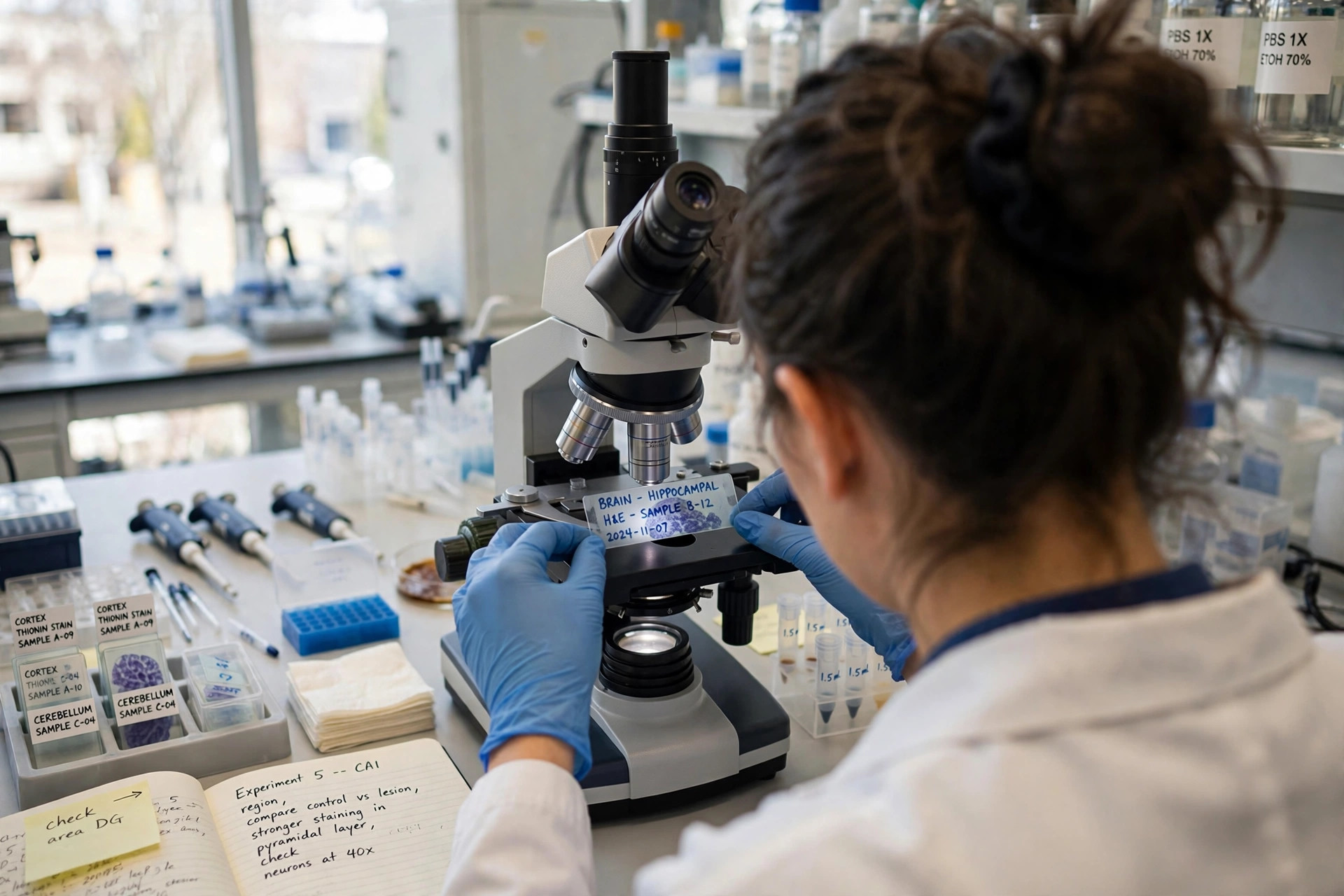
Huiwen Lu and colleagues at the University of Birmingham and Newcastle University applied advanced single-cell mitochondrial DNA sequencing to individual neurons from postmortem brain tissue donated by people with Parkinson's, plus healthy controls. Studying cells one by one exposed detail bulk sequencing smears away: the pontine cholinergic neurons carried extensive large-scale deletions in their mitochondrial DNA, concentrated in the 'major arc' — a stretch that holds many of the genes the cell needs to produce energy.
Damaged mitochondrial DNA means compromised energy production, and neurons that fire constantly to govern sleep, cognition, and movement are the least able to tolerate it. The finding reframes these neurons' vulnerability as, at least in part, a mitochondrial story — not just an alpha-synuclein one.
The brain's own defense — strongest in longer survivors
Alongside the damage, the team found the neurons fighting back. Affected cells had increased levels of PINK1 — the mitochondrial quality-control gene whose job is to flag damaged mitochondria for disposal so healthy ones can keep the energy flowing. Mutations in PINK1 cause rare inherited Parkinson's, so seeing the gene rise here is a signal the brain is mounting a defense.
Here's the part that matters: higher PINK1 was most pronounced in neurons from people who had lived longer after their Parkinson's diagnosis. The longer survivors' cells showed the strongest quality-control response — suggesting, cautiously, that a more vigorous mitochondrial cleanup may help some neurons withstand damage longer. That association is not proof of protection; the surviving neurons could simply be the ones that always had stronger defenses. But it points at a biological pathway — the brain's own mitochondrial maintenance — as a therapeutic target worth pursuing.
Where the evidence stands
- Established: The studied brainstem neurons produce acetylcholine, a messenger for sleep, cognition, and movement; their loss tracks with Parkinson's most disabling, treatment-resistant symptoms.
- Preliminary: Extensive major-arc mtDNA deletions in pontine cholinergic neurons with compensatory PINK1 upregulation — one study of postmortem tissue; the protective interpretation rests on the longer-survivor association.
- Absent: Proof that boosting PINK1-driven quality control slows Parkinson's progression in living patients; any therapeutic application.
Join the discussion
To get the conversation started: What questions does this story raise for you? Share them below — every comment is reviewed by our moderators before it appears.
Community discussion only — not medical advice. Every comment is reviewed by our moderators before it appears. Sign in with Google or a free Hyvor account to join in.