
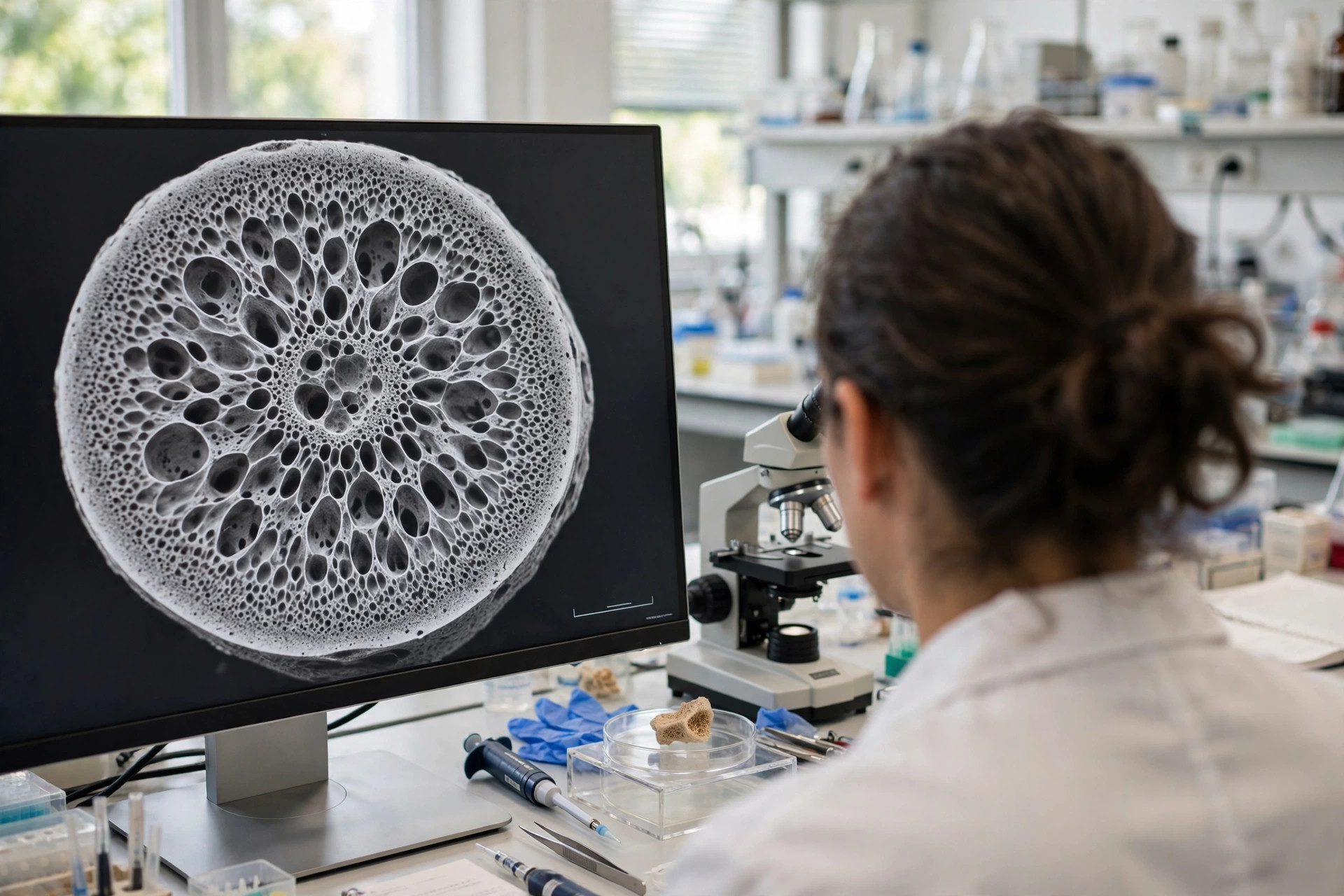
A mitochondrial enzyme guards bone-building cells as they age — losing it sped bone loss in mice
Edited by Samael A. Tejada, Founder & Editor-in-Chief
·Tip: press play, then lock your phone or switch apps — the article keeps reading.
In mice, losing the mitochondrial enzyme SIRT5 caused succinyl-tag buildup, loss of the fatty-acid-burning protein HADHA, DNA-damage-linked R-loop accumulation in bone-building cells, and faster age-related trabecular bone loss; restoring SIRT5 with a viral vector reversed the pattern and eased bone loss. The work is mouse and cell evidence only, with no human data.
A mitochondrial enzyme best known for tidying metabolic proteins turns out to be standing guard over the genome of bone-building cells. Remove it, and ageing bone loses both its fat-burning machinery and its DNA housekeeping. Put it back, in mice, and bone holds up better. The distance from that result to a treatment is long — and this page keeps it measured.
How does a mitochondrial enzyme end up protecting DNA?
Through chemistry and consequence. SIRT5 removes succinyl groups — small chemical tags that change how proteins behave — and the study found that in ageing bone, the upstream regulator PRMT6 normally keeps SIRT5 levels up. When SIRT5 is absent, succinylation accumulates across many proteins, including multi-site tagging and loss of HADHA, the alpha subunit of the mitochondrial trifunctional protein that performs fatty-acid oxidation. In osteoblasts, that loss was accompanied by broad accumulation of R-loops — three-stranded DNA-RNA tangles that form around transcription start sites and, when they pile up, damage DNA. The authors' model is a single axis: PRMT6 maintains SIRT5, SIRT5 protects HADHA and restrains R-loops, and bone-forming cells stay functional longer.
What did the knockout and rescue experiments show?
The loss-of-function side used naturally aged mice alongside Sirt5-knockout and Prmt6-knockout animals, plus primary osteoblasts aged in culture or stressed with hydrogen peroxide. Sirt5-deficient mice showed more trabecular bone loss and weaker bone formation than wild-type mice, with lower Runx2, ALPL and OCN, higher p16 and p21, lower alkaline phosphatase activity and more senescence-stained cells; Prmt6 deficiency lowered Sirt5 and phenocopied the loss. The gain-of-function side is the stronger test: AAV5-mediated Sirt5 overexpression restored HADHA, attenuated R-loops and senescence markers, and alleviated trabecular bone loss. Ageing signals were cross-checked against public single-cell RNA-sequencing datasets from mouse bone marrow. What the fetched primary text does not provide is group sizes or numeric bone-density effect sizes, so this page reports the direction of the findings, not magnitudes it cannot verify.
What would it take for this to matter to patients?
Everything that is currently missing. There is no human bone tissue data in this study, no demonstration that raising SIRT5 in a person is feasible or safe, and no drug that does so — the rescue used a viral gene-delivery vector in mice, a long road from a clinic therapy. Osteoporosis already has effective, proven treatments; a mitochondrial-enzyme pathway would have to show it adds something they do not. What the study genuinely adds is a mechanism: a named axis connecting mitochondrial protein quality control to genome stability in the cells that build bone, with a rescue experiment behind it. The authors' own framing matches that scale — targeting the pathway, they write, may represent a potential therapeutic strategy.
Frequently asked questions
What is SIRT5?
SIRT5 is a mitochondrial enzyme (a desuccinylase) that removes succinyl chemical tags from proteins, regulating metabolic adaptation. In this study it protected HADHA, a fatty-acid-burning mitochondrial protein, in bone-building cells.
What happened to mice without SIRT5?
They lost more trabecular bone with age and formed bone less well, with lower bone-building markers (Runx2, ALPL, OCN), higher senescence markers (p16, p21), and accumulation of DNA-damaging R-loops in osteoblasts.
Is there a SIRT5 treatment for osteoporosis?
No. The rescue in this study used a viral vector to add Sirt5 in mice. There is no human data and no SIRT5-raising drug; proven osteoporosis treatments remain the standard of care.
Where the evidence stands
- Established: SIRT5 is a mitochondrial desuccinylase that regulates metabolic adaptation by removing succinyl tags from proteins; HADHA is a core subunit of the mitochondrial fatty-acid-oxidation machinery; and R-loop accumulation is a recognized source of DNA damage and cellular senescence.
- Preliminary: In naturally aged and knockout mice and cultured primary osteoblasts (Cell Death Discovery, Oct 31, 2026; DOI 10.1038/s41420-026-03354-x), SIRT5 loss drove succinylation accumulation, HADHA loss, R-loop buildup and accelerated trabecular bone loss, while AAV5-mediated Sirt5 restoration reversed HADHA loss, R-loops and senescence and alleviated bone loss.
- Absent: Human bone data of any kind, verified group sizes and effect magnitudes, a deliverable human SIRT5-raising intervention, and any comparison with existing osteoporosis treatments.
Join the discussion
To get the conversation started: What questions does this story raise for you? Share them below — every comment is reviewed by our moderators before it appears.
Community discussion only — not medical advice. Every comment is reviewed by our moderators before it appears. Sign in with Google or a free Hyvor account to join in.