
A newly found protein acts as a pillar that sets the space inside mitochondria
Edited by Samael A. Tejada, Founder & Editor-in-Chief
·Tip: press play, then lock your phone or switch apps — the article keeps reading.
Every mitochondrion is a room inside a room: an outer membrane, an inner membrane, and between them the intermembrane space (IMS), the narrow compartment where much of the chemistry of energy production is staged. The new work shows that compartment is not left to chance — its height is genetically set, by a pillar.
What does SPRIZ actually do?
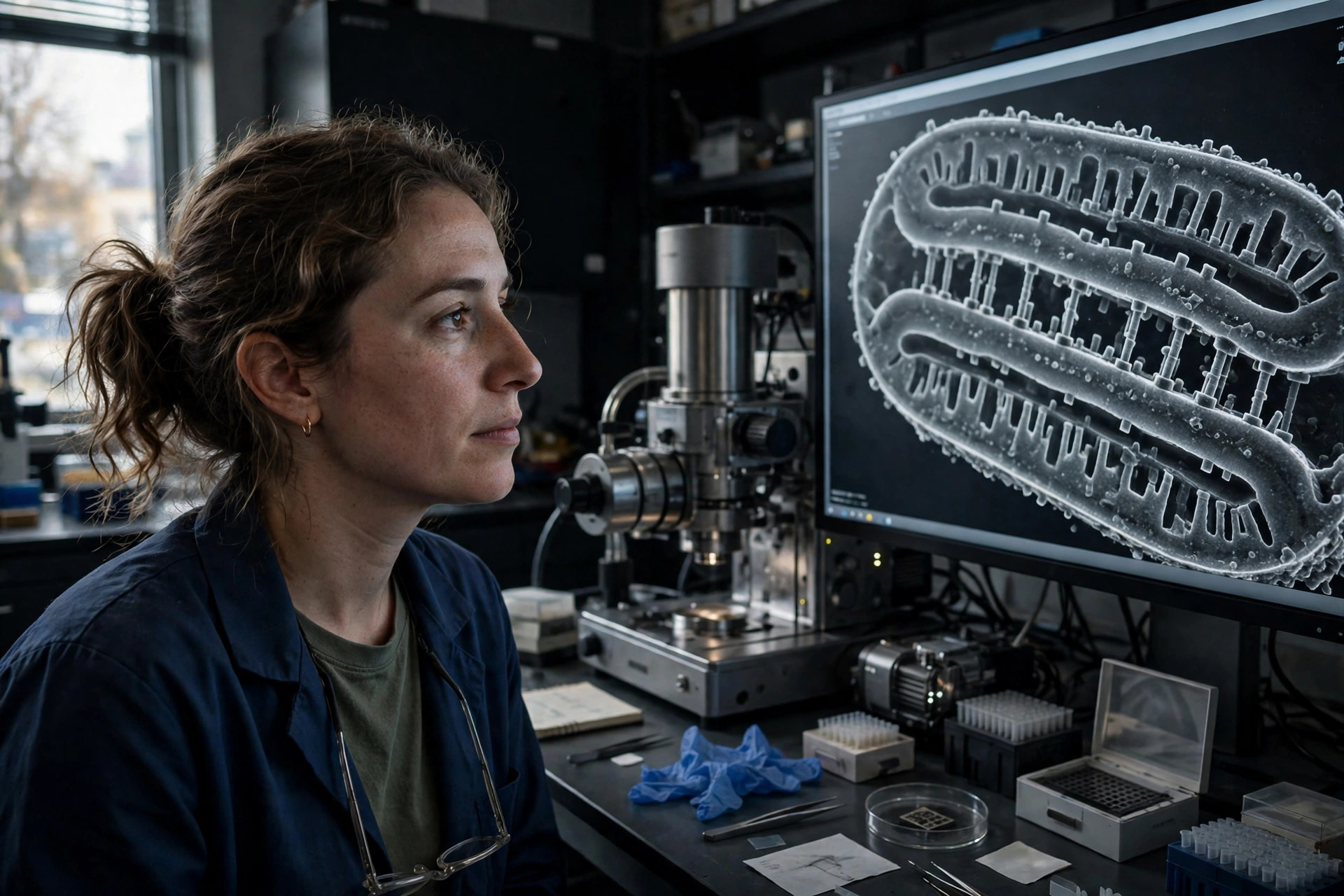
SPRIZ — short for SPatial Regulator of the mitochondrial Intermembrane Zone — bridges the two membranes as a rigid OMM–IMM tether. Most tethers pull membranes together so they can exchange material; SPRIZ instead holds them a set distance apart, more like a spacer bar than a zipper, in Pellegrini's framing. The team combined molecular simulations, genetics, large-scale protein analysis and three-dimensional electron tomography to show the pillar in place and to measure the space it sets.
What happens when you change the height of the room?
Altering the system substantially changed IMS size. Engineering a longer version of the pillar pushed the membranes farther apart; the expanded space let molecules gain greater access to the compartment and changed mitochondrial calcium uptake — a central signaling and metabolic function. 'A change of only a few nanometres in the height of that room is enough to slow the calcium that must cross it to reach the reactor,' Pellegrini says. In mice, removing the SPRIZ gene altered membrane spacing while leaving overall mitochondrial structure intact, and the animals remained viable — evidence the protein's job is specifically to set that dimension.
Why does an ancient spacing system matter for disease?
The evolutionary analysis places SPRIZ's emergence around the origin of vertebrates, roughly 500 million years ago: it is present in humans and every other vertebrate examined, and absent from plants, fungi and invertebrates such as sponges, worms and insects. The researchers argue that as animal tissues diversified, tailoring IMS dimensions may have given cells another way to tune energy production. Disrupted spacing is now a candidate mechanism to examine in diseases where mitochondria fail to meet energy needs or damaged mitochondria are not cleared, including Parkinson's disease — a hypothesis, not a demonstrated link in patients.
Frequently asked questions
What is SPRIZ?
SPRIZ is a protein (gene name CCDC127) that spans the space between a mitochondrion's outer and inner membranes, acting as a rigid pillar that holds the membranes a set distance apart and locally controls the volume of the intermembrane space.
What is the mitochondrial intermembrane space?
It is the narrow compartment between a mitochondrion's outer membrane and its inner membrane. It helps sustain the chemistry of energy production, and its dimensions affect how molecules and calcium signals reach the machinery inside.
What happened when researchers changed the spacing?
Engineering a longer SPRIZ pillar pushed the membranes farther apart. The expanded space changed molecular access and slowed mitochondrial calcium uptake. Deleting the gene in mice changed the spacing while leaving overall mitochondrial structure intact.
Does SPRIZ cause or treat any disease?
No such link has been shown. The researchers propose that disrupted spacing could be worth examining in diseases where mitochondria fail, including Parkinson's disease, but there are no human disease data and no intervention targeting SPRIZ.
Where the evidence stands
- Established: Mitochondria have outer and inner membranes separated by the intermembrane space, a compartment central to energy-production chemistry and calcium signaling.
- Preliminary: In cell and mouse work (Science Advances, Oct 14, 2026), SPRIZ/CCDC127 acted as a rigid membrane tether locally setting IMS volume; lengthening it expanded the space, changed molecular access and calcium uptake, and deleting it in mice changed spacing without disrupting overall mitochondrial structure.
- Absent: Human disease data linking SPRIZ or IMS spacing to any condition, and any intervention targeting this spacing system.
Join the discussion
To get the conversation started: What questions does this story raise for you? Share them below — every comment is reviewed by our moderators before it appears.
Community discussion only — not medical advice. Every comment is reviewed by our moderators before it appears. Sign in with Google or a free Hyvor account to join in.