
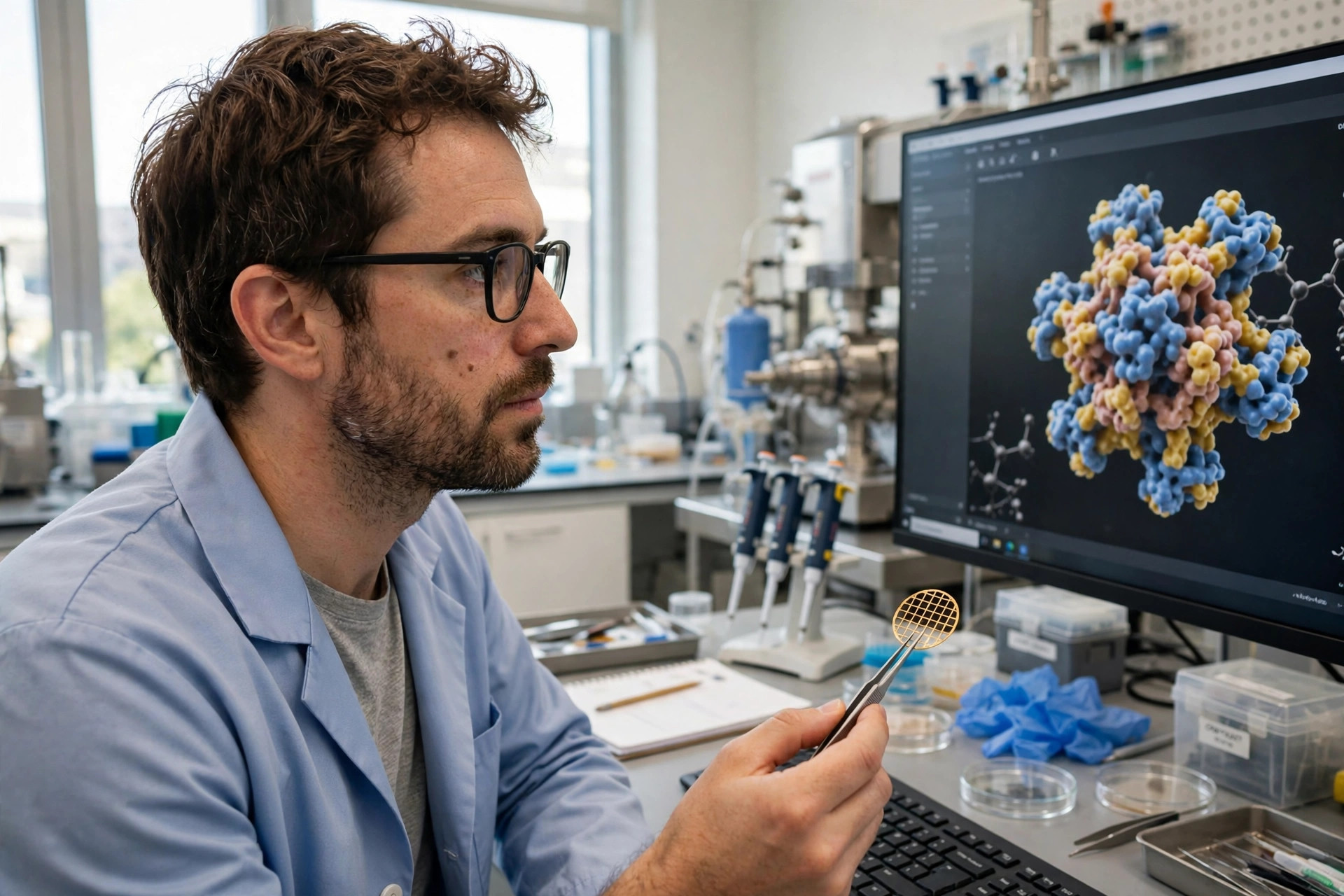
How mitochondria keep protein production moving: a helper protein caught in the act — in lab models
Edited by Samael A. Tejada, Founder & Editor-in-Chief
·Tip: press play, then lock your phone or switch apps — the article keeps reading.
Karolinska researchers used cryo-electron microscopy to capture human TACO1 bound to a mitochondrial ribosome, showing it stabilizes the incoming transfer RNA at the A site to keep protein synthesis moving through difficult proline-rich sequences (Nature Communications, reported November 5, 2026). It is basic structural biology — no treatment was tested — that helps explain TACO1-linked mitochondrial diseases including Leigh syndrome.
Every energy-producing enzyme your mitochondria run on starts as a protein that must be built without stalling. This study photographs the helper that keeps the assembly line moving.
What did the structure show?
TACO1 binds close to the mitoribosome's A site — the slot where each new amino acid arrives on a transfer RNA — and interacts directly with that incoming tRNA. Combining cryo-EM with AlphaFold analysis, computational modeling and molecular dynamics simulations, the team proposes that TACO1 can undergo substantial movements that help position and stabilize the tRNA during the challenging steps. Lead corresponding author Joanna Rorbach describes it as 'a distinct solution to a challenge faced by all ribosomes: keeping protein synthesis moving through difficult sequences.'
Why does TACO1 matter for disease?
Mutations in TACO1 are associated with cytochrome c oxidase deficiency — a shortfall in a central enzyme of mitochondrial energy production — and with late-onset Leigh syndrome, a severe neurological disease. Until now, exactly how TACO1 helps translation, and therefore how its failure breaks protein synthesis, was unclear. First author Vivek Singh and co-corresponding author Anas Khawaja note the findings connect changes in TACO1 to defects in mitochondrial protein synthesis, offering a clearer molecular basis for the associated diseases.
What are the limits?
This is a frozen structure plus computation: the proposed movements are drawn from modeling, not filmed in a living cell, and the study tests no treatment and shows no way to fix a broken TACO1. Its value is foundational — a precise map of a machine whose failure causes human disease, of the kind that drug and gene-therapy design eventually builds on. Readers should file it as basic biology done well, not as a therapy announcement.
Frequently asked questions
What is TACO1?
A protein factor that helps mitochondrial ribosomes continue protein synthesis through difficult sequences, such as runs of proline. This study imaged it bound to a human mitoribosome.
What diseases is TACO1 linked to?
Mutations in TACO1 are associated with cytochrome c oxidase deficiency and late-onset Leigh syndrome, both mitochondrial diseases.
Does this lead to a treatment?
Not directly. It is basic structural biology that explains how TACO1 works and how its failure may impair mitochondrial protein synthesis. No treatment was tested.
Where the evidence stands
- Established: Mitochondria synthesize essential proteins on mitoribosomes; proline-rich sequences stall ribosomes; TACO1 mutations are associated with cytochrome c oxidase deficiency and late-onset Leigh syndrome.
- Preliminary: The TACO1 mechanism: one cryo-EM structural study with AlphaFold and molecular-dynamics modeling (Nature Communications, 2026). The movement model is inferred from simulation, not directly observed in living cells.
- Absent: Therapeutic evidence — no intervention targeting TACO1 has been tested in this study or established for the diseases it is linked to.
Join the discussion
To get the conversation started: What questions does this story raise for you? Share them below — every comment is reviewed by our moderators before it appears.
Community discussion only — not medical advice. Every comment is reviewed by our moderators before it appears. Sign in with Google or a free Hyvor account to join in.