
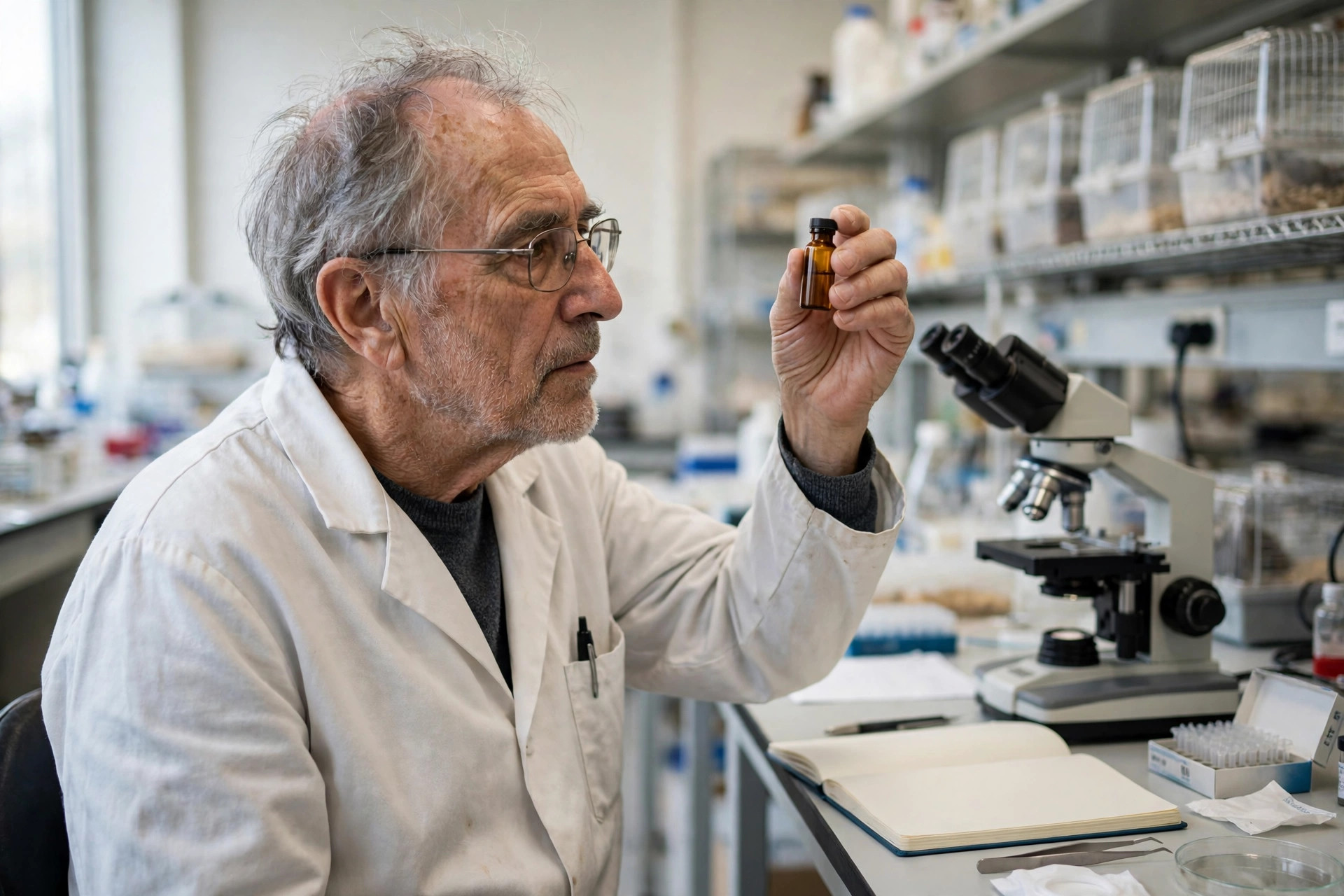
A blood-sugar mineral cleared senescent cells and extended lifespan — in mice
Edited by Samael A. Tejada, Founder & Editor-in-Chief
·Tip: press play, then lock your phone or switch apps — the article keeps reading.
Vanadyl sulfate, a vanadium compound sold as a blood-sugar supplement, selectively killed senescent cells by oxidizing their altered reactive cysteines and, given in drinking water for three months to aged male mice, extended median survival from 886.5 to 952 days (Nature Aging, November 6, 2026). The evidence is mice only — males only for lifespan — with a narrow safety window and no human data.
Old cells that will not die are a liability the body carries for decades. This study finds their chemistry betrays them — a specific pattern of reactive cysteines that a simple mineral compound can exploit, at least in mice.
What did vanadyl sulfate do to senescent cells?
The team first mapped how protein cysteine reactivity changes as cells become senescent, then screened for compounds that exploit that change. Vanadyl sulfate selectively oxidized the reactive cysteines enriched in senescent cells, triggering catastrophic protein aggregation and an autophagic form of cell death, while healthy, non-senescent cells were spared. That selectivity is the whole ballgame for a senolytic: a compound that killed old and young cells alike would be a poison, not a therapy candidate.
What happened in the aged mice?
Two animal designs were used. In phenotype experiments, young (12-week-old) and old (76-week-old) male mice received vanadyl sulfate in drinking water (0.15 mg per ml) for 13 weeks; treated aged mice showed doubled hanging grip endurance, reduced visceral fat, and reversal of hepatic and renal decline markers reported by the team and its coverage. In the separate lifespan experiment, male mice starting at 70 weeks of age received vanadyl sulfate in drinking water from day 500 for three months (n=19 treated, n=20 controls), and median survival increased to 952 days versus 886.5 days in controls, with significantly extended overall lifespan. A dose-finding arm using gavage (34.1 mg per kg, three times weekly for four weeks) reduced senescence transcripts in kidney. Serum vanadium on the drinking-water regimen measured about 300 micrograms per litre.
Why the strong caveats?
Four reasons. First, species: mouse senolytic results have repeatedly failed to translate directly to people. Second, scope: the lifespan result is in males only; a separate female arm showed improved muscle endurance and metabolic parameters and reduced senescent burden, but no female lifespan result. Third, dose and safety: vanadium has a narrow therapeutic window, with pulmonary and renal toxicity at excess exposure, and the mouse regimen is far above the 10-30 mg per day typical of consumer supplements — secondary coverage estimated a human-equivalent dose near 290-330 mg per day, which is precisely why nobody should improvise this at home. Fourth, interest: a senior author is an inventor on a pending US patent application for vanadyl sulfate compositions for aging-related diseases, disclosed in the paper. The honest summary: a rigorous, interesting mouse result that nominates cysteine reactivity as a senolytic target — and no basis for taking the supplement for longevity.
Frequently asked questions
What is vanadyl sulfate?
A vanadium compound long sold as an over-the-counter supplement, mainly marketed for blood sugar. This study tested it as a senolytic — a compound that selectively kills senescent cells — in cells and aged mice.
How much longer did the mice live?
In the lifespan experiment, aged male mice given vanadyl sulfate in drinking water for three months had a median survival of 952 days versus 886.5 days in controls — 65.5 days longer (Nature Aging, 2026).
Should I take vanadyl sulfate for longevity?
No. The result is in mice only, the lifespan arm was males only, vanadium has a narrow safety window with pulmonary and renal toxicity at excess doses, and the mouse dose was far above typical supplement doses. There are no human data.
Where the evidence stands
- Established: Senescent cells accumulate with age and contribute to tissue decline; selective senolysis is an established research strategy; vanadium compounds have a narrow therapeutic window with known pulmonary and renal toxicity at excess exposure.
- Preliminary: Vanadyl sulfate as a senolytic: one Nature Aging study (2026) with a cysteine-reactivity mechanism in cells and lifespan extension in one male mouse cohort (median 952 vs 886.5 days). No replication, no female lifespan data, no mammalian safety package for this use.
- Absent: Human evidence of any kind — no clinical trial, dosing or safety data for vanadyl sulfate on aging or senescence outcomes in people.
Join the discussion
To get the conversation started: What questions does this story raise for you? Share them below — every comment is reviewed by our moderators before it appears.
Community discussion only — not medical advice. Every comment is reviewed by our moderators before it appears. Sign in with Google or a free Hyvor account to join in.