
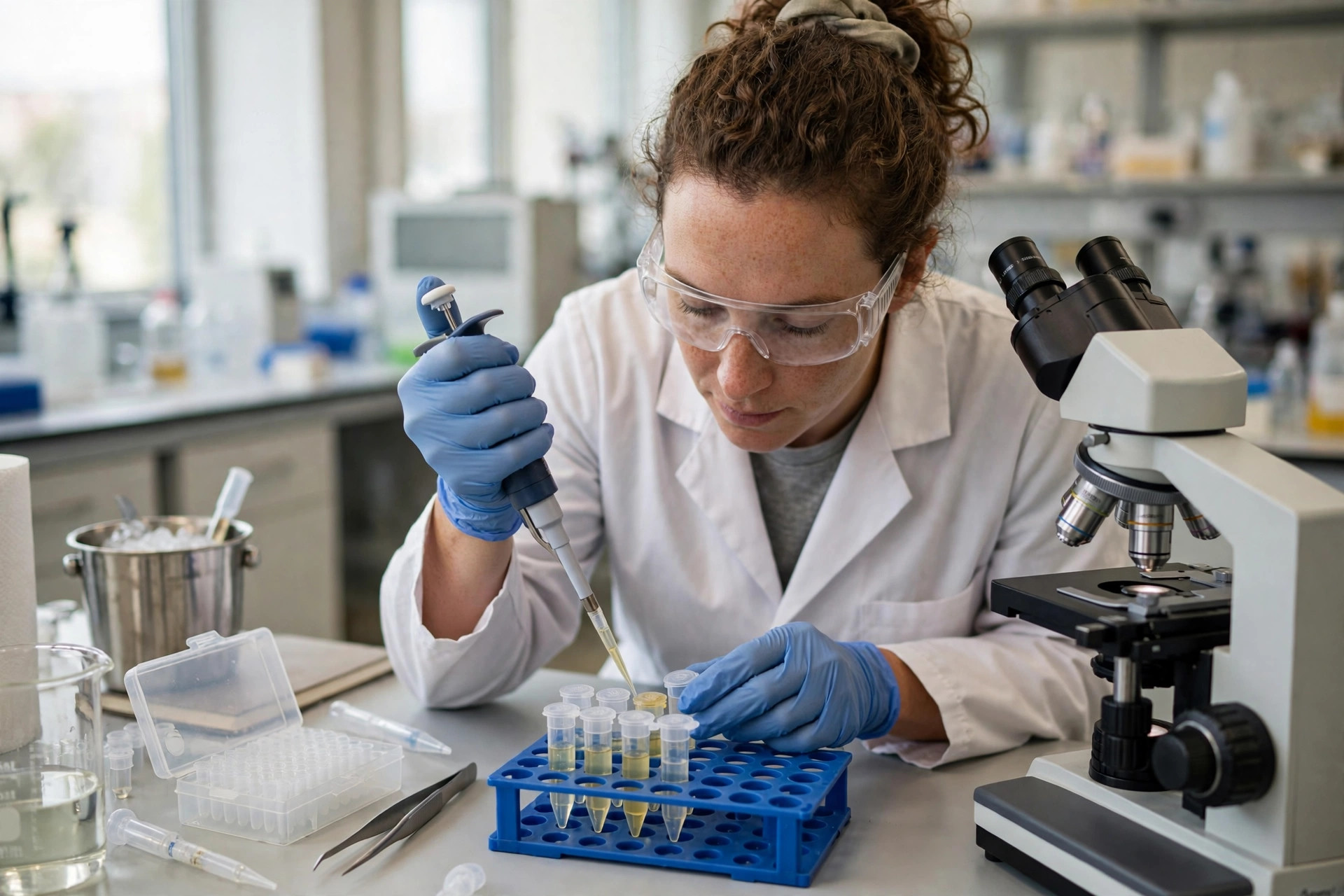
A gentler way to harvest mitochondria recovered twice as many intact organelles in 30 minutes — and they still worked after transplant — in lab-grown cells
Edited by Samael A. Tejada, Founder & Editor-in-Chief
·Tip: press play, then lock your phone or switch apps — the article keeps reading.
The Gentle-Mito workflow isolated intact mitochondria from cultured cells within 30 minutes at more than twice the recovery of conventional methods, preserving enzyme activity and calcium responses, a Frontiers in Molecular Biosciences methods study reports (2026). Transplanted mitochondria entered recipient cells, stayed active over 48 hours and restored metabolic activity in drug-resistant lung cancer cells; all evidence is in cell cultures.
Mitochondrial medicine cannot test or transplant what it cannot harvest intact. Gentle-Mito's claim is simple — faster, gentler, higher yield — and the study checks the harvested organelles the way a sceptic would: structure, enzymes, calcium handling, and function after transplant.
How does Gentle-Mito work?
After gentle lysis, positively charged aluminium species adsorb to the negatively charged outer mitochondrial membrane, neutralising surface charge and inducing aggregation so mitochondria sediment at low speed — avoiding the harsh mechanical shear and long high-speed spins of conventional differential centrifugation that damage organelles and leak matrix proteins.
How intact were the harvested mitochondria, really?
They retained intact morphology, preserved citrate synthase activity (a standard marker of mitochondrial content and integrity), and showed robust calcium-induced swelling. The method also supported mitochondrial DNA isolation, which matters for accurate mtDNA copy-number testing — a widely used measure of mitochondrial abundance and biogenesis.
Why does a better harvest matter beyond the lab bench?
Mitochondrial transplantation — introducing healthy mitochondria into compromised cells — depends entirely on organelle quality. Here, transplanted Gentle-Mito mitochondria were efficiently internalised, improved gap closure, remained functionally active for more than 48 hours with no detectable cytotoxicity, and re-sensitised osimertinib-resistant lung cancer cells to treatment. That is cell-culture evidence, but it is the kind of platform result translational work builds on.
Frequently asked questions
What is mitochondrial isolation?
Separating mitochondria from the rest of a broken-open cell so their function, DNA and proteins can be measured — or so they can be transplanted into other cells.
What is citrate synthase activity?
A standard laboratory marker: this mitochondrial enzyme's activity indicates how much intact mitochondrial material a sample contains.
Is mitochondrial transplantation a clinical treatment?
Not yet. It is an experimental approach tested mainly in cells and animals; this study improves the harvest step it depends on.
Where the evidence stands
- Established: Conventional mitochondrial isolation is slow, variable and can damage organelles; citrate synthase activity and calcium responsiveness are standard integrity checks; mtDNA copy number is a common mitochondrial biomarker.
- Preliminary: Gentle-Mito's yield, integrity and transplant performance: one methods study (Frontiers in Molecular Biosciences, 2026) across cultured human and mouse cell lines.
- Absent: Performance in human tissue samples, clinical-grade manufacturing data, and any patient use.
Join the discussion
To get the conversation started: What questions does this story raise for you? Share them below — every comment is reviewed by our moderators before it appears.
Community discussion only — not medical advice. Every comment is reviewed by our moderators before it appears. Sign in with Google or a free Hyvor account to join in.