
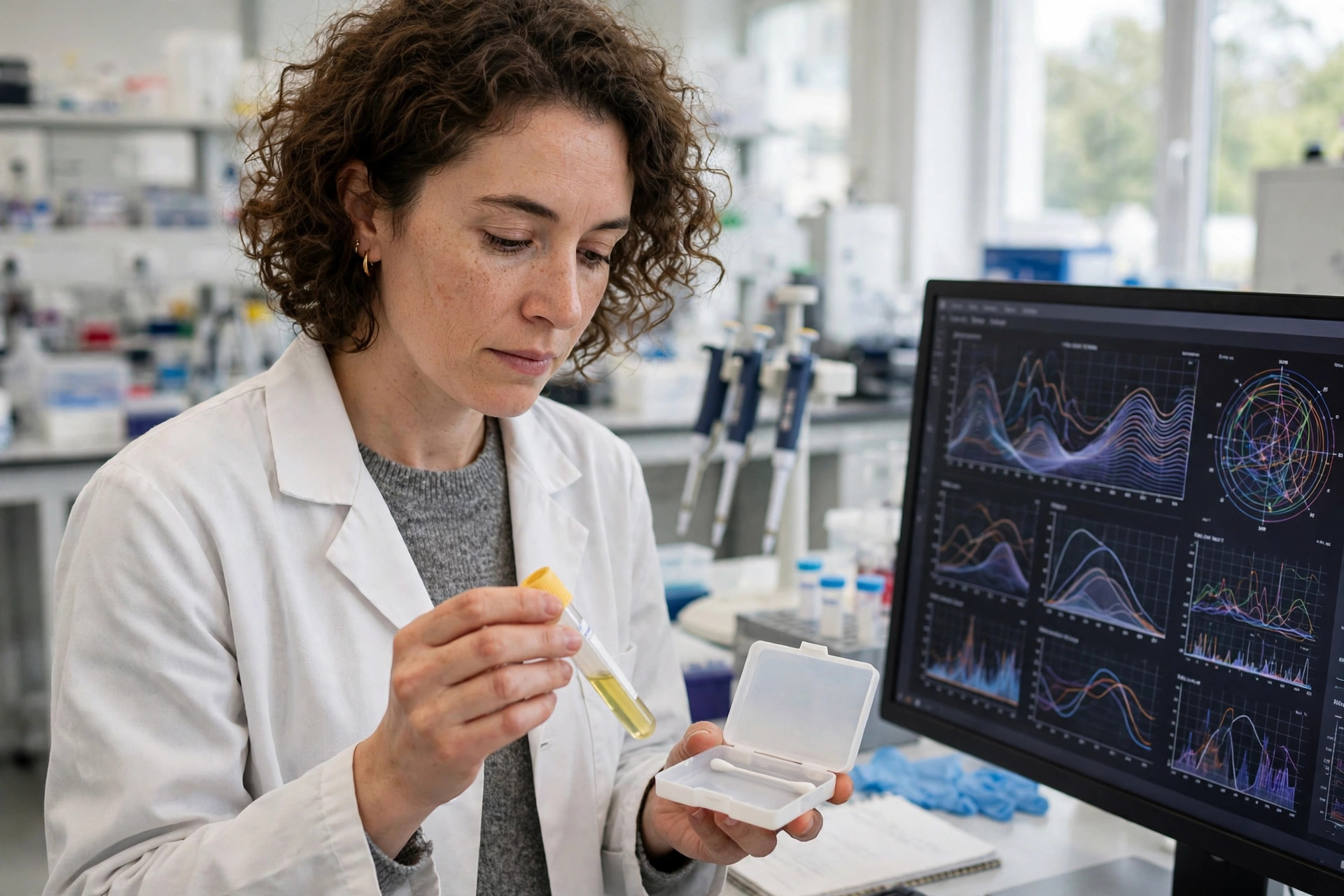
For mitochondrial diabetes, a urine sample found what a blood test can miss
Edited by Samael A. Tejada, Founder & Editor-in-Chief
·Tip: press play, then lock your phone or switch apps — the article keeps reading.
In 496 people referred with suspected monogenic diabetes, mitochondrial DNA sequencing found a pathogenic variant in 4.23%, most often m.3243A>G (Frontiers in Endocrinology, November 11, 2026). Mutation levels were highest in urine sediment (60.7%), then cheek cells (39.1%) and blood (21.6%), and blood levels fell with age — so a blood-only test can miss the diagnosis, particularly in older patients.
A mitochondrial diagnosis can hide in the sample you did not take. In the largest tissue comparison of its kind in this population, the mutation showed up most clearly in urine — and faded in blood with every year of age.
What did the study test?
The team performed next-generation sequencing of mitochondrial DNA in 496 patients (255 women and 241 men; median age 17) referred between 2022 and 2025 with suspected monogenic diabetes after causative nuclear-gene variants had been excluded. Clinical analysis covered 53 individuals from 31 families. In 30 carriers of the m.3243A>G variant, heteroplasmy — the proportion of mitochondrial DNA copies carrying the mutation — was quantified in urine sediment and buccal swabs, and in peripheral blood at two time points.
Why does the tissue matter so much?
Because the same person gives three different answers. Mean heteroplasmy was 60.7% in urine sediment, 39.1% in buccal swabs and 21.6% in blood (p < 0.0001 for the hierarchy), and blood heteroplasmy decreased by 0.58% per year of age (p < 0.0001). A blood sample from an older carrier can therefore read low — or miss the variant's significance — while a urine sample from the same person shows it plainly. The authors state the practical conclusion directly: urine sediment appears to be the most informative material for assessing heteroplasmy, and analysis of blood alone may be insufficient to establish the genetic basis of mitochondrial diabetes, particularly in older patients.
What did not show up?
No significant association was found between heteroplasmy in any tissue and specific clinical features, although the authors note statistical power was limited. Three further probands carried rare mitochondrial tRNA variants of uncertain significance, two of them in MT-TL2 — a gene the authors say warrants further functional study. Mitochondrial diabetes accounts for roughly 0.5-3.0% of all diabetes and is most often maternally inherited diabetes and deafness (MIDD), driven by beta-cell dysfunction and impaired insulin secretion, which is why it is so often mistaken for common diabetes.
Frequently asked questions
What is mitochondrial diabetes?
A rare monogenic form of diabetes caused by mitochondrial DNA variants — most often m.3243A>G — accounting for roughly 0.5-3.0% of diabetes. It is usually maternally inherited and often presents as maternally inherited diabetes and deafness (MIDD).
Why can a blood test miss it?
The share of mutated mitochondrial DNA (heteroplasmy) is much lower in blood (mean 21.6% in this study) than in urine sediment (60.7%), and blood levels fall by about 0.58% per year of age, so blood alone may be insufficient, especially in older patients.
What sample does the study recommend?
Urine sediment, which the authors found to be the most informative material for assessing heteroplasmy, with buccal swabs intermediate between urine and blood.
Where the evidence stands
- Established: Mitochondrial diabetes (most often MIDD, caused mainly by m.3243A>G) accounts for about 0.5-3.0% of diabetes, stems from beta-cell dysfunction, and is frequently mistaken for type 1 or type 2 diabetes.
- Preliminary: The tissue hierarchy and diagnostic recommendation: one cohort study (Frontiers in Endocrinology, 2026) of 496 referred Polish patients, with heteroplasmy measured in 30 m.3243A>G carriers. The heteroplasmy-phenotype analysis was underpowered by the authors' own account.
- Absent: Evidence that changing the default sample type improves patient outcomes — the study addresses diagnostic yield and measurement, not treatment results.
Join the discussion
To get the conversation started: What questions does this story raise for you? Share them below — every comment is reviewed by our moderators before it appears.
Community discussion only — not medical advice. Every comment is reviewed by our moderators before it appears. Sign in with Google or a free Hyvor account to join in.