
The Estimate and the Measurement: How WHOOP and PNOE Arrive at Your VO2 Max — and Which Number to Trust
·Tip: press play, then lock your phone or switch apps — the article keeps reading.
VO2 max — the maximum rate at which your body can take in and use oxygen during hard exercise — is one of the most meaningful numbers in health. It predicts cardiovascular risk and all-cause mortality more strongly than many traditional risk factors, and it is trainable at almost any age. It is also, physiologically, a whole-system number: lungs, heart, blood, and finally the mitochondria in your muscle fibers, where the oxygen is actually consumed. That is exactly why so many people want it — and why it matters which device's version of it you believe.
What it actually takes to measure VO2 max
Start with the physics. Oxygen consumption is defined by the Fick principle: VO2 equals cardiac output multiplied by the difference in oxygen content between arterial and venous blood. You cannot read that off a wrist. The only way to measure VO2 directly is to capture the air a person breathes — how much air moves in and out, and how much oxygen and carbon dioxide are in each breath — while they exercise to exhaustion. That is what a laboratory metabolic cart does during a cardiopulmonary exercise test (CPET), and it is the gold standard every other method is judged against.
Any device that does not sample your breath is, by definition, estimating. That is not a criticism — estimates can be useful — but it frames the comparison honestly.
PNOE: a metabolic cart that fits in a backpack
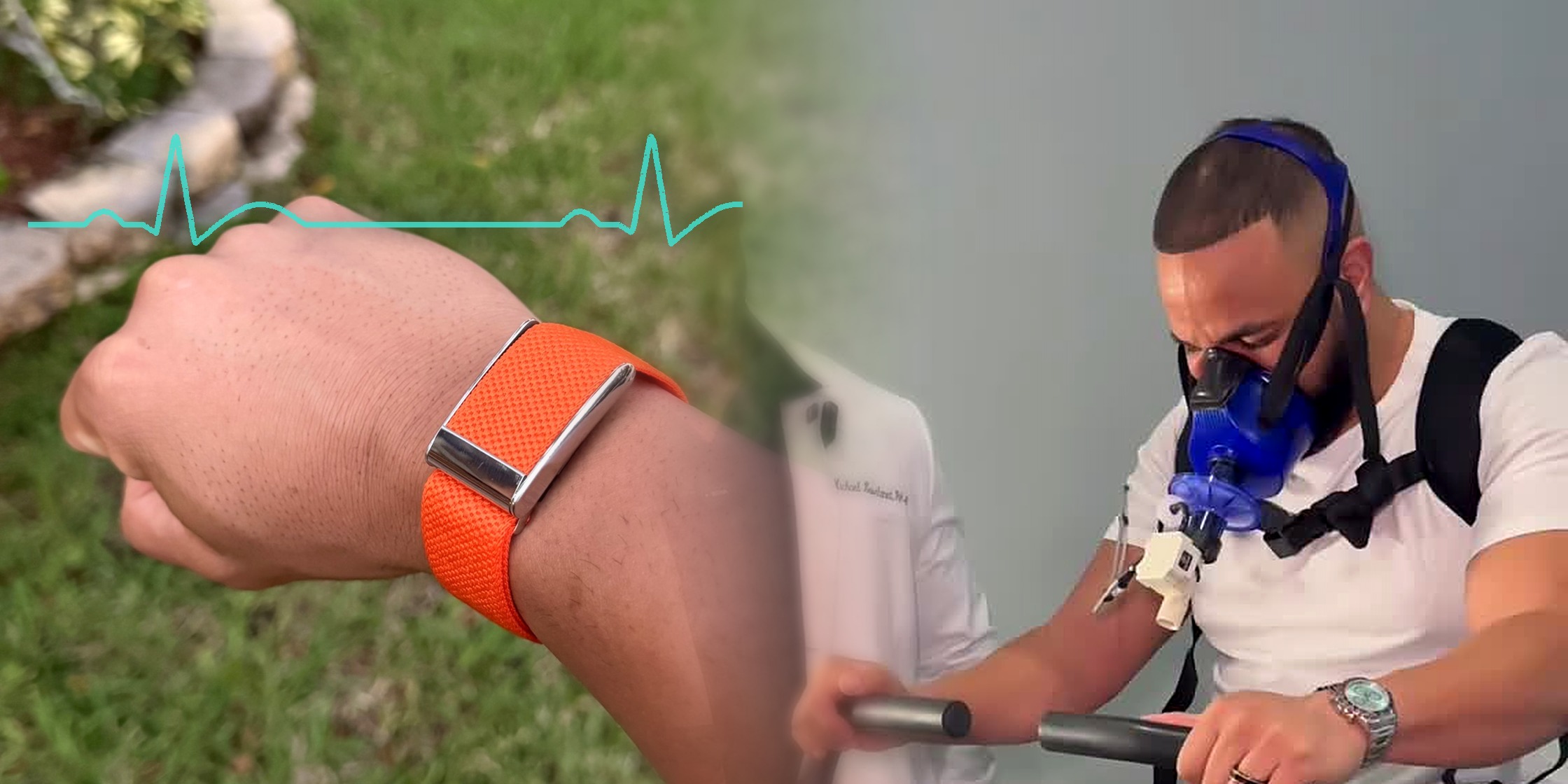
PNOE is a portable metabolic analyzer. You wear a mask connected to a small unit that analyzes your exhaled air breath by breath: oxygen uptake (VO2), carbon dioxide output (VCO2), and ventilation, across a graded exercise test — typically a treadmill or bike ramp that gets harder until you cannot continue. It is the same measurement principle as the stationary carts used in hospital exercise labs, miniaturized. The company also uses the same hardware for resting metabolic rate testing.
And the mask is only half the instrument setup. During a PNOE test you also wear a heart rate monitor — a chest strap, in most setups (clinical settings may use ECG) — so your heart rate is recorded continuously, in sync with every breath you take. That pairing is easy to overlook and it matters twice over. First, the strap reads the heart's electrical signal directly, which is substantially more accurate than a wrist's optical sensor — especially at the high intensities where a VO2 max test is decided and optical readings are most prone to drift. Second, because heart rate and gas exchange are captured on the same timeline, the PNOE report can anchor your heart rate zones to the heart rate you were actually at when your ventilatory thresholds occurred — your real measured physiology, not an age-based formula like 220 minus your age. The heart rate at VO2 max, heart rate recovery, and the heart-rate-versus-oxygen-uptake relationship all come out of the same synchronized record. So a PNOE test is not breath instead of heart rate; it is breath and heart rate, measured together, each making the other more useful.
Because it measures gas exchange directly, PNOE can be validated head-to-head against a reference cart — and it has been. In the key validation study (Tsekouras and colleagues, Frontiers in Sports and Active Living, 2019), 22 healthy adults performed an incremental cycling protocol with PNOE and a COSMED Quark CPET — an established stationary metabolic cart — measuring the same exercise. The agreement was tight: VO2 correlated at r = 0.98, the mean difference between the two devices was about 34 mL/min (roughly 1 mL/kg/min for an average-sized adult — inside the noise between two lab tests), and when subjects repeated the test on another day, PNOE's own reproducibility was equally strong (ICC 0.98). A second validation, published in 2025 against the COSMED K5 during treadmill walking, likewise found PNOE acceptable for VO2, VCO2, and energy expenditure across intensities, with small differences in tidal volume the authors partly attributed to the device's sensitivity to ambient CO2 — a reminder that calibration and testing conditions matter.
A PNOE test also gives you far more than the single number: ventilatory thresholds (the intensities where breathing and lactate dynamics shift), fat-versus-carbohydrate oxidation across intensities, breathing pattern, and a resting metabolic rate if you do the resting protocol. Those are the outputs a coach or clinician actually programs from.
The costs are real, though. A PNOE VO2 max is a snapshot from one hard test on one day: it requires a maximal effort (under-perform on the day and you get a VO2 peak, not a VO2 max), a mask, a trained operator, and a clinic visit that typically runs a few hundred dollars. Biological day-to-day variability alone moves even laboratory VO2 max by a few percent between tests. And between tests — which most people do once or twice a year — it tells you nothing about what your fitness is doing this week.
WHOOP: an algorithm that never sees your breath
WHOOP measures none of the gases. The band's sensors are optical: LEDs and photodiodes that track heart rate (and, from it, heart rate variability, resting heart rate, respiratory rate, blood oxygen saturation, and skin temperature), plus motion. Its VO2 max is the output of what WHOOP describes as a three-tier proprietary algorithm — a passive model, a GPS-augmented model, and a calibrated estimate — that combines resting heart rate, HRV, exercise heart-rate patterns, GPS-tracked pace where available, and your age, height, weight, and sex. The algorithm was trained and internally validated at WHOOP Labs against metabolic-cart tests, and WHOOP states that its estimates track “within 3.3 to 3.7 mL/kg/min of a lab-measured value.” The estimate refreshes weekly, so what WHOOP really sells is not a measurement but a continuously updated inference and a trend line.
That 3.3–3.7 figure deserves a label: it is the company's own internal validation, and WHOOP has not published a peer-reviewed validation of its VO2 max feature for independent scrutiny. The independent literature on wearable VO2 max estimates generally — Garmin, Apple, Google, Polar — shows why the distinction matters. In a 2025 PLOS ONE validation of the Google Pixel Watch 3 against indirect calorimetry, the watch's average bias was small (−0.53 mL/kg/min) but the limits of agreement ran from −12.56 to +11.50 mL/kg/min, with a mean absolute percentage error of 8.65% — fine for population averages, far too wide to certify one person's number. A Garmin fenix 6 validation (2025) found a mean absolute percentage error around 7% against a metabolic system. And across brands, a consistent pattern shows up: estimates regress toward the middle — flattering the unfit, underestimating the very fit. Small independent comparisons of WHOOP specifically have found cases of substantial overestimation in trained athletes. None of this makes the WHOOP number useless; it makes it a trend tool, not a measurement.
WHOOP's inputs can also be knocked sideways by things that have nothing to do with your aerobic capacity: heat and humidity raise heart rate at a given workload, caffeine and poor sleep move resting heart rate and HRV, illness suppresses them, beta-blockers cap heart rate outright, and optical heart-rate sensors lose accuracy during exactly the high-intensity, wrist-flexing efforts that matter most. The algorithm knows your pulse's story; it cannot know your lungs'.
Side by side
- What is measured: PNOE — your actual exhaled O2 and CO2, breath by breath, during a graded maximal test, with heart rate recorded simultaneously by a chest-strap monitor (or ECG) in sync with the breathing data. WHOOP — heart rate (optical, at the wrist) and motion only; VO2 max is inferred by a proprietary model.
- Accuracy against the gold standard: PNOE — validated against a stationary metabolic cart at r = 0.98, mean difference ~1 mL/kg/min. WHOOP — company-reported typical error 3.3–3.7 mL/kg/min (internal validation, not peer-reviewed); independent wearable studies show individual errors can exceed ±10 mL/kg/min.
- What else you get: PNOE — ventilatory thresholds, heart rate zones anchored to those measured thresholds (not age formulas), fat/carb oxidation, breathing quality, resting metabolic rate. WHOOP — sleep, recovery, strain, and a weekly-updated VO2 max trend in context.
- Effort and access: PNOE — a scheduled clinic test, maximal effort, mask, a few hundred dollars, once or twice a year. WHOOP — passive, 24/7, subscription, no test required.
- Failure modes: PNOE — a submaximal effort or poor calibration on test day; a snapshot that ages. WHOOP — heat, illness, caffeine, medication, sensor noise, and any physiology that breaks the population-average relationship between pulse and oxygen use.
WHOOP's own answer: anchor the estimate with a measurement
WHOOP has effectively conceded the point, and productised it. In November 2019, WHOOP announced a partnership with PNOE under the headline “the most accurate health monitoring wearable”: members would take a PNOE cardio-metabolic test, and the measured snapshot would be used to personalise WHOOP’s continuous data and algorithms.
The claims were specific. Calorie counting 2.5 times more precise. Strain scores that better account for the type of workout. More accurate recovery monitoring. The logic: a wearable’s estimates improve when they are calibrated against the individual’s measured metabolic profile instead of population averages. WHOOP’s own framing mirrors this article’s: a PNOE snapshot “only paints part of the picture” on its own, continuous data without an anchor drifts, and the combination is stronger than either alone.
Treat the numbers as company claims. They come from WHOOP’s own announcement, not independent validation, and we found no peer-reviewed test of the combined system’s accuracy. But the direction of travel is telling: when the biggest name in wearables wanted better numbers, it did not just tune the algorithm. It partnered with the mask.
The takeaway
If the question is which number is accurate, the answer is PNOE, and it is not close — because PNOE is not really a different kind of test than the laboratory gold standard; it is the same test in a portable box. WHOOP's VO2 max is a well-built estimate of that number, useful precisely because it costs you nothing to obtain and updates every week. The sensible protocol uses each for what it is: wear the WHOOP for the trend — is my aerobic fitness moving, and how do sleep, illness, and training load move it — and sit for a PNOE (or full laboratory CPET) once or twice a year to anchor the trend to a measured value, set real training thresholds, and get the metabolic detail no wrist sensor can see. Trust the breath for the number. Trust the band for the direction. And remember what both are ultimately reporting on: the capacity of a system whose final step happens in your mitochondria — which is why a few points of VO2 max, measured honestly, are worth having.
This article compares measurement methods and published validation data. It is educational and is not medical advice. Neither device is endorsed here; WHOOP's accuracy figure is the manufacturer's own published claim, as noted.
Where the evidence stands
- Established: Direct VO2 max measurement requires gas-exchange analysis; PNOE performs that measurement and has been validated against a reference metabolic cart with near-unity correlation and a mean difference around 1 mL/kg/min in healthy adults under laboratory conditions. Wearable VO2 max figures are algorithmic estimates, and independent validations of comparable wearables show wide individual limits of agreement even when average bias is small.
- Preliminary: WHOOP's stated accuracy (within 3.3–3.7 mL/kg/min of lab values) comes from the company's internal lab validation; no peer-reviewed, WHOOP-specific VO2 max validation has been published, so the figure should be read as a manufacturer claim. PNOE's validation base, while positive, is still small — a 22-subject laboratory study and a walking study — and largely in healthy adults rather than patients or elite athletes.
- Contested: How much an individual should act on a wearable VO2 max number. The trend over months is defensible; the absolute value, used for medical decisions or precise training prescription, is not — and no regulator has cleared a wrist wearable's VO2 max for clinical use.
- Preliminary: WHOOP’s 2019 partnership with PNOE uses a measured cardio-metabolic test to personalise its wearable algorithms; WHOOP’s claimed gains, including 2.5x more precise calorie counting, are company claims without independent validation.
Join the discussion
To get the conversation started: What questions does this story raise for you? Share them below — every comment is reviewed by our moderators before it appears.
Community discussion only — not medical advice. Every comment is reviewed by our moderators before it appears. Sign in with Google or a free Hyvor account to join in.