
A gene therapy that helps blind eyes sense light just reached the New England Journal of Medicine
·Tip: press play, then lock your phone or switch apps — the article keeps reading.
Days after the Nobel Prize honored the founders of optogenetics, the technique's most advanced medical application landed in the New England Journal of Medicine. GenSight Biologics and the 15-20 National Hospital in Paris announced the NEJM publication of the PIONEER Phase 1/2 trial of GS030 — a one-time gene-therapy injection that makes the eye's surviving retinal cells sensitive to light, paired with amber-light goggles. In late-stage retinitis pigmentosa, where patients have little or no light perception, most participants showed measurable gains in light sensitivity.
Gene therapy plus goggles: how it works
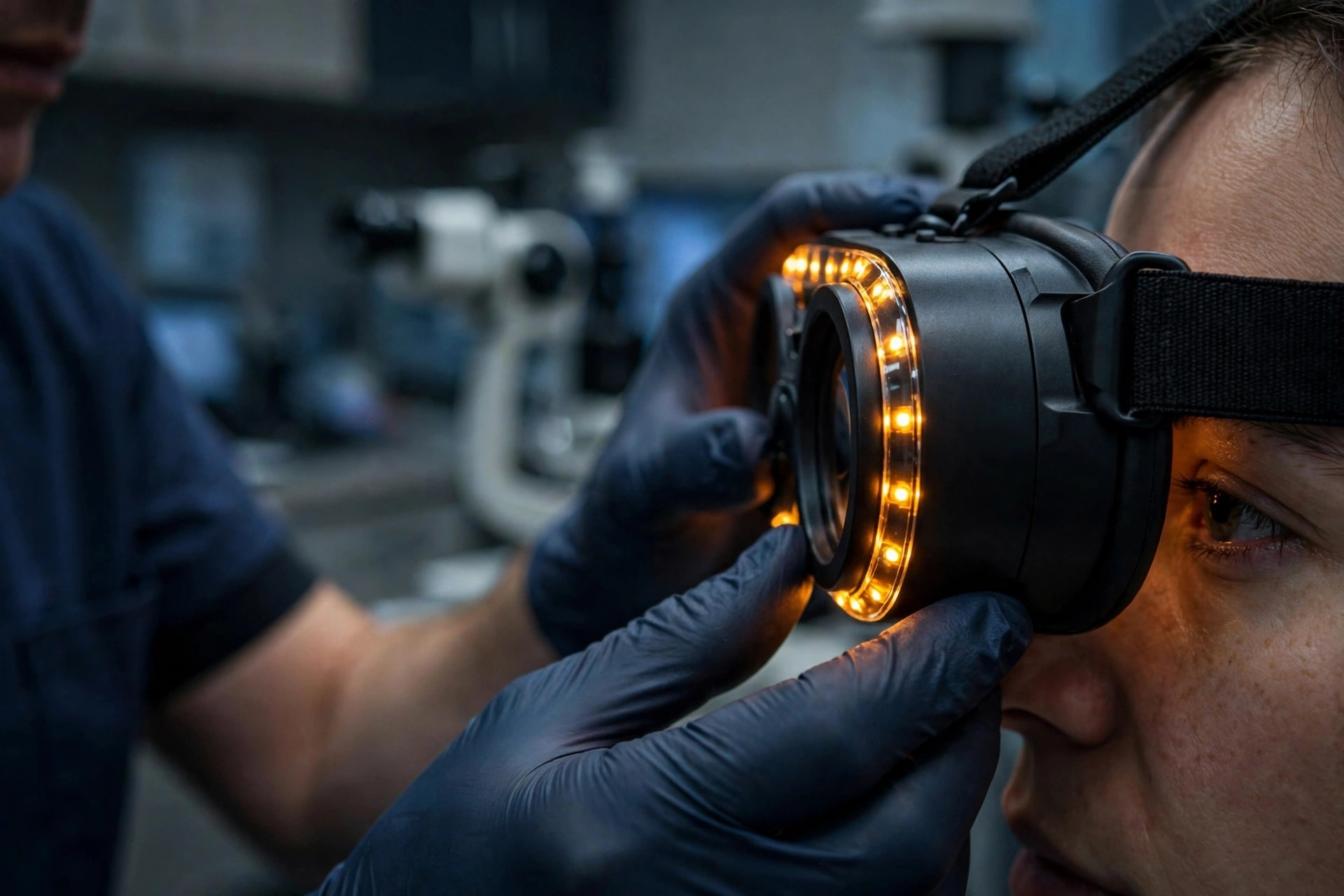
GS030 combines an intravitreal injection of an AAV-based gene therapy with a wearable medical device. The injection delivers a gene encoding ChrimsonR-tdT — a light-sensitive protein — into the patient's intact retinal ganglion cells, bypassing the photoreceptors the disease has destroyed. Because ChrimsonR-tdT responds to high-intensity amber light, patients wear optronic light-stimulating goggles (GS030-MD) that encode the visual scene in real time and project it onto the treated retina.
The approach is mutation-agnostic: it does not depend on which of the 100-plus RP gene mutations a patient carries, which is why the company sees potential in other photoreceptor-degenerating diseases such as dry age-related macular degeneration.
What the trial showed — and what's next
PIONEER (NCT03326336) enrolled patients with late-stage, non-syndromic RP at no-light-perception or light-perception acuity — people with very limited options. Across three dose cohorts plus an extension, six of ten participants showed clinically meaningful improvement in light sensitivity, and four of the eight who completed visual behavioral testing improved at real-world tasks while wearing the goggles. Exploratory EEG recordings suggested the signals were reaching the visual cortex — not an artifact.
GenSight's pipeline notably runs on two platforms: optogenetics and a Mitochondrial Targeting Sequence (MTS) — its lead candidate GS010 is in Phase 3 for Leber Hereditary Optic Neuropathy, a mitochondrial disease that blinds teens and young adults. For GS030, long-term follow-up continues to five years. The results remain exploratory, as the investigators stress — but for a disease with no approved treatment, a first human signal in NEJM is the kind of milestone worth watching.
Where the evidence stands
- Established: Retinitis pigmentosa affects about 1 in 4,000 people (over 1.5 million worldwide); there is currently no approved treatment for most; the 2026 Nobel Prize in Physiology or Medicine honored the founders of optogenetics (Deisseroth, Hegemann, Nagel).
- Preliminary: PIONEER: 10 participants, first-in-human open-label dose escalation, safety as primary; 6 of 10 showed clinically meaningful light-sensitivity improvement (full-field stimulus threshold); 4 of 8 completing visual behavioral tests improved at detecting, localizing, or touching objects; high-density EEG changes consistent with visual cortex signals; mostly mild/moderate ocular adverse events.
- Absent: Proven efficacy — the study was not designed to establish efficacy; marketing authorization in any country.
Join the discussion
To get the conversation started: What questions does this story raise for you? Share them below — every comment is reviewed by our moderators before it appears.
Community discussion only — not medical advice. Every comment is reviewed by our moderators before it appears. Sign in with Google or a free Hyvor account to join in.