
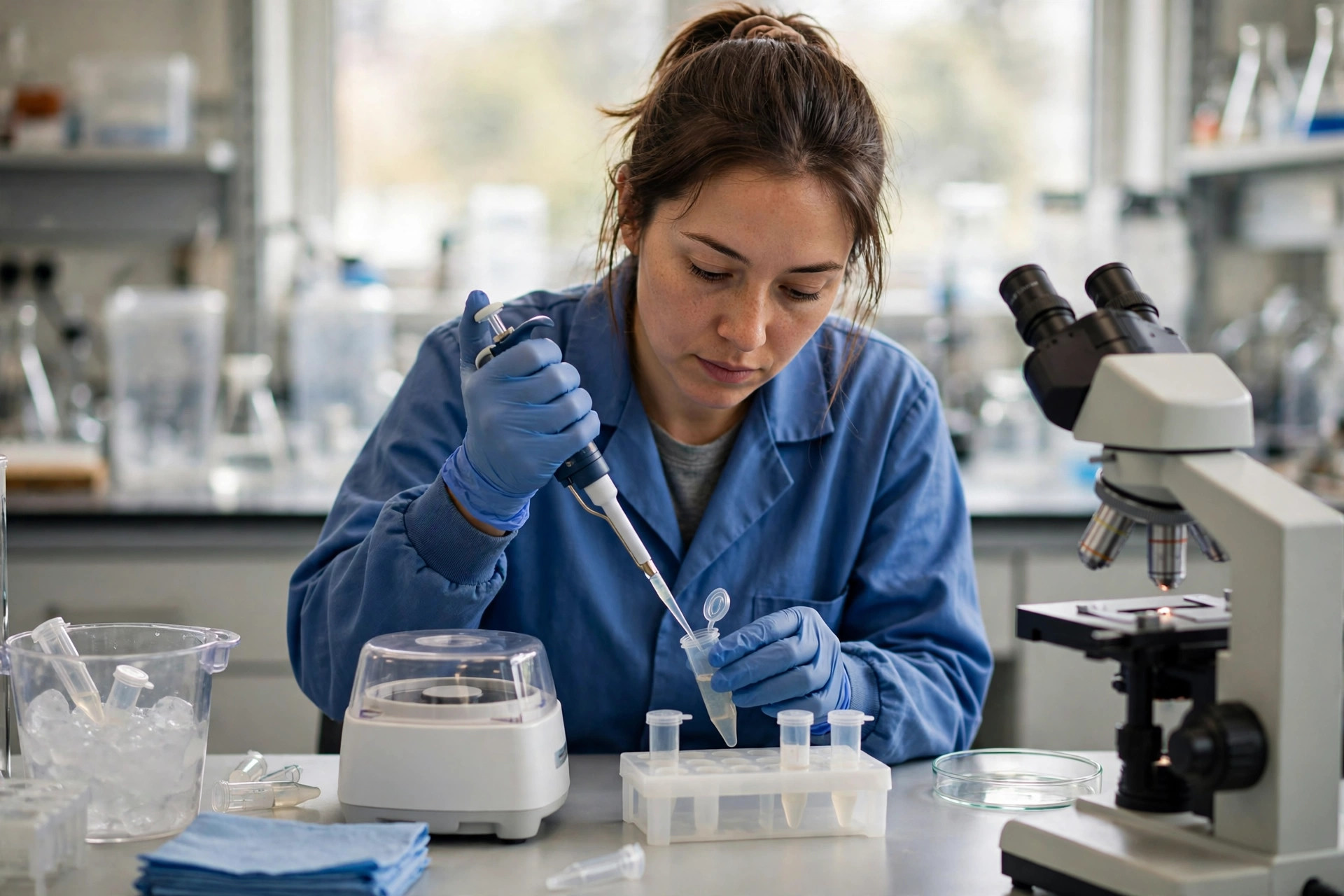
A gentler way to harvest intact mitochondria doubled the yield in 30 minutes — in lab cells
Edited by Samael A. Tejada, Founder & Editor-in-Chief
·Tip: press play, then lock your phone or switch apps — the article keeps reading.
A two-stage method called Gentle-Mito isolated intact mitochondria from cultured cells in about 30 minutes with more than double the conventional yield, a Frontiers in Molecular Biosciences study reports (November 13, 2026) — and the harvested mitochondria survived transplantation into other cells. The work is entirely in cell cultures, a laboratory platform rather than a therapy.
Mitochondrial transplantation has an engineering bottleneck that rarely makes headlines: the cargo is fragile, and the standard harvest — harsh disruption and hard spinning — damages exactly what it collects.
How does Gentle-Mito work?
Two refinements of the classic protocol. First, gentle lysis replaces harsh mechanical disruption. Second, instead of pelleting mitochondria with high-speed centrifugation, the method adds positively charged aluminium species (from ammonium aluminium sulfate) that adsorb to the negatively charged outer mitochondrial membrane, neutralise its surface charge and induce aggregation — so mitochondria sediment at low speed. The authors evaluated yield, morphology, enzymatic activity, calcium responsiveness and mitochondrial DNA integrity.
Did the harvested mitochondria still work?
By the study's measures, yes. Isolated mitochondria kept intact morphology, preserved citrate synthase activity and showed robust calcium-induced swelling. Used for transplantation, they were efficiently internalised by recipient cells, improved gap closure in a wound-style assay, remained functionally active for more than 48 hours, and elicited no detectable cytotoxicity. In a translational test, transplantation restored metabolic activity and re-sensitised osimertinib-resistant lung cancer cells to the drug.
What are the limits?
Everything shown is in cultured cell lines — including the cancer re-sensitisation result, which is a dish experiment, not a patient outcome. Clinical mitochondrial transplantation will still need sourcing, dosing, delivery and safety answers that a harvesting method cannot provide. What Gentle-Mito changes is the starting material: more of it, faster, in better shape — the kind of platform improvement that quietly enables the experiments that come next.
Frequently asked questions
Why is isolating mitochondria hard?
The standard approach — breaking cells open mechanically and spinning hard — shears and damages the organelles. Yield falls, and what survives may not behave like mitochondria inside a living cell.
What is mitochondrial transplantation?
An experimental strategy that delivers healthy mitochondria into compromised cells or tissue to restore energy production. It is under research for several conditions and is not an approved treatment.
Could this be used in patients soon?
The study is a laboratory method in cell cultures. It improves the supply of intact mitochondria for research; clinical use would require many further steps.
Where the evidence stands
- Established: Conventional mitochondrial isolation often compromises organelle integrity, and intact, viable mitochondria are a prerequisite for mitochondrial-function assays and transplantation research.
- Preliminary: Gentle-Mito's performance: one methods study (Frontiers in Molecular Biosciences, 2026) across cultured cell lines, with transplantation shown in cell models only.
- Absent: Evidence in animals or people, and any clinical use of Gentle-Mito-harvested mitochondria.
Join the discussion
To get the conversation started: What questions does this story raise for you? Share them below — every comment is reviewed by our moderators before it appears.
Community discussion only — not medical advice. Every comment is reviewed by our moderators before it appears. Sign in with Google or a free Hyvor account to join in.