
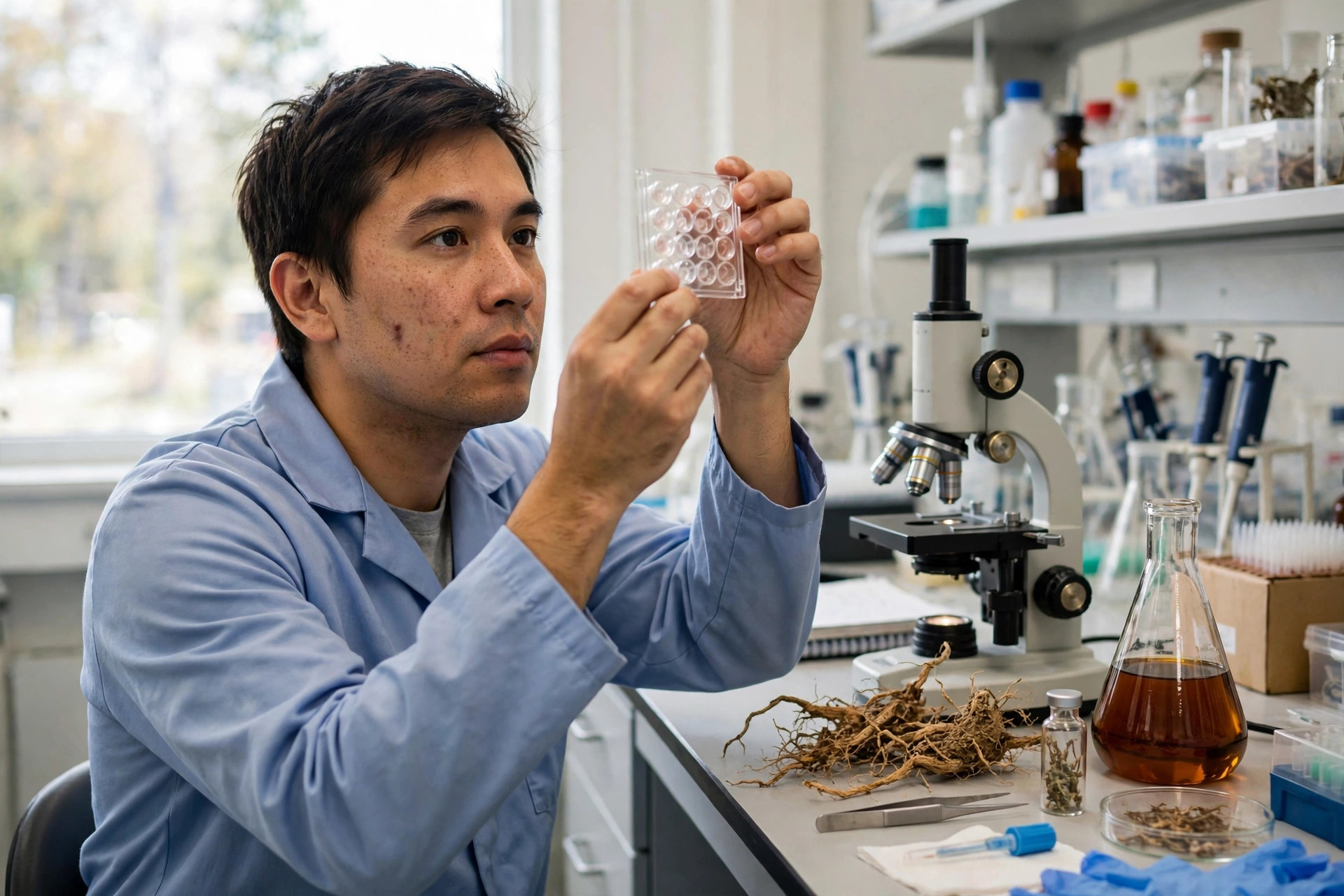
A botanical extract made a standard chemotherapy work harder against gastric cancer — in cells, mice and patient organoids
Edited by Samael A. Tejada, Founder & Editor-in-Chief
·Tip: press play, then lock your phone or switch apps — the article keeps reading.
An ethanol extract of the botanical Huang-Jin-Shuang-Shen (HJSS-E) potentiated the chemotherapy oxaliplatin in gastric cancer cells, mouse xenografts and patient-derived organoids, alongside reduced ATP and NAD+/NADH, altered RYR2 and mitochondrial SIRT3, and increased mitochondria-associated calcium (Pharmaceuticals, November 8, 2026). The evidence is preclinical only, reported qualitatively, with no human trial data.
Chemotherapy resistance is often an energy story: cells that can keep their mitochondria funded can survive the drug. This extract appears to cut the funding — in three preclinical models at once.
How was the combination studied?
The team combined target discovery with functional testing. DARTS proteomics — a method that finds proteins a compound physically engages — together with TCGA cancer-database mining and RNA sequencing nominated FBLN1 as a candidate target of the extract. A single component, salvianolic acid A, reproduced selected effects of the whole extract and interacted with recombinant FBLN1 in a surface plasmon resonance binding assay. The combination itself was then tested across the three standard preclinical tiers: cultured gastric cancer cells, mouse xenograft tumours, and organoids grown from patient tumour tissue — the last of these being the closest preclinical proxy for a real patient's cancer.
What happened to the cancer cells' mitochondria?
The mechanistic readouts centre on energy collapse. HJSS-E plus oxaliplatin was associated with altered RYR2 — a calcium-release channel — and altered SIRT3, the mitochondrial NAD+-dependent deacetylase that coordinates antioxidant defence and metabolism. ATP content fell, NAD+/NADH ratios fell, and a mitochondria-associated calcium signal (Rhod-2 fluorescence) rose. In parallel, oxaliplatin-associated DNA damage and apoptosis increased. That combination — less ATP, a drained NAD+ pool, calcium loading at the mitochondria — is the signature of a cell whose energy system can no longer fund drug resistance. The abstract reports all of this qualitatively; no fold-changes or percentages are given, which limits how strong a claim any reader should take from it today.
What are the limits?
Botanical extracts are mixtures, and mixtures are hard to standardize: the FBLN1 and salvianolic acid A work is a start on identifying active components, not a finished characterization. Xenografts in immunocompromised mice and organoids in dishes both lack a patient's full physiology, and there are no human pharmacokinetic, safety or efficacy data for HJSS-E with oxaliplatin — including the crucial question of whether the extract changes oxaliplatin's own toxicity in people. Gastric cancer patients should not add botanical preparations to chemotherapy outside a trial: interactions run both ways. What this study earns is a place in the queue for proper translational testing.
Frequently asked questions
What is HJSS-E?
An ethanol extract of Huang-Jin-Shuang-Shen, a botanical preparation. This study tested it as a partner for the chemotherapy oxaliplatin in gastric cancer models; salvianolic acid A is one component studied separately.
How did it affect the cancer cells?
Combined with oxaliplatin, the extract was associated with reduced ATP and NAD+/NADH ratios, altered RYR2 and mitochondrial SIRT3, increased mitochondria-associated calcium, and enhanced DNA damage and apoptosis in cells, mouse xenografts and patient-derived organoids (Pharmaceuticals, 2026).
Can gastric cancer patients use this extract with chemotherapy?
No — not outside a clinical trial. There are no human safety, dosing or interaction data, and botanical products can change how chemotherapy behaves. This is a preclinical finding.
Where the evidence stands
- Established: Oxaliplatin is a standard gastric cancer chemotherapy and resistance is common; SIRT3 is a mitochondrial NAD+-dependent deacetylase central to tumour metabolism; patient-derived organoids are an accepted preclinical model.
- Preliminary: HJSS-E potentiation of oxaliplatin: one study (2026) across cells, one xenograft model and patient-derived organoids, with FBLN1 as a candidate target. Findings reported qualitatively in the abstract, without effect sizes; no replication.
- Absent: Human evidence — no clinical trial, dosing, interaction or safety data for HJSS extract combined with oxaliplatin in patients.
Join the discussion
To get the conversation started: What questions does this story raise for you? Share them below — every comment is reviewed by our moderators before it appears.
Community discussion only — not medical advice. Every comment is reviewed by our moderators before it appears. Sign in with Google or a free Hyvor account to join in.