
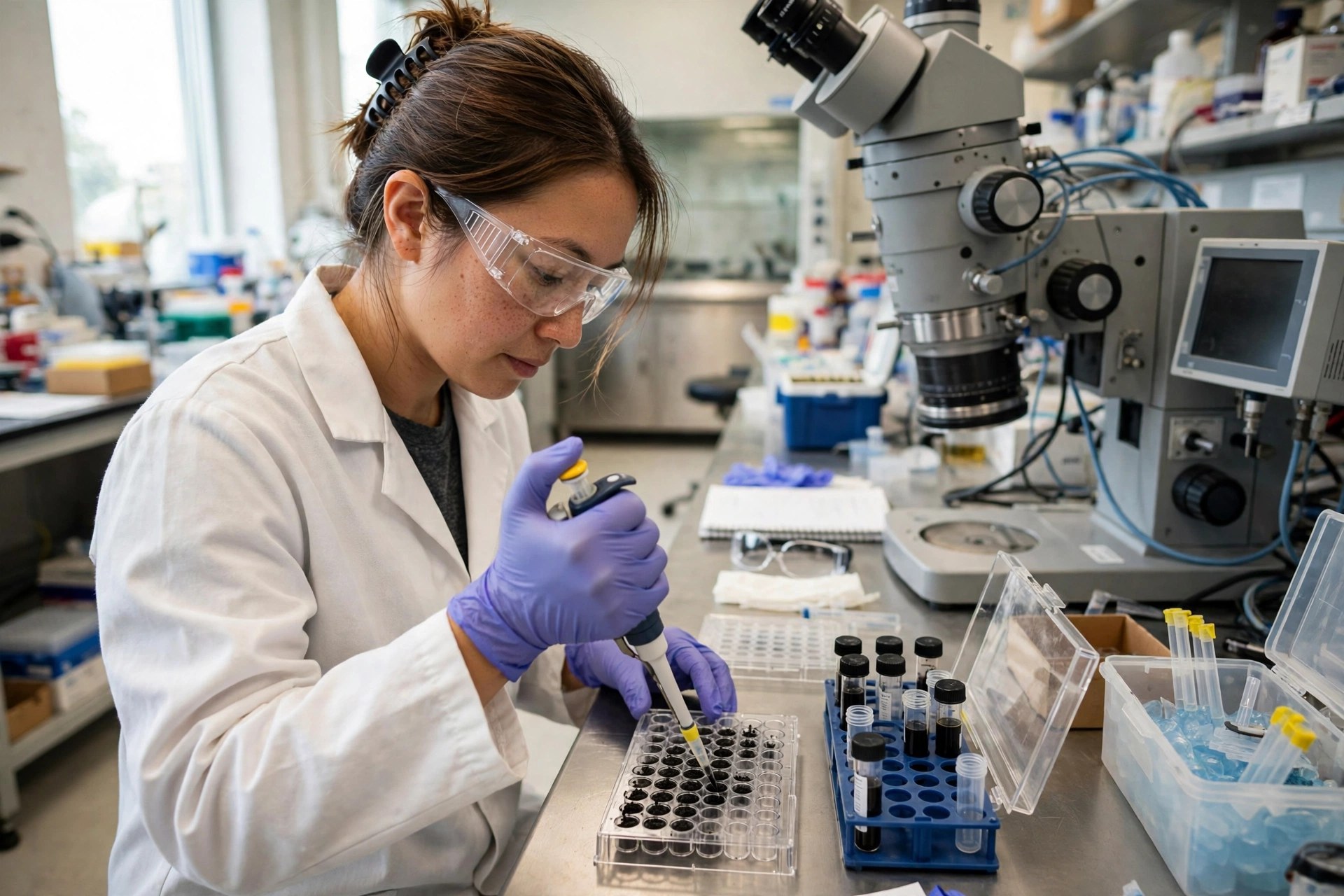
Iron-grabbing nanoparticles preserved mitochondrial function and blocked ferroptotic cell death — in lab cells and live-animal injury models
Edited by Samael A. Tejada, Founder & Editor-in-Chief
·Tip: press play, then lock your phone or switch apps — the article keeps reading.
Mesoporous polydopamine nanoparticles that chelate iron and scavenge radicals preserved mitochondrial function and rescued cells from ferroptotic death in laboratory models, and reduced lipid peroxidation in live-animal muscle and limb-ischemia injury models (Nano Letters, November 4, 2026). The platform is preclinical — no human testing — and animal group details were limited in the published abstract.
Ferroptosis runs on iron the way fire runs on oxygen. These nanoparticles attack both halves of the reaction at once — they mop up the iron and the radicals — and in the study's cell and animal models, mitochondria came through the insult still working.
Why are mitochondria central to ferroptosis?
Mitochondria concentrate both ingredients of ferroptotic damage: iron (imported for heme and iron-sulfur cluster assembly) and reactive oxygen species (an unavoidable by-product of respiration). When iron handling fails, mitochondrial membranes peroxidize, energy production collapses, and the organelle's distress signals help tip the whole cell into ferroptosis. A therapy that lowers available iron while quenching radicals is, in effect, protecting the mitochondria to protect the cell — which is what the PDN readouts measured: preserved mitochondrial function alongside survival.
What did the animal experiments show?
Two in-vivo injury models were reported. In an erastin-induced muscle ferroptosis model, PDN treatment reduced lipid peroxidation and restored expression of GPX4, the glutathione-dependent enzyme that detoxifies lipid peroxides and whose failure is a defining ferroptosis event. In a hindlimb ischemia model — restricted blood flow to a limb — the particles enhanced blood perfusion and vascular recovery. The metabolomics arm, in cells, showed the ferroptosis-distorted metabolic profile moving back toward normal, including glutathione-metabolism and energy-production metabolites.
What don't we know yet?
A great deal, starting with scale: the published abstract does not state animal species or group sizes, and the paper is a Letter — a short-format report. Nanoparticle platforms also face the standing questions of where particles accumulate, how long they persist, and whether chronic iron chelation stays safe in tissues that need iron. None of that diminishes the mechanism demonstration; all of it stands between this result and any patient.
Frequently asked questions
What is ferroptosis?
Ferroptosis is a form of regulated cell death driven by iron-dependent peroxidation of membrane lipids. Mitochondria — rich in both iron chemistry and reactive oxygen species — are central to the process, and the enzyme GPX4 is the cell's main defense against it.
How do the nanoparticles work?
The mesoporous polydopamine particles combine two actions: they chelate (bind) ferrous iron and they scavenge free radicals. In cell models that preserved mitochondrial function and prevented ferroptotic death; in animal injury models they reduced lipid peroxidation and restored GPX4.
Is this a treatment for any disease yet?
No. It is a preclinical platform tested in cells and animal injury models. No human study has been reported.
Where the evidence stands
- Established: Ferroptosis as an iron-dependent, lipid-peroxidation-driven cell-death pathway, and mitochondria's role within it, are established; GPX4 is its canonical guardian enzyme.
- Preliminary: The PDN platform: one short-format report spanning cell models and two animal injury models, with abstract-level detail — promising, early, unreplicated.
- Absent: Human data of any kind, and long-term nanoparticle safety data.
Join the discussion
To get the conversation started: What questions does this story raise for you? Share them below — every comment is reviewed by our moderators before it appears.
Community discussion only — not medical advice. Every comment is reviewed by our moderators before it appears. Sign in with Google or a free Hyvor account to join in.