
Hydrogen Water: The Dose Is the Story
Edited by Samael A. Tejada, Founder & Editor-in-Chief
·Tip: press play, then lock your phone or switch apps — the article keeps reading.
The short answer: If hydrogen water does anything at all, the research points to one active ingredient — dissolved molecular hydrogen (H2) — and one variable that decides whether it can work: the dose, measured in milligrams per liter (mg/L). The numbers sellers advertise instead, pH and ORP, cannot tell you that dose. And in the cleanest dose test available, electrolyzed water carrying a low dose did nothing at all, while a higher measured dose showed an effect — in mice, not people.
That finding sits inside two 2022 reviews and one animal study. Our Watchdog review of hydrogen-water hype found no credible human evidence behind the longevity claims sold at retail. This article covers the other half of the problem: even on the research's own terms, most of what is sold may not contain enough of the only ingredient that matters.
What is actually in “hydrogen water”?
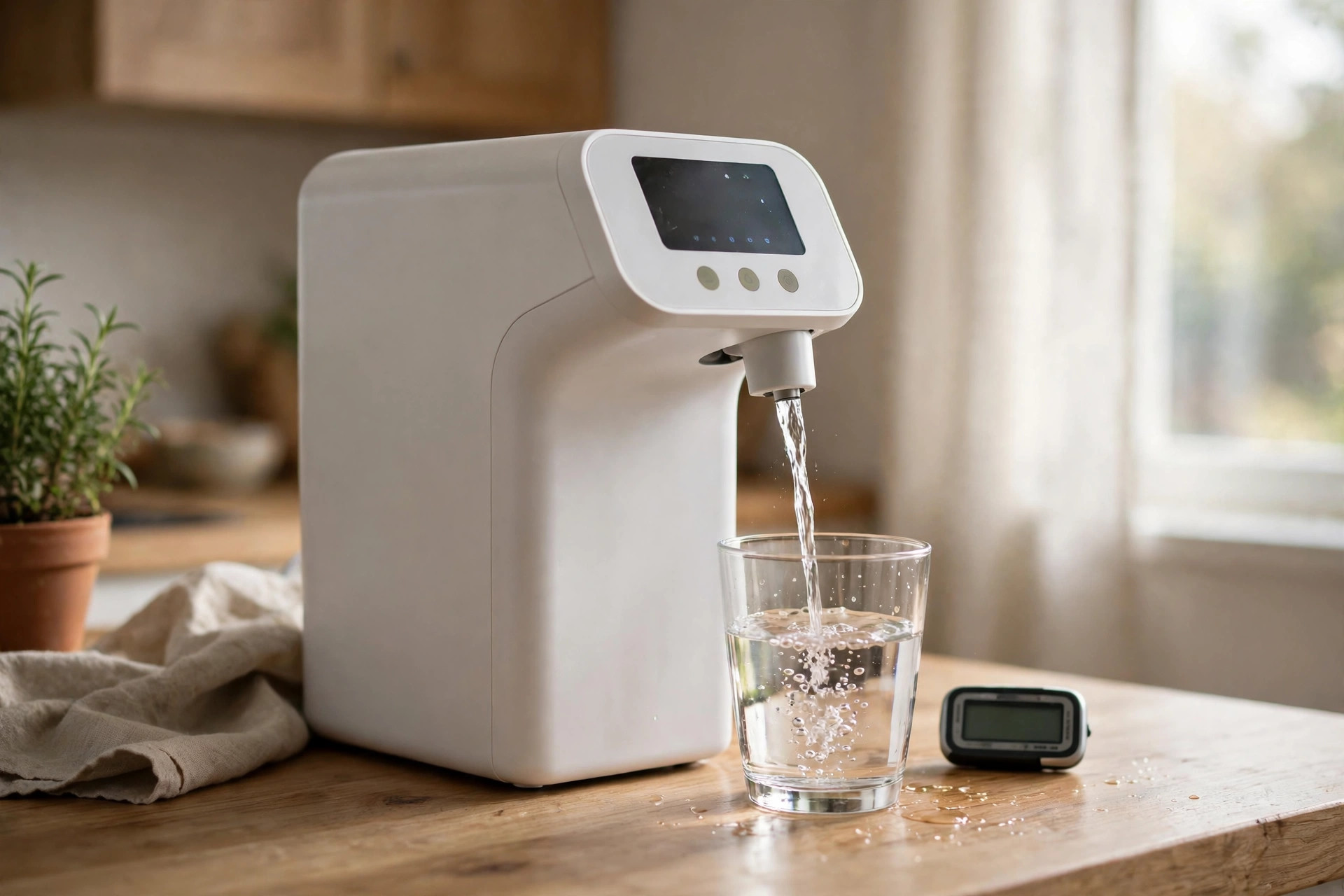
Hydrogen water is ordinary water with hydrogen gas dissolved in it. One common way to make it is electrolysis: a countertop ionizer splits water at two electrodes, producing an alkaline stream called electrolyzed-reduced water (ERW). For decades, sellers credited ERW's supposed benefits to its alkalinity, its negative oxidation-reduction potential (ORP), "microclustered" water structure, free electrons, or something called "active hydrogen."
A 2022 review by Tyler LeBaron, Randy Sharpe, and Kinji Ohno worked through those claims one by one and rejected all of them. Alkaline pH does not explain the effects; microclusters and altered water structure are not physically plausible in bulk water; free electrons and mineral hydrides have been directly investigated and refuted; and "active" atomic hydrogen is, in the authors' assessment, scientifically impossible. Their conclusion: molecular hydrogen is the exclusive agent responsible for both the negative ORP of ERW and its observed effects in laboratory and animal research. When the dissolved H2 is removed, the benefits disappear.
The same review makes a second point that matters for buyers: because H2 is the agent, the H2 concentration of any electrolyzed water should be measured and compared with the concentrations used in clinical studies. Hydrogen dissolves in water only up to about 1.6 mg/L — where a product sits in that narrow band is the whole story.
Why can't pH and ORP tell you the dose?
Because both numbers mostly measure the wrong thing: pH dominates the ORP reading. The companion safety review gives a worked example: water at pH 9 containing just 0.1 mg/L of H2 already reads an impressive-looking ORP of about −497 mV. Multiply the hydrogen tenfold, to 1 mg/L, and the ORP moves only to about −527 mV — a change within the margin of error of a typical meter. Raising the pH by half a unit moves the needle by roughly the same amount as that tenfold increase in hydrogen.
In plain terms: a dramatic ORP number on a sales page can reflect a high pH and a trivial amount of hydrogen. The reviewers are blunt — ORP can hint that some H2 is present, but it cannot estimate the concentration or even reliably compare one glass of water against another. Their guidance: measure H2 with accurate methods, and avoid ORP-based hydrogen meters entirely.
How much hydrogen do ionizers actually deliver?
Less than the marketing implies, and less consistently. The safety review reports that most alkaline ionizers, brand-new and running under optimal conditions, produce roughly 0.2 to 1.2 mg/L of dissolved H2, depending on the machine, the electrodes, the mineral content of the source water, and the flow rate. Two practical problems follow.
First, the trade-off built into electrolysis: pushing for more dissolved hydrogen also pushes the pH up. The reviewers note that reaching around 1 mg/L can coincide with a pH above 10 — past the safety line discussed below. Second, output decays. Calcium scale builds on the electrodes, and the authors report observing ionizers fall from nearly 1 mg/L to below 0.01 mg/L in as little as two weeks, while the ORP stayed convincingly negative because the pH stayed high. Cleaning restored the hydrogen output; nothing about the water's advertised numbers warned the user it had collapsed. The reviewers' risk-benefit map leaves only a small zone — adequate hydrogen while pH stays below 9.8 — as recommended territory, and not every device can reach it.
What happened when researchers actually tested the dose?
The cleanest test in this set is a 2018 mouse study (Jackson and colleagues, with LeBaron as a co-author) that modeled fatty liver disease with a high-fat diet. It ran, in effect, as a dose experiment:
- Electrolyzed alkaline water (pH 11, ORP −495 mV, H2 just 0.2 mg/L): no benefit — mice drinking it did no better than mice on regular water, on either a regular or a high-fat diet.
- Low-dose hydrogen water (0.3 mg/L): no benefit.
- High-dose hydrogen water (0.8 mg/L): mice gained less fat mass (46% vs. 61%) and accumulated significantly less fat in the liver (P < 0.01) than controls. Liver cells taken from the high-dose mice were also protected against fat overload in the lab dish.
That contrast is the article in miniature. The water with the most impressive sales numbers — pH 11, strongly negative ORP — was the water that did nothing, because its hydrogen dose was the lowest of the three. The effect appeared only when the dose was measured and raised. And one caution must stay attached to this result every time it is told: these were mice, on a fatty-liver model, over twelve weeks. It is a proof of principle about dosing, not evidence that hydrogen water treats fatty liver — or anything else — in people.
Is electrolyzed water safe? Where is the line?
At moderate pH, the reviews describe a long history of use. But the safety review documents a hard edge buyers rarely hear about:
- Hyperkalemia. Clinical reports describe dangerous elevations of blood potassium in some people drinking ERW above pH 9.8, and several 1990s animal studies reported heart-tissue damage with hyperkalemia after ERW consumption; the mechanism is unsettled, and electrode degradation is a leading suspect.
- The 9.8 line. Regulations cited in the review cap ERW at pH 9.8, and the authors recommend not ingesting ERW above that pH. People with impaired kidney function are advised to avoid ERW without medical supervision.
- Electrode leaching. As electrodes degrade — a process worse at high pH and high voltage — platinum nanoparticles and other metals can leach into the water.
Note the trap: chasing a higher dose with the wrong machine — slower flow, higher voltage — also pushes pH toward the zone where these concerns live, trading an underdosed drink for an unsafe one.
A disclosure readers deserve
All three sources behind this article share an author — Tyler LeBaron, a PhD researcher who founded the Molecular Hydrogen Institute and advocates for molecular hydrogen research. His reviews argue against most of the industry's marketing claims, which lends them credibility, but he is an interested party in hydrogen's future, and we weight his conclusions accordingly. A separate question — what heavy hydrogen, the isotope deuterium, does inside mitochondria — is covered in our companion article on deuterium and mitochondria.
Frequently asked questions
What is the right dose of hydrogen water?
Nobody knows for humans — no human dose-response trial exists in the sources reviewed here. In the one controlled mouse study, 0.8 mg/L worked and 0.3 mg/L did not. What researchers insist on is measurement: any claim should come with an actual H2 concentration in mg/L.
My ionizer shows −500 mV ORP. Is that good?
It tells you almost nothing about hydrogen. At pH 9, water with only 0.1 mg/L of H2 reads about −497 mV, and ten times the hydrogen barely moves the reading. A very negative ORP at high pH can accompany a hydrogen level below 0.1 mg/L.
Is alkaline water the same as hydrogen water?
No. Alkalinity is a pH property; hydrogen water is defined by dissolved H2 gas. The reviews conclude the alkaline pH itself explains none of the observed effects — and water pushed above pH 9.8 carries a specific safety warning.
Is hydrogen water safe?
Molecular hydrogen itself has a reassuring safety profile in the research literature. The documented concerns attach to high-pH electrolyzed water: hyperkalemia reports above pH 9.8, possible metal leaching from degrading electrodes, and extra caution for anyone with impaired kidney function.
Should I buy a hydrogen water machine?
That is a personal call, but go in with the dose question in hand: ask for the measured H2 concentration in mg/L, ask how it was measured (not by ORP), ask how often the electrodes need cleaning to hold that level, and check the pH stays at or below 9.8. A seller who cannot answer the first question is selling you the two numbers that do not matter.
Where the evidence stands
- Established: In electrolyzed water, the only candidate agent that survives scrutiny is dissolved molecular hydrogen; the alkaline-pH, microcluster, free-electron, and active-hydrogen explanations have been examined and refuted. ORP cannot measure or compare H2 dose, and water above pH 9.8 carries a documented hyperkalemia concern.
- Preliminary: That a sufficient H2 dose produces biological effects — supported by laboratory work and one controlled mouse study in which 0.8 mg/L, but not 0.2 or 0.3 mg/L, reduced fat gain and liver fat accumulation. All of it is preclinical.
- Contested: How strongly to state H2's therapeutic promise. The reviews' lead author states the case for hydrogen more affirmatively than the underlying human data currently supports.
- Absent: Any credible human evidence that retail hydrogen water, at any dose yet tested in people, improves energy, cognition, or longevity in healthy users; and any human dose-response trial showing what mg/L level, if any, matters in people — no human dose-finding data appear in any of the three sources behind this article.
Join the discussion
To get the conversation started: Have you bought a hydrogen water machine or bottle? Were you ever told its measured hydrogen dose in milligrams per liter?
Community discussion only — not medical advice. Every comment is reviewed by our moderators before it appears. Sign in with Google or a free Hyvor account to join in.