
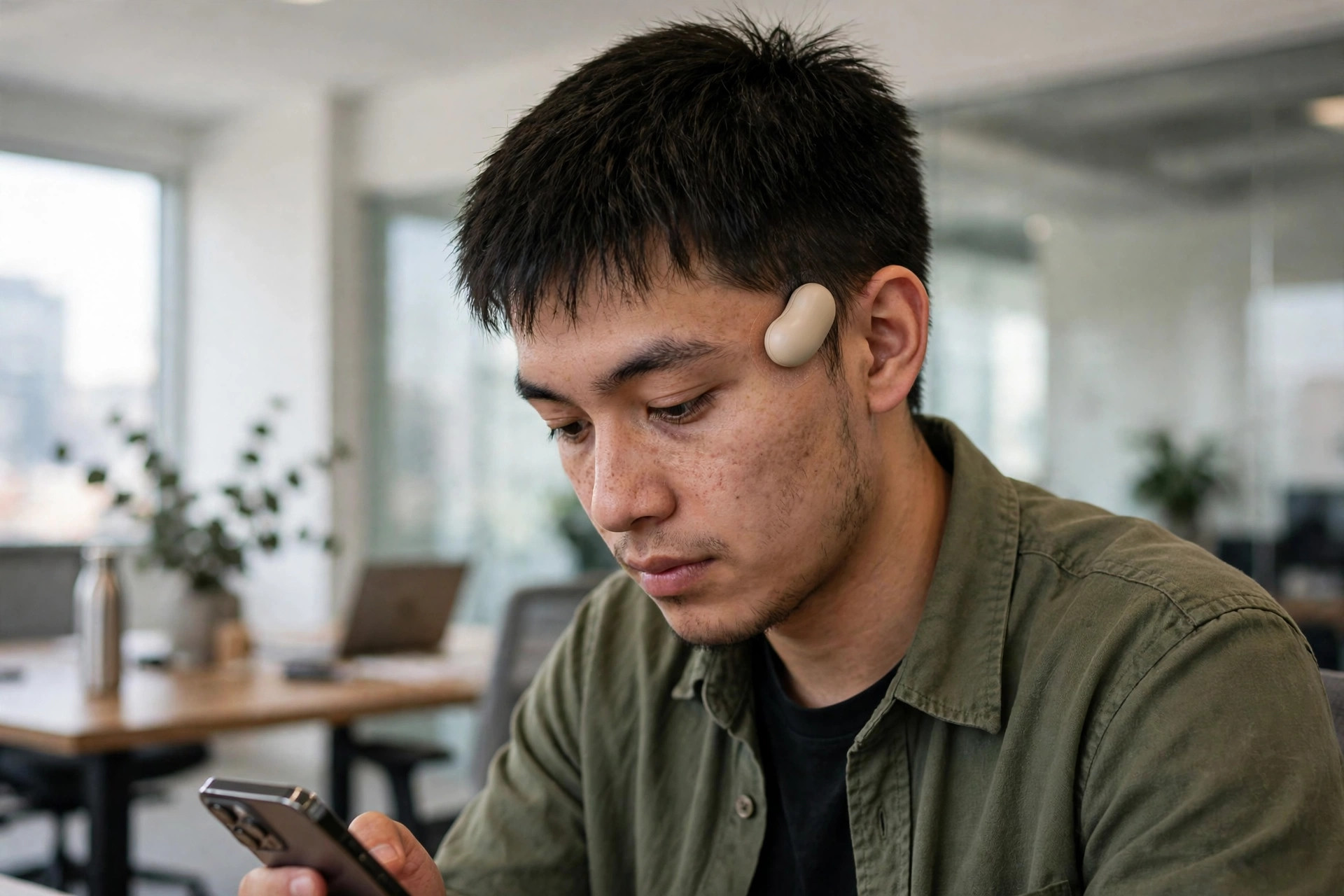
An 85,000-rupee forehead wearable promises a 'brain flow' score — doctors say the anatomy does not add up
Edited by Samael A. Tejada, Founder & Editor-in-Chief
·Tip: press play, then lock your phone or switch apps — the article keeps reading.
Temple, a forehead wearable from Zomato founder Deepinder Goyal, opened Indian pre-orders at 85,000 rupees for two proprietary scores — BrainFlow, an optical reading over the superficial temporal artery, and Entropy, a 1-to-250 effort score. Named doctors dispute that scalp-artery flow measures brain circulation, the supporting studies are company-run and not peer-reviewed, and Goyal himself says it is a wellness device that has not been clinically validated.
A sensor on your temple can certainly measure something. The question this launch turns on is whether that something is blood flow in your brain — and anatomists say the artery under the device does not go there.
What is Temple, and what does it claim?
Temple is a small, bean-shaped wearable worn on the temple with adhesive 'Grips', sold made-to-order with delivery in about three months. Its two headline metrics are proprietary: BrainFlow, described as relative changes in cerebral circulation from an optical (PPG) sensor over the superficial temporal artery, and Entropy, a real-time 1-to-250 score influenced by sleep, exercise, stress, food, caffeine and meditation, representing how hard the body works to sustain itself. The intellectual frame is Goyal's Gravity Ageing Hypothesis — gravity's long effect on brain circulation across an upright lifetime — which he has recently been careful to call a hypothesis. Goyal says he has put $20 million of his own money into the venture, of a reported $30 million spent building it.
What do the critics say?
The criticism is specific, which is what makes it worth reporting. Dr. Navin Gnanasekaran, head of clinical services for radiology and interventional radiology at Apollo Hospitals Chennai, points out that the superficial temporal artery branches from the external carotid and supplies the scalp and face; the brain itself is supplied primarily by the internal carotid and vertebral arteries, and scalp flow changes with heat and exercise 'do not necessarily reflect cerebral circulation' — 'an accurate heart-rate monitor is not a brain-flow tracker,' as he put it; he also notes cerebral autoregulation, the brain's own flow-keeping system, which undermines simple gravity claims. Senior neurologist Dr. Sudhir Kumar calls the idea intriguing but says the methodology, biological basis and independent validation are not publicly available. Neurologist Dr. Rahul Chawla notes no methodology has been revealed behind the fancy metric names. Hepatologist Dr. Cyriac Abby Philips, the loudest critic, calls the brain-flow claim unfounded in the strongest terms. One study detail cuts the same way: a reference-equipment study reportedly excluded women because hair interfered with the sensor setup.
What does the maker say — and what would settle it?
Goyal's defence, in his November 5 note and after, is more modest than the marketing surface: Temple is 'strictly fitness and wellness, not a medical device', it makes no medical claims, it has not been clinically validated, and buyers should judge it when it ships, with independent studies to come. A company preprint claims about a 0.8 correlation with a major brain artery measured by transcranial Doppler — company-run, not peer-reviewed. That is the whole ballgame, stated plainly by both sides: an intriguing sensor, an unproven inference from scalp to brain, and a premium price collected before the validation exists. The mitochondrial-adjacent lesson generalizes: a real measurement (blood pulsing under a temple sensor is real) plus an unvalidated inference (therefore your brain's circulation and ageing rate) is the standard shape of longevity hype. Pay for the measurement if you like; do not mistake it for the inference.
Frequently asked questions
What is the Temple wearable?
A small bean-shaped device from Deepinder Goyal's venture Temple, worn on the temple with adhesive patches. It reports BrainFlow (an optical reading over the superficial temporal artery) and Entropy (a 1-to-250 score). Pre-orders in India opened November 1, 2026 at 85,000 rupees.
Can a temple sensor measure brain blood flow?
That is the disputed claim. The sensor reads the superficial temporal artery, which supplies the scalp and face; the brain is supplied mainly by the internal carotid and vertebral arteries. Named specialists argue scalp flow does not necessarily reflect cerebral circulation, and the device has no independent peer-reviewed validation.
Is Temple a medical device?
No — by its maker's own statement it is a fitness and wellness device, not a medical device, and it has not been clinically validated.
Where the evidence stands
- Established: The launch facts: pre-orders opened in India November 1, 2026 at 85,000 rupees, delivery in about three months; the device measures optically over the superficial temporal artery; that artery is an external-carotid branch supplying scalp and face, distinct from the brain's internal-carotid and vertebral supply.
- Preliminary: The BrainFlow inference: one company-run, non-peer-reviewed preprint reports about 0.8 correlation with transcranial Doppler. No independent validation has been published.
- Absent: Clinical validation of any kind — by the maker's own statement the device is a wellness product that has not been clinically validated and makes no medical claims.
Join the discussion
To get the conversation started: What questions does this story raise for you? Share them below — every comment is reviewed by our moderators before it appears.
Community discussion only — not medical advice. Every comment is reviewed by our moderators before it appears. Sign in with Google or a free Hyvor account to join in.