
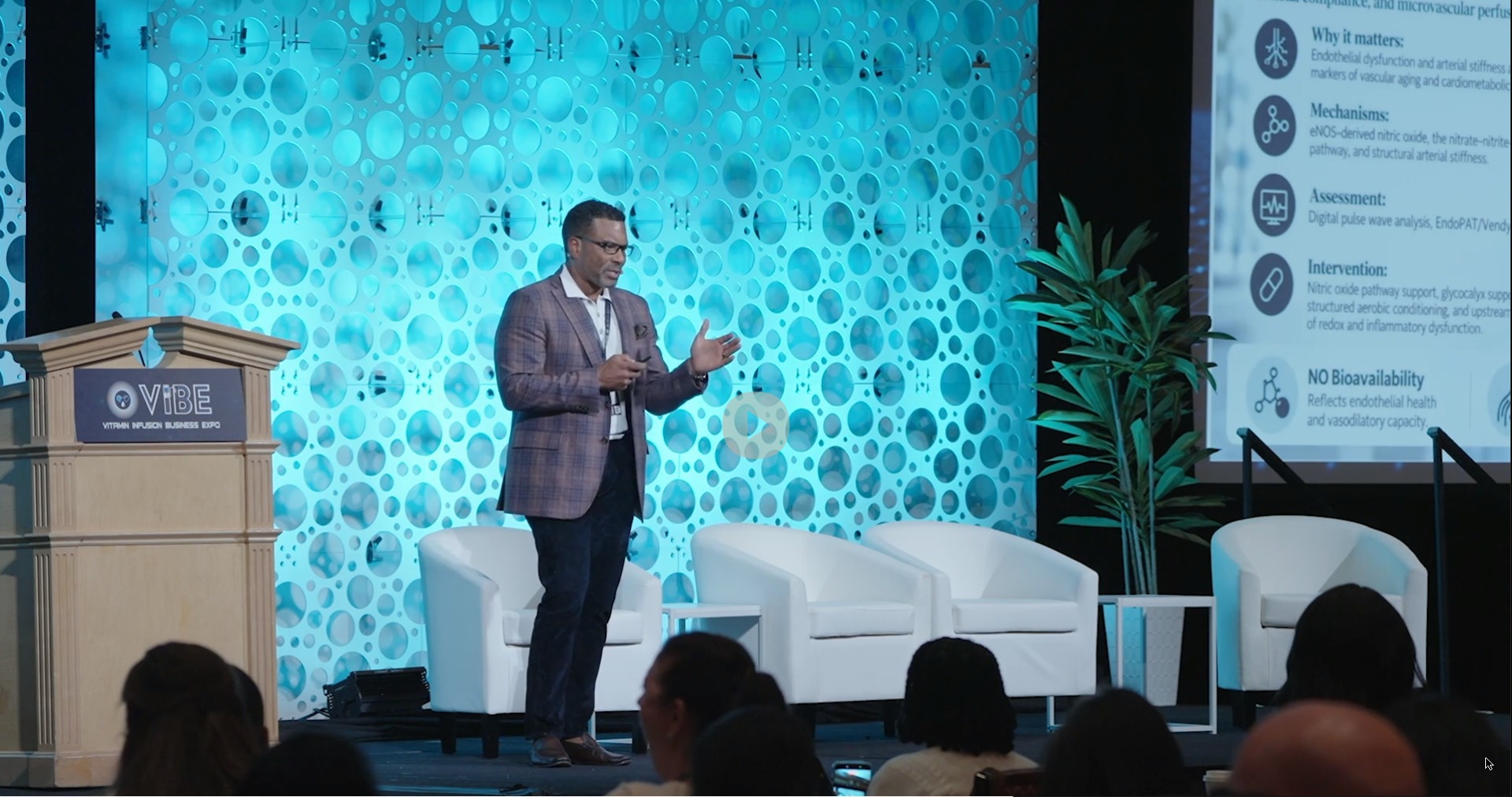
Photo: Vibe Expo 2026
“Beyond the Bag”: Dr. Christopher Davis Asked IV Clinics to Audit Everything in the Infusion — Not Just the Vitamins
·Tip: press play, then lock your phone or switch apps — the article keeps reading.
Before Dr. Christopher Davis said a word at Vibe Expo 2026, Sammy Tejada had the whole room screaming — literally. Then he introduced his business partner to deliver the weekend's most important quality message for the IV industry itself: the nutrient in the bag is only part of what reaches the patient. The preservatives, the plastic, and the tubing count too — and he challenged the room to know exactly what theirs were made of.
The opener was theater with a purpose. Tejada ran what he called a “scream therapy” session — “You have my permission. You're allowed to scream” — counting the room down twice so the audience would be “nice and relaxed to take this message in.” Then the introduction: “One of the smartest doctors that I personally know — I know it's kind of biased because he's my business partner — Dr. Christopher Davis, who's an interventional cardiologist by training, who was stuck in that broken medical system and decided to really shift gears.”
Davis presented “The Bag and Beyond: Rethinking IV Nutrient Therapy Through the Cardiometabolic Vitality Framework.” He calls himself “a reformed interventional cardiologist,” and the résumé behind that line is conventional in the extreme before it pivots: Duke University, Eastern Virginia Medical School, chief medical resident at Johns Hopkins/Sinai, NIH cardiology and interventional cardiology fellowships at the University of Virginia, and triple board certification in internal medicine, cardiovascular disease, and interventional cardiology. After about a decade in conventional practice he founded Reveal Vitality in Sarasota in 2017 — now the Reveal Vitality and Longevity Institute — and serves as chief medical officer of Liquivida and chief cardiologist at Humann. He is also a medical reviewer for this site (disclosure below).
The talk in one idea: total infusion exposure
Davis's core concept is what he calls total infusion exposure. Clinics think about the nutrients on the label. But an infusion also delivers formulation excipients (preservatives, stabilizers, buffers) and chemicals that leach from the bag, vial, and tubing. “What reaches that patient,” he said, “is much more than the nutrient that we think we're getting.” He tested the room early: how many attendees knew whether their own IV tubing was DEHP-free? When he asked how many did not know, he made his point: “These are the type of things that I want to talk about when we talk about doing better for our patients. It's not just talk. It's real.”
Around that idea he wrapped the Cardiometabolic Vitality Framework — six pillars he applies to every patient: mitochondrial efficiency, membrane integrity, metabolic flexibility, redox balance, inflammatory load, and vascular signaling. The framework talk was measurement-driven: VO2 max and substrate-crossover breath testing, InBody scans (visceral fat, skeletal muscle, phase angle — his marker of cell-membrane health), omega-3 index and antioxidant-gene panels, and pulse-wave devices estimating arterial stiffness. “Your genes are not your destiny,” he said, “but the genes give you a roadmap.” His guiding conviction, stated plainly: “most chronic illnesses, they are caused by inflammation and oxidative stress, and most of that's caused by either infection or environmental toxins”.
The preservative argument: benzyl alcohol and glycine
The talk's most specific claim concerned benzyl alcohol, the preservative in many multi-dose vials. The biochemistry Davis walked through is textbook: benzyl alcohol is oxidized to benzoic acid, which the liver conjugates with the amino acid glycine and excretes in urine as hippurate. Glycine, however, is also one of the three building blocks of glutathione, the body's central antioxidant. His question to the room: “Why would I want to give you something that's going to use the glycine that's needed to make glutathione?” — especially for a patient already carrying a heavy oxidative-stress burden, like his neuro-Lyme patients.
He quantified the exposure: bacteriostatic preparations typically carry about 9 milligrams of benzyl alcohol per milliliter, so multi-vial bags on a twice-weekly package schedule stop looking trivial. “It adds up,” he said. “It adds up.” Davis made the scientific distinction himself on his slide — the glycine-competition idea is “biologically plausible; not yet proven as a routine adult clinical outcome” — the mark of a clinician presenting a mechanism with precision while making the practical case: where a preservative-free option is clinically equivalent, prudence favors choosing it.
The case: one patient, twenty IVs, a spiking plastic metabolite
The emotional center of the talk was a case from three weeks before the conference: a 64-year-old woman Davis described as in great shape with no significant health history, who had received about 20 IV nutrient therapies over the previous nine months to a year. Her toxin panel showed MEHP — the breakdown product of DEHP, the plasticizer used to soften PVC bags and tubing — up from 0.34 to 31.81 ug/g, above the lab's reference range and past its 95th percentile. Her oxidative stress panel, he said, showed 13 of 16 markers elevated. “Her oxidative stress age was 98 or something like that,” he said.
Davis included the scientific caution on his own slide — “Temporal association does not prove causation” — and then made the clinician's case for acting on the finding anyway: a sharply rising plastic-metabolite level alongside broadly elevated oxidative stress is, in his words, “the type of situation” that clinicians work to keep from progressing toward cancer and heart disease. “But if we never look,” he said, “we won't ever be preventative.” His prescription was practical: preservative-free when clinically equivalent, DEHP-free bags and sets when feasible, every inactive ingredient audited. “Inactive,” his slide noted, “does not mean biologically irrelevant.”
The takeaway
Davis's message to his own industry was concrete: know what's in your vial, your bag, and your tubing; test instead of guessing; and don't hand a patient with a heavy oxidative burden an infusion whose inactive ingredients add to it. Clinics can act on most of that tomorrow — DEHP-free sets and preservative-free formulations are purchasing decisions, not research programs. Patients considering any IV package can borrow his question directly: what else is in the bag? The extras are real, measurable, and worth minimizing — and Davis's standard is one any clinic can adopt today: know every ingredient, choose the cleaner material when it is clinically equivalent, and test to prove it worked.
Disclosure: Dr. Christopher Davis is a business partner of Sammy Tejada (including as a co-founder of EREGIMEN), serves as chief medical officer of Liquivida, and is a medical reviewer for MyMitochondria.com. He recommended specific commercial tests and devices in the talk (Vibrant Wellness, PNOĒ, InBody); those mentions are reported, not endorsed. This article covers a conference presentation and is not medical advice.
Where the evidence stands
- Established: DEHP genuinely leaches from PVC medical devices; the FDA issued a public health notification about it in 2002. Benzyl alcohol really is cleared by glycine conjugation to hippurate — and benzyl alcohol toxicity in premature infants (the 1982 “gasping syndrome” reports) is the historical proof that preservative exposure can matter. Glycine really is required to make glutathione, creatine, heme, and collagen, and standard bacteriostatic solutions really do contain 0.9% (9 mg/mL) benzyl alcohol, matching Davis's figure.
- Emerging: Trials of GlyNAC (glycine plus N-acetylcysteine) have improved glutathione status and several oxidative and metabolic measures in older adults and in type 2 diabetes, and research into glycine's role in metabolic health is active and growing. Low circulating glycine is consistently seen alongside obesity, insulin resistance, fatty liver, and coronary disease. Urinary MEHP is an established exposure marker, and Davis's case shows its clinical value: serial testing surfaced an exposure trend the clinic could act on — by auditing materials and re-testing.
- The precautionary principle: The glycine question is, in the words of Davis's own slide, biologically plausible and still being studied in routine adult care — which is precisely his point. His recommendations do not depend on waiting for that research to finish. Preservative-free formulations and DEHP-free bags and sets are available now, and choosing them when clinically equivalent removes a plausible, unnecessary exposure at no cost to the therapy itself. Federal regulators have flagged DEHP in medical devices since 2002, with the strongest concern for the most vulnerable patients; Davis extends that same caution to everyday wellness infusions. It is a higher quality standard — and one the industry can meet today.
Dr. Christopher Davis bio (MDLifespan) ↗
Dr. Christopher Davis profile (Reveal Vitality) ↗
Sarasota Magazine, Top Doctors 2026 — Christopher Davis ↗
FDA Public Health Notification: PVC Devices Containing the Plasticizer DEHP (2002) ↗
Leaching of Phthalates from Medical Supplies and Their Implications for Exposure (PMC review) ↗
Excipient Exposure in Very Low Birth Weight Preterm Neonates (PMC) ↗
Join the discussion
To get the conversation started: What questions does this story raise for you? Share them below — every comment is reviewed by our moderators before it appears.
Community discussion only — not medical advice. Every comment is reviewed by our moderators before it appears. Sign in with Google or a free Hyvor account to join in.