
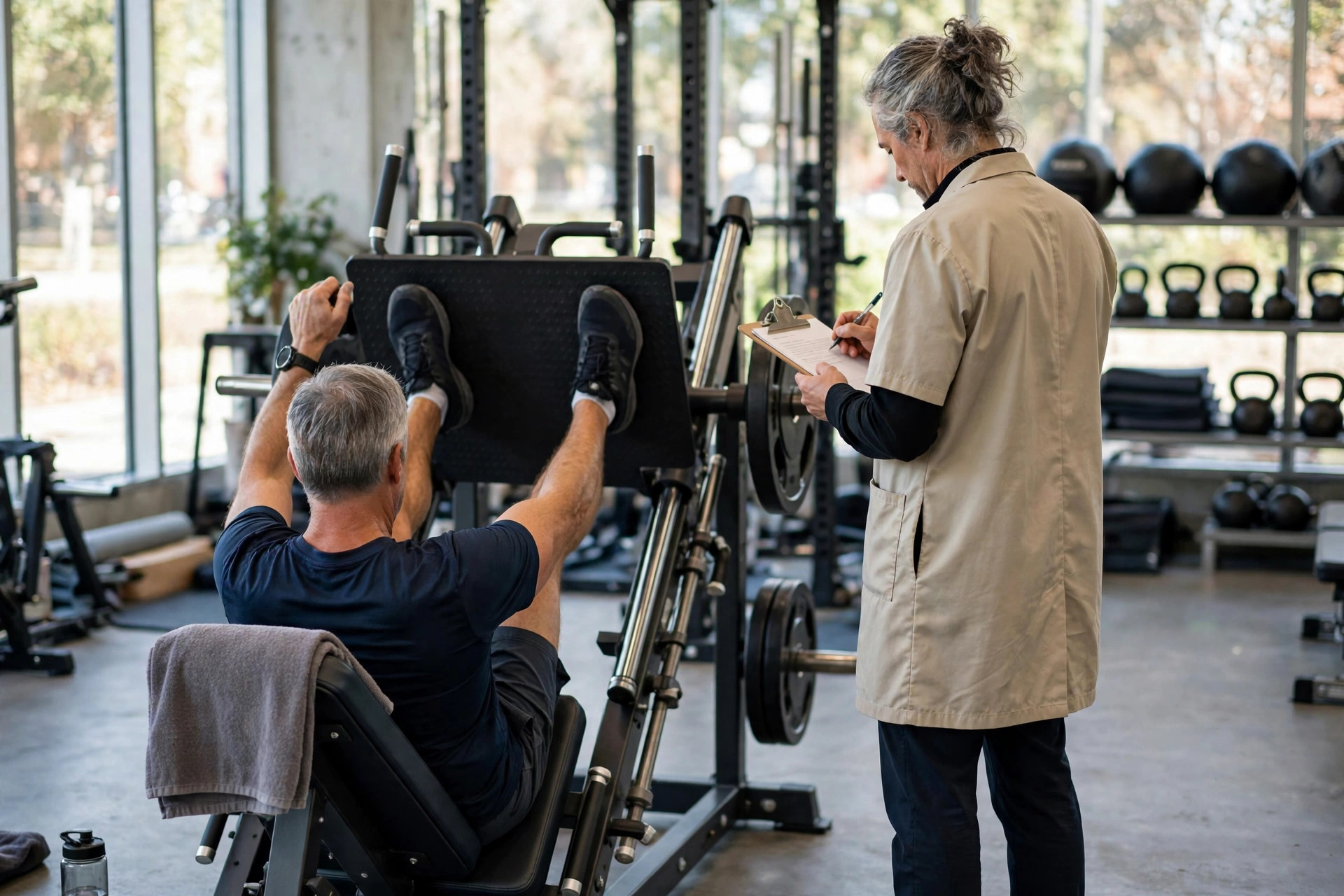
Creatine added lean tissue and strength in adults aged 45 to 65 — even without a workout program, in a 12-week trial
·Tip: press play, then lock your phone or switch apps — the article keeps reading.
Creatine monohydrate is one of the most studied supplements in sports nutrition: it feeds the phosphocreatine system that rapidly regenerates ATP, the energy currency mitochondria produce, during short bursts of effort. What the evidence has lacked is controlled data in the people now being marketed to — adults in midlife and beyond. A randomized, placebo-controlled trial from Texas A&M University's Exercise and Sport Nutrition Lab, led by Richard Kreider, PhD, and reported October 1, 2026, set out to fill that gap.
How was the trial run, and what changed?
The trial enrolled 73 healthy adults aged 45 to 65, of whom 64 completed the 12-week protocol. Participants chose either a structured program of resistance and aerobic training with a calorie-deficit diet, or a non-exercise group; within each group they were randomly assigned to 10 grams of creatine monohydrate daily or a maltodextrin placebo. Among non-exercisers, the creatine group gained about 2.4 pounds (about 1.1 kg) of lean tissue and improved leg and bench press strength relative to placebo. With exercise and diet, creatine users gained nearly 3 pounds of lean tissue and lost more body fat than the exercise-and-diet placebo group. Aerobic capacity did not improve — consistent with creatine's strength-and-power mechanism rather than an endurance effect.
What about safety — and the brain claims?
The trial sits alongside a 2025 analysis by Kreider and colleagues of 685 clinical trials, which found no significant difference in reported adverse-event rates between creatine and placebo groups. That is a reassuring safety picture for a widely used compound, though it does not replace individual medical judgment. The brain story is different: this trial measured body composition and strength, not cognition, and European regulators have already found the evidence for a creatine cognitive-function claim insufficient to establish cause and effect (EFSA, 2024). A result in muscle does not transfer to memory by association.
Also in longevity news: a brain-healthy diet pattern, tracked for 12 years
In the Framingham Heart Study Offspring cohort, researchers followed 1,647 middle-aged and older adults with repeated brain scans over roughly 12 years and found that closer adherence to the MIND diet — a Mediterranean-DASH pattern emphasizing leafy greens, berries, nuts, whole grains, and fish — was associated with slower grey-matter loss and slower enlargement of the brain's ventricles, a difference the team calculated as about 2.5 years of delayed structural brain aging (Journal of Neurology, Neurosurgery & Psychiatry, reported October 1, 2026). It is an association, not proof: the one large randomized trial of the MIND diet found no cognitive or brain-scan advantage over a control diet, so the pattern stays in the promising-but-unproven column — much like creatine for cognition.
Where the evidence stands
- Established: Creatine supports rapid ATP regeneration through the phosphocreatine system, and a 2025 analysis of 685 trials found adverse-event rates no different from placebo.
- Preliminary: In one 12-week randomized trial (73 enrolled, 64 completers, ages 45–65), 10 g/day creatine produced lean-tissue and strength gains versus placebo with and without structured exercise, and no improvement in aerobic capacity (Journal of the International Society of Sports Nutrition, 2026).
- Contested: Whether creatine improves cognition: regulators in the EU found the submitted evidence insufficient for a cognitive-function claim, and this trial did not measure cognitive outcomes.
- Absent: Long-term data in older adults with chronic conditions, and evidence for the cognitive benefits common in current marketing.
Join the discussion
To get the conversation started: What questions does this story raise for you? Share them below — every comment is reviewed by our moderators before it appears.
Community discussion only — not medical advice. Every comment is reviewed by our moderators before it appears. Sign in with Google or a free Hyvor account to join in.