
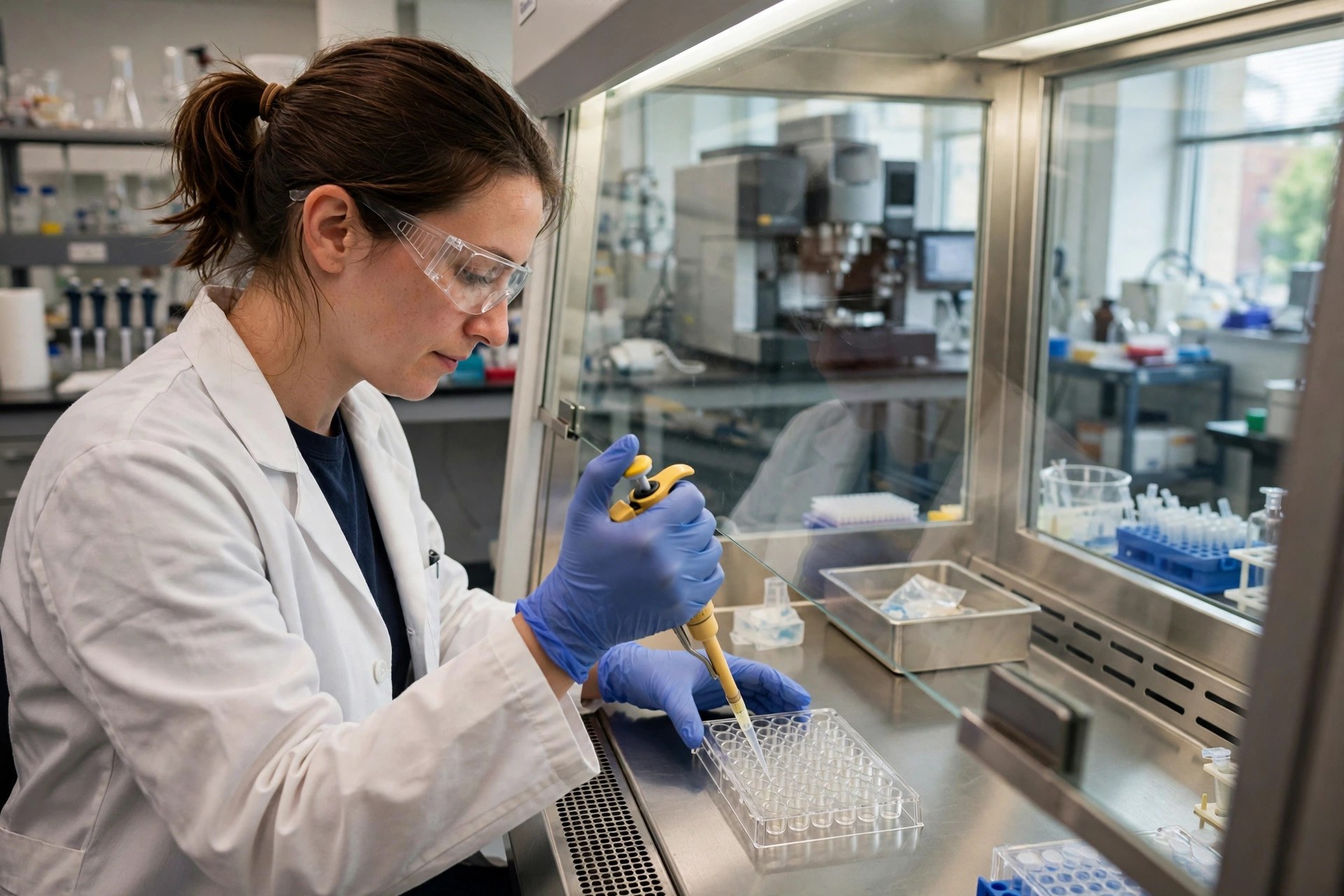
A seizure drug candidate reshaped mitochondrial proteins and restored membrane voltage — in lab-grown TSC cells
·Tip: press play, then lock your phone or switch apps — the article keeps reading.
Tuberous sclerosis complex (TSC) is a multisystem developmental disorder caused by mutations in TSC1 or TSC2, which unleash the growth regulator mTORC1 and drive abnormal growths in the brain, kidneys, skin, heart, and lungs. Approved treatments lean on mTOR inhibition, yet epilepsy and neurodevelopmental symptoms often remain incompletely controlled — which is why a Yale team asked what the small molecule simufilam (PTI-125), previously reported to reduce seizure activity in a TSC mouse model, actually does inside TSC-deficient cells.
What did simufilam change in the cells?
Working with human HEK293T cells engineered to lack TSC2, the researchers confirmed the expected disease signatures: elevated mTORC1 activity and raised levels of the cellular stress marker ATF4. Simufilam lowered ATF4 but — notably — did not reduce mTORC1 activity or cell size over 48 hours. Mass-spectrometry proteomics then found 514 proteins whose abundance changed with treatment, clustering in mitochondrial translation and energy-production pathways (including mitochondrial ribosomal proteins and respiratory-chain components) alongside ribosome-biogenesis and RNA-processing pathways. Functionally, the drug restored mitochondrial membrane potential — the voltage across the inner membrane that drives ATP production — which was impaired in the TSC2-deficient cells.
Why does an mTOR-independent effect matter?
If a drug can ease cellular stress and support mitochondrial function without leaning on mTORC1, it could in principle complement existing mTOR inhibitors rather than duplicate them — relevant because mTOR suppression carries its own burden of side effects, and many TSC symptoms persist despite it. The authors frame mitochondrial dysfunction as a complementary therapeutic target in TSC, a disease not usually discussed in mitochondrial terms.
How far is this from helping a patient?
Very far, for now. These are kidney-derived human cells grown in dishes, missing one gene, treated for two days — a mechanism probe, not a treatment result. Simufilam itself also carries a complicated history outside TSC, and nothing in this study tests seizures, brain cells, animals, or people. The finding earns attention as a map of where the drug acts, and as one more sign that mitochondrial function sits downstream of many genetic growth disorders; it is not evidence that simufilam treats TSC.
Where the evidence stands
- Established: TSC1/TSC2 loss causes mTORC1 hyperactivity in tuberous sclerosis complex; mTOR inhibitors help some manifestations, but epilepsy and neurodevelopmental symptoms are often incompletely controlled.
- Preliminary: In TSC2-knockout human HEK293T cells, simufilam altered 514 proteins (many mitochondrial), reduced the stress marker ATF4, and restored mitochondrial membrane potential over 48 hours — without suppressing mTORC1 (Cells, Oct 14, 2026).
- Absent: Evidence in neurons, animals in this study, or patients that simufilam improves any TSC outcome, and confirmation that the mitochondrial changes drive its reported anti-seizure effects.
Join the discussion
To get the conversation started: What questions does this story raise for you? Share them below — every comment is reviewed by our moderators before it appears.
Community discussion only — not medical advice. Every comment is reviewed by our moderators before it appears. Sign in with Google or a free Hyvor account to join in.